

After the government led by Anutin Charnvirakul, Prime Minister and Minister of Interior, announced that if the opposition files a no-confidence debate, the House of Representatives will be dissolved immediately on 12 Dec 2025, instead of the previously announced dissolution on 31 Jan 2026.
This announcement has caused many citizens to speculate whether, if the House dissolves so quickly to avoid the debate, this government will promptly implement any substantial policies to gain votes for the upcoming election.
Therefore, the author examines government policies beyond the 'Khon La Khrueng Plus' initiative, focusing on the '20 Baht All-Day Electric Train Fare,' another policy closely watched by many Bangkok Metropolitan and suburban residents, especially young workers without private cars who rely on electric trains for commuting, eager to see whether this policy will continue or end.
When the government first took office, the Ministry of Transport, led by Deputy Prime Minister and Minister of Transport Pipat Ratchakitprakarn, strongly declared it would not proceed with the project, even though it was clear that continuing it would gain massive urban voter support, until later reversing course and deciding to proceed.
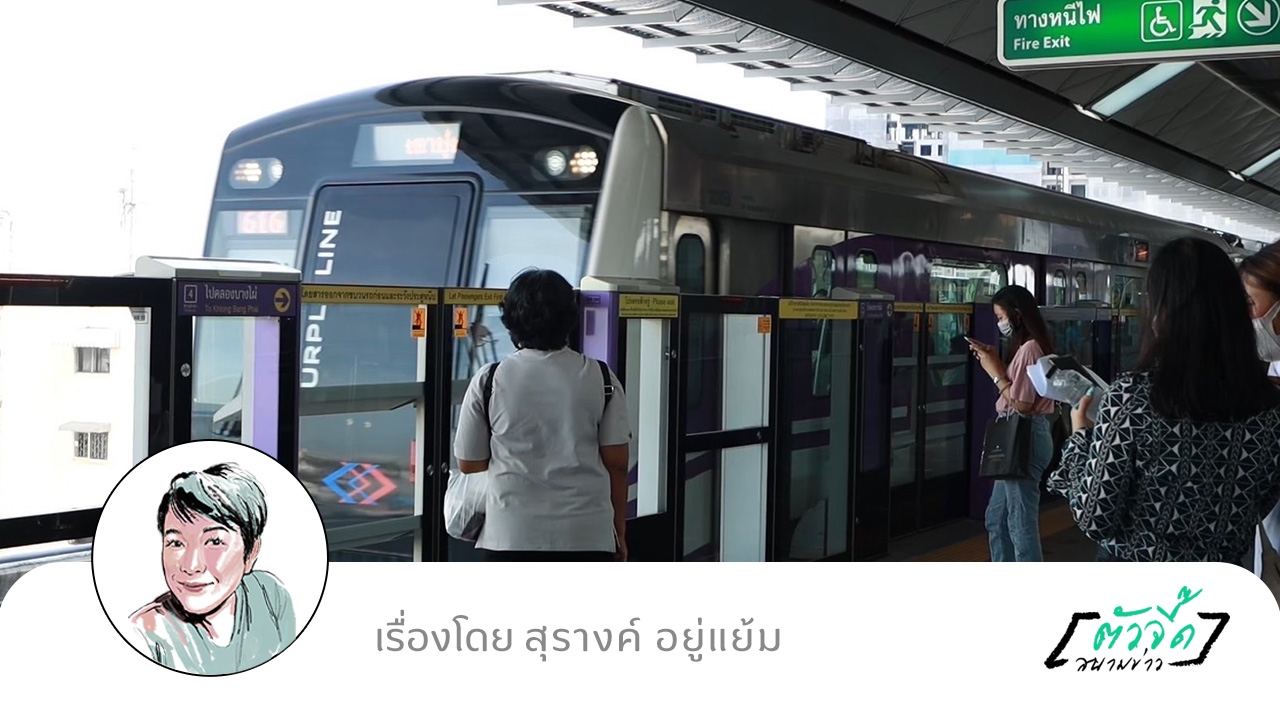
However, this time the policy changed under the same concept to '40 Baht All-Day Electric Train Fare,' effective only on two lines: the suburban Red Line between Bang Sue and Rangsit and Bang Sue to Taling Chan, and the Purple Line between Tao Poon and Khlong Bang Phai.
This measure will be implemented for only one year, from 1 Dec 2025 to 30 Nov 2026, to maintain continuity after the previous 20 Baht maximum fare policy ended on 30 Nov 2025.
This means that the '40 Baht All-Day Electric Train Fare' applies only to rides on the Red and Purple lines, with passengers paying a flat 40 baht fare for unlimited trips throughout the day.
For passengers who usually travel short distances and paid less than 40 baht, the fare will be charged according to the actual distance if it is below 40 baht. Students pay no more than 30 baht per day.
Senior citizens and children between 90 cm and 120 cm tall pay 50% of the regular fare per trip. State welfare cardholders use the allocated 750 baht monthly credit. People with disabilities and children under 90 cm tall ride free. Special fare cards supporting daily flat fare measures include EMV Contactless Card, MRT EMV, and Mangmoom EMV.
Deputy Prime Minister and Minister of Transport Pipat Ratchakitprakarn also said that whether this scheme will expand to cover all electric train lines is under discussion among related agencies: the Department of Rail Transport, Mass Rapid Transit Authority of Thailand, and State Railway of Thailand.
Initially, it seems necessary to buy back all privately owned electric train projects into state ownership and create a Single Ownership under the Mass Rapid Transit Authority of Thailand to establish a Common Fare system or integrated ticketing, but this cannot be achieved during this government if the House dissolves on 12 Dec 2025.
Besides this policy, which may gain popularity among residents of Bangkok and its vicinity, what other vote-winning policies does the Ministry of Transport have?
So far, it appears there are no projects that could stimulate investment, because if the government dissolves the House on 12 Dec 2025, the Ministry of Transport’s investment plans will effectively end, awaiting the next government.
Follow economic and government policy updates with ThairathMoney athttps://www.thairath.co.th/money/economics/thailand_econ
Follow the Facebook page: Thairath Money at this linkhttps://www.facebook.com/ThairathMoney