

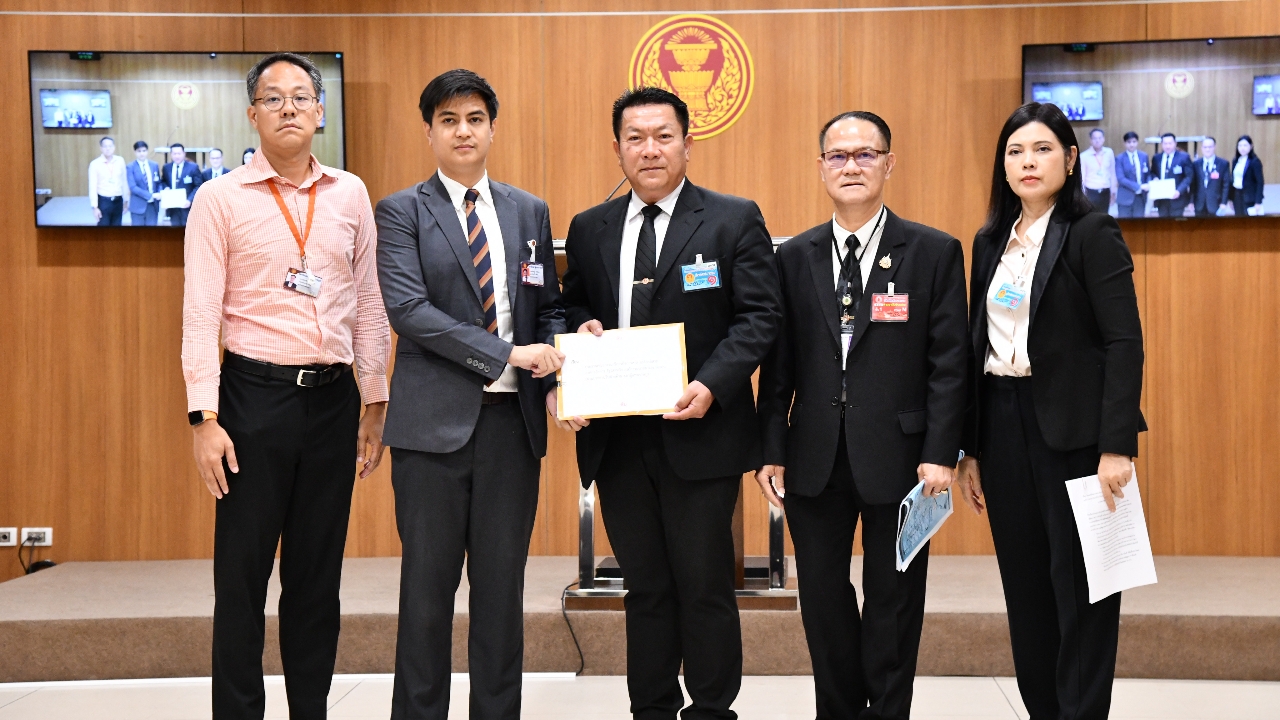
As planned, reserve senators brought a key witness to petition the opposition's Independent Organizations Committee to investigate the Election Commission and Saeng regarding collusion in the senator election. Meanwhile, Prasit raised four suspicious questions about the Election Commission's intent to dismiss the senator election fraud case.
At 11:45 a.m. on 9 June 2026 at the Parliament, Prasit Watcharasinthu, a party-list MP of the People’s Party and chairman of the opposition coalition whip, received a complaint from reserve senator Akarawat Phongthanachalitkul and Pol. Col. Manat Nakornsi, the election inspector for Samut Prakan province. Akarawat said that in relation to the senator election fraud on 26 June 2024, additional evidence including video clips and a key witness, Pol. Col. Manat, revealed that Thitiket Nuchanat, an Election Commission member, and Saeng Boonmee, the Election Commission secretary-general and directly responsible official, showed conduct suggesting a conflict of interest and possibly violated Section 157 of the Criminal Code for dereliction of duty. Scientific proof clearly indicated nationwide collusion in the senator election.
Pol. Col. Manat stated that during the senator election on 26 June 2024, around 8:10 a.m., he met a female senator candidate from Samut Prakan province who asked him to inform the Election Commission that candidates were involved in collusion with prepared ballots, later proven by pamphlets found. As an election inspector, he reported this to Saeng, the election director, at 8:29 a.m. However, Saeng replied, “Let them be; they have planned this well.” Saeng’s concealment of this information as election director effectively opened the door for successful collusion in the senator election, culminating by 9:00 a.m. when the first round concluded.
“There is CCTV evidence showing Thitiket collecting evidence of ballots from senator candidates, which I reported to Saeng that morning, but he did nothing and never responded. On 20 May 2025, the Election Commission publicly denied my claims, but today we have video clips of ballot collection supporting my testimony that these events occurred. Additionally, when the case arose, complaints were filed with the DSI and the Election Commission, which established Subcommittee 26 that found collusion involving 229 senators, including 136 current senators with credible evidence. Yet, the Election Commission appointed Subcommittee 36, comprising their allies, to assist in covering up, leading the central Election Commission to vote 5 to 2 to dismiss all investigations by Subcommittee 26, despite clear witnesses and evidence. Therefore, I consider the central Election Commission itself as orchestrating the senator election fraud.”
Meanwhile, Prasit said that the opposition whip will immediately review and act on the information. Saeng Boonmee, Election Commission secretary-general, stated the Commission would start considering findings from Subcommittee 26’s investigation today (9 June). Prasit posed four suspicious points for the Commission to clarify publicly: 1) If the Election Commission dismisses the senator collusion case, does it differ factually from Subcommittee 26’s findings? 2) Was Subcommittee 36 appointed to whitewash the 229 accused in the senator collusion case? 3) Is there mutual benefit or conflict of interest since four of the current seven Election Commissioners were endorsed and elected by senators under investigation for collusion, implying a conflict of interest? 4) Has the Election Commission neglected its duty to investigate despite abundant evidence and witness testimony about planned ballot instructions, while publicly denying such ballots existed? He urged the Commission to explain these issues.
Prasit added that last week the opposition whip formed a dedicated task force to follow up on the senator election collusion fraud, intending to scrutinize both parliamentary and external mechanisms. Within Parliament, the Committee on Justice, Independent Organizations, the Attorney General's Office, state enterprises, public organizations, and the parliamentary fund have monitored the issue. Last week, they passed a resolution summoning the Election Commission to explain on 11 June, but they were recently informed the Commission cannot attend, indicating non-cooperation. The committee will discuss how to proceed next.