


The 31st anniversary of the Tokyo subway sarin attack on 20 March 1995 recalls the event when terrorists released deadly sarin gas, resulting in multiple deaths and injuries and prompting Japan to significantly reduce the number of public trash bins.
Japan is widely recognized around the world as a clean and orderly country. However, tourists often wonder where to dispose of their trash since public trash bins are rarely seen in public spaces. Common sense might suggest that a clean area should have trash bins on every corner, but this is not the case.
Originally, Japan had trash bins on street corners like other countries. The turning point came with the emergence of a cult called Aum Shinrikyo (meaning Supreme Truth), which Japanese police were pursuing after the group committed several crimes including kidnapping government officials and causing eight deaths with sarin gas. To distract police from arresting Shoko Asahara, the cult’s founder, he ordered five well-educated members to carry out another sarin gas attack on the subway.
Sarin is a chemical used militarily that disrupts the nervous system. It was first produced by German scientists under Nazi rule, originally intended not as a weapon but as an insecticide and herbicide. After discovering its lethal effect on humans, German forces used sarin in World War II. The name Sarin derives from the initials of the four Nazi scientists: Schrader, Ambros, Rüdiger, and Van der Linde.
The five cult members boarded trains on three lines—Chiyoda, Marunouchi, and Hibiya—and dropped newspaper-wrapped bags of sarin onto the train floors. Just before reaching their destination stations, they pierced the bags with umbrella tips and quickly exited the trains to escape by waiting vehicles.
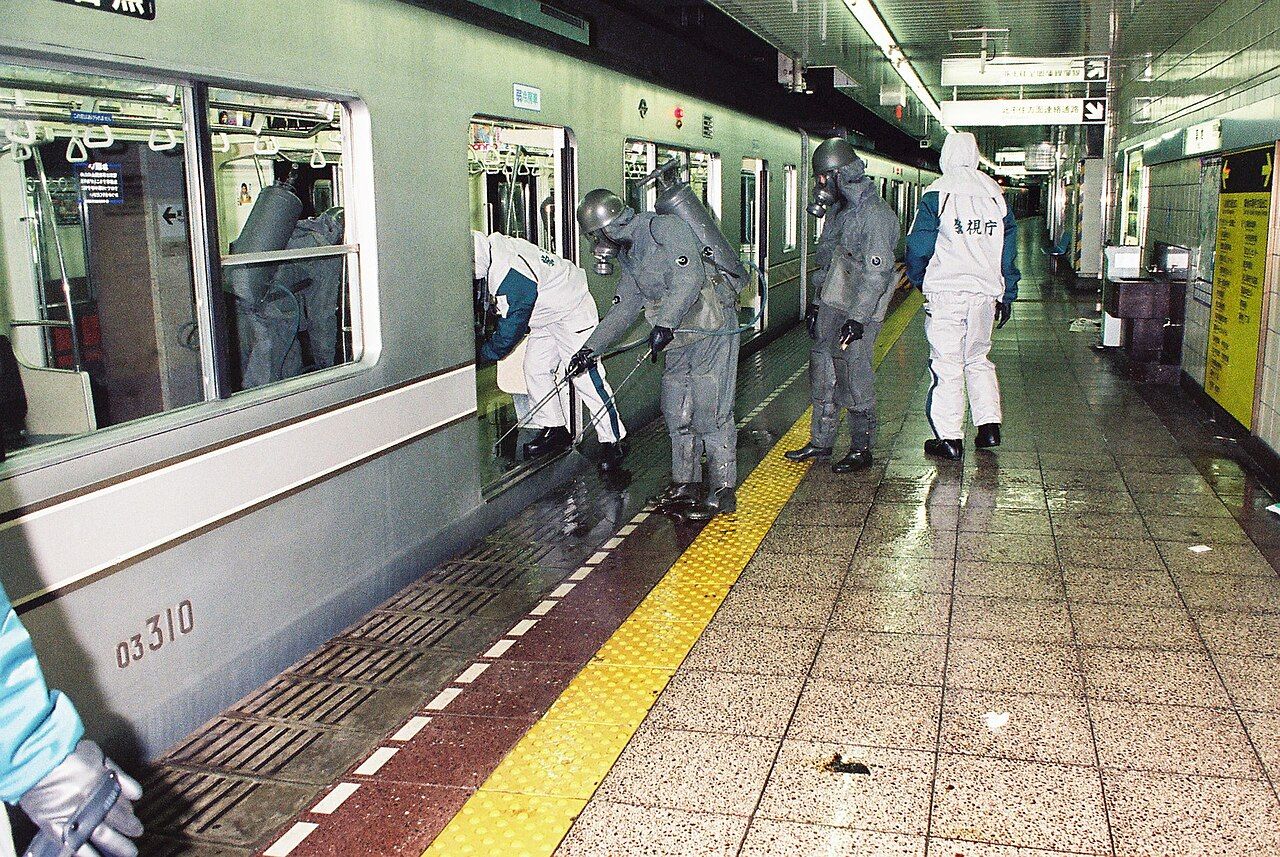 Photo: Japan Ground Self-Defense Force
As the sarin leaked onto the floors, it evaporated into the air. With train doors open constantly for ventilation, no one realized what was happening because sarin is colorless and odorless. Passengers began coughing violently, choking, and vomiting. Many lost vision, became paralyzed, and foamed at the mouth. Awareness of the poison only came when victims collapsed on station platforms. Hospitals found sarin residues on victims’ clothing. In total, 14 people died and 5,000 suffered long-term physical and psychological effects, ranging from vision problems to severe PTSD.
Asahara’s attempt to divert police attention failed. Two days after the subway attack, police raided Aum Shinrikyo’s hideout, discovering enough chemical weapons to kill millions. Hundreds of cult members were arrested. Asahara himself was captured two months later while hiding in a secret room at the cult’s headquarters.
Aum Shinrikyo was founded in 1987 by Shoko Asahara, blending Buddhist and Hindu beliefs and prophesying an imminent apocalypse, possibly a third world war, after which cult members would rebuild the world. The cult attracted many talented Japanese, including recent university graduates.
After years of trials, the court sentenced Asahara and 12 senior members to death by hanging in July 2018. The government ordered the removal of nearly all public trash bins to prevent their use for hiding dangerous objects like bombs. Since 1995, Japan has remained vigilant against terrorism, especially from Aum Shinrikyo, which continued plotting attacks such as a cyanide gas plan at Shinjuku station men’s restroom in May of the same year. The Japanese government has taken extensive measures to minimize future terrorist threats.
A positive outcome was government realization that removing trash bins saved millions of yen in waste management costs and fostered a new public awareness encouraging people to carry their trash home. Although initially inconvenient, citizens adapted due to fears of terrorism.
Many Japanese schools do not employ janitors but practice "Osoji," a form of deep cleaning similar to Thailand’s big cleaning days, where students sweep classrooms, clean restrooms, and serve lunch. This instills responsibility for maintaining public cleanliness. Families teach children to carry their trash home, and households strictly follow municipal waste sorting rules, sometimes detailed in manuals as long as 30 pages.
Japan also embraces the concept of Meiwaku, a cultural norm meaning not to cause trouble for others. Littering is seen as imposing problems and burdens on others. Today, laws, lifestyles, and culture have shaped the avoidance of public littering into the New Normal, widely practiced to this day.
References: