

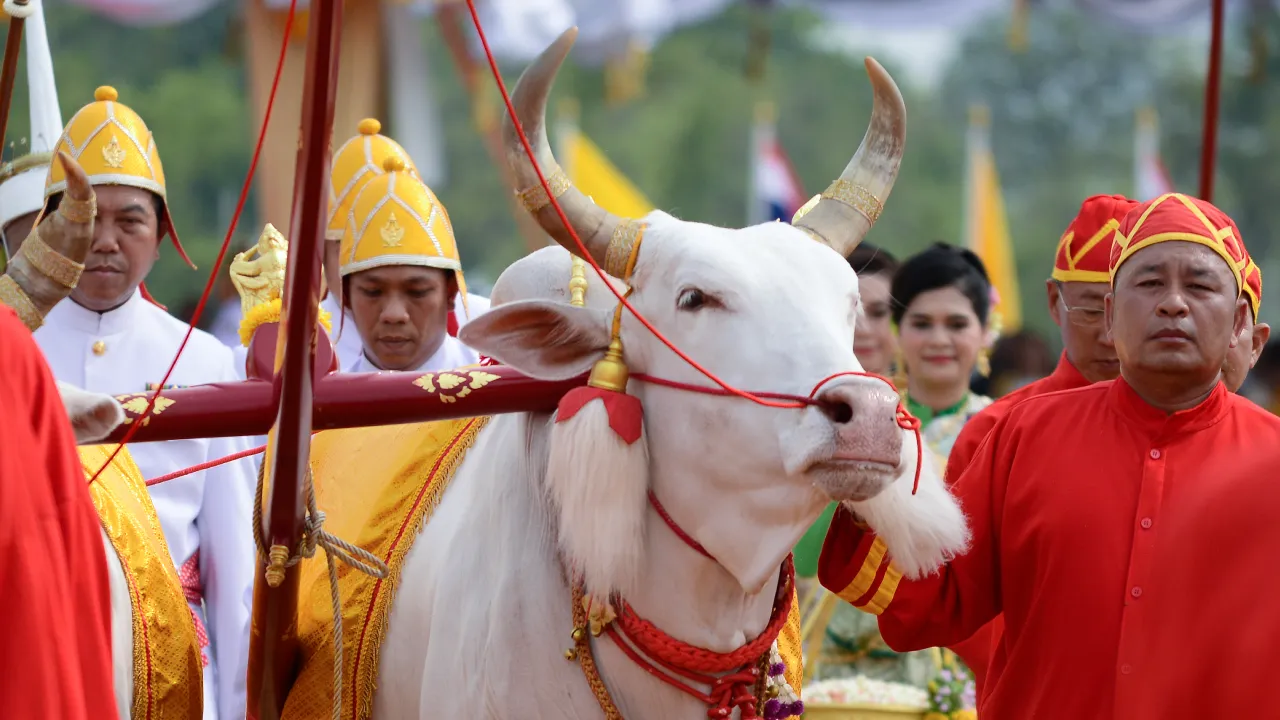
A familiar image from the Royal First Plowing Ceremony, beyond the rice grains and plow, is the majestic "sacred bull," a seasonal agricultural omen believed to nurture the spirit and morale of Thai farmers nationwide.
Behind this elaborate spectacle lies an ecological and historical narrative: the breed of sacred bull seen here is the "White Lamphun Cattle," a native breed once legendary in an ancient kingdom but now classified as a conservation animal due to its limited population.
According to Brahmin-Hindu beliefs, the "cow" is not merely a working animal but a symbol of sanctity linked to the story of the divine bull Ushabhraraj, regarded as the deity of quadrupeds and the sacred mount of Lord Shiva. It is also closely cared for by Lord Krishna and Baladeva in Hindu lore.
Thus, cattle symbolize strength, vigor, and fertility. Since the reign of King Rama I of the Chakri dynasty, formal protocols have mandated the use of male sacred bulls in the Royal First Plowing Ceremony.
Obtaining the sacred bulls is no simple task. The Ministry of Agriculture and Cooperatives has delegated the Department of Livestock Development and the Ratchaburi Artificial Insemination and Biotechnology Research Center to conduct the most stringent selection. Candidates must meet minimum criteria: height not less than 150 cm, body length at least 120 cm, and chest girth no less than 180 cm.
Beyond balanced rectangular side profiles, both bulls must be uniformly colored, have smooth skin, glossy hair, well-mannered behavior, ease of training, and non-aggressiveness. Their horns must be equally curved, eyes bright, ears flawless, tails long and elegant, legs and hooves strong, and importantly, they must possess "kwan"—rings of curled hair in specific traditional patterns including at the forehead, flower decoration sides, and back—according to ancient texts.
For the 2026 Royal First Plowing Ceremony, the Department of Livestock Development selected two pairs of White Lamphun cattle, all donated and respectfully presented since the reign of King Bhumibol Adulyadej the Great, including:
The primary pair consists of Phra Kho Por, 14 years old, 165 cm tall, 226 cm long, 210 cm chest girth, donated by Mr. Somchai Damthamis; and Phra Kho Piang, 14 years old, 169 cm tall, 239 cm long, 213 cm chest girth, donated by Mr. Arkom Wattanakoon.
The reserve pair includes Phra Kho Perm, 16 years old, 162 cm tall, 236 cm long, 199 cm chest girth, donated by Mr. Tritdee Chawsuanjaroen, former Director-General of the Department of Livestock Development; and Phra Kho Phun, 16 years old, 158 cm tall, 243 cm long, 203 cm chest girth, donated by Mr. Wichan Phukphiboon.
All four bulls embody the distinctive elegance of the White Lamphun breed: pale pinkish-white skin, clean white hair without spots, white horns, tapering bodies, bright light brown eyes, pink eyelashes, pristine white tails, and an impressive stature both standing and walking.
Why the 'White Lamphun Cattle'? The answer lies in a long history of breed development through Northern villagers’ wisdom, spreading from Lamphun and Chiang Mai to Lampang, Phayao, and Chiang Rai.
Interestingly, the origin of White Lamphun cattle remains a mystery between local legend and scientific theory. Legend holds they mutated during the reign of Queen Cham Thewi, founder of the Hariphunchai kingdom over a thousand years ago. They were revered as royal animals symbolizing power and wealth, used to pull carts. Although the Hariphunchai kingdom fell and endured many wars, this native cattle lineage has survived.
Meanwhile, foreign literature suggests Southeast Asian native cattle descended from hornless European cattle crossed with horned Indian cattle, giving White Lamphun cattle their unique blend: short dewlap, flat forehead, and small ears like European cattle, but with Indian-style horns.
The beauty of White Lamphun cattle is defined by 15 distinctive traits: 1) medium-sized horns, 2) thin pink skin, 3) smooth white hair, 4) pink-orange mucous membranes without white spots, 5) white tail tuft, 6) pink-orange hooves, 7) genitalia close to abdomen, 8) short neck dewlap attached to abdomen, 9) medium neck dewlap, 10) pink-orange nose, 11) dark brown eyes, 12) long eyelashes, 13) flat forehead, 14) pink-orange horns, and 15) small, flared ears. Their white body color helps them endure sunlight and heat well.
However, in the capitalist era driven by economic factors, their majestic appearance could not meet practical needs. White Lamphun cattle are relatively small and produce less meat, so most farmers switched to larger, higher-yield foreign breeds, causing the White Lamphun population to plummet toward endangerment.
Consequently, the Department of Livestock Development declared White Lamphun cattle a "conservation animal," recognizing their unique traits: high fertility, resistance to diseases, parasites, and tropical insects, and ability to thrive even in harsh environments and scarce food—qualities suited for rural Thai agricultural ecology.
Conservation efforts began in 1978 with Chiang Mai University's Animal Husbandry Department initiating breeding for study and improvement. This momentum expanded to community levels, such as the White Lamphun Cattle Farmers Group in Ban Rai Pa Kha, Pa Sang district, Lamphun province, established in 2003.
This awareness was evident earlier this year when Lamphun's governor visited the farm of Mr. Sumet Sukpreedachit, a local expert and farmer who once presented the "Phra Kho Mun" and "Phra Kho Khong" bulls in 2013.
Today, this farm raises 32 White Lamphun cattle, not primarily for commercial purposes but for conservation and genetic research. There is also a niche market for purchasing these cattle for their beauty and heritage preservation.
Ultimately, the annual appearance of the sacred bulls in the Royal First Plowing Ceremony carries deeper meaning beyond symbolizing fertility.
"Royal Plowing Day" is more than a milestone for uplifting farmers; it is a vital opportunity for the government, private sector, and public to recognize the value of biodiversity. White Lamphun cattle represent the cultural and agricultural heritage passed down by Lanna ancestors.
We cannot allow this breed to exist only as a ceremonial figure seen once a year or as a mere textbook illustration. True agricultural prosperity also means preserving original roots and native breeds sustainably for future generations.
#ThairathPlus #Thairath #RoyalPlowingDay #RoyalPlowingDay2026 #WhiteLamphunCattle #SacredBull