

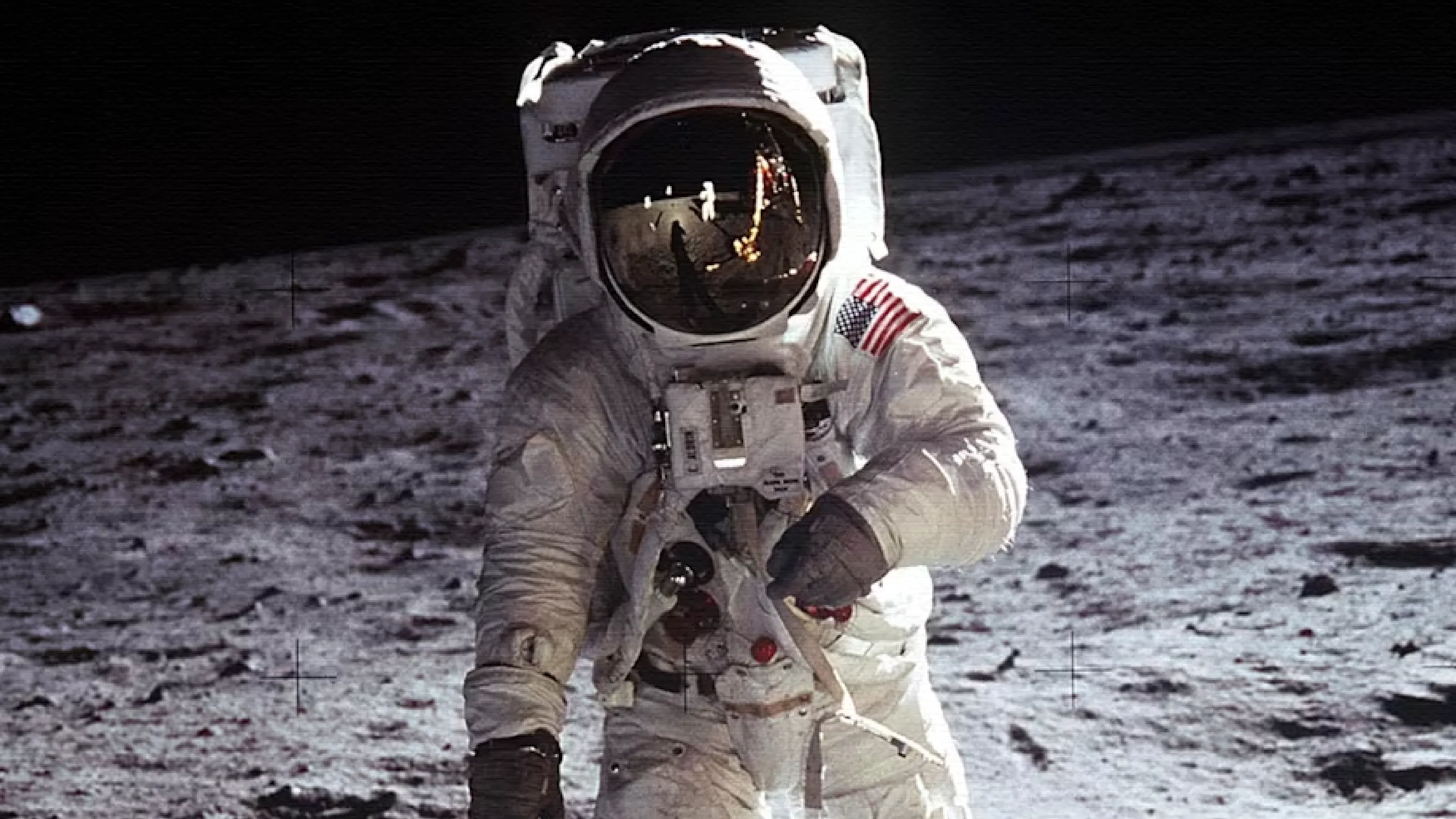
On 20 July 1969, Apollo 11, part of NASA's Apollo program aimed at sending humans to explore the Moon, propelled humanity beyond Earth's limits by sending three astronauts—Neil Armstrong, Buzz Aldrin, and Michael Collins—to create history and leave the first footprints on the lunar surface.
Today, on its 57th anniversary, Thairath Plus invites everyone to revisit that historic moment, along with five behind-the-scenes stories that many may not know.
The historic moment of the three astronauts.
First, it is important to recall that this historic mission was divided into two main parts: the Command Module orbiting the Moon, and the Lunar Module, named 'Eagle.' Neil Armstrong was the astronaut who first stepped onto the Moon, followed by Buzz Aldrin who also touched its surface, while Michael Collins piloted the Command Module, orbiting and waiting for the other two around the Moon.
Did you know that the computer controlling Apollo 11 (AGC) at the time had much less memory and processing power than today's smartphones? Yet Apollo 11 safely carried humans to the Moon and back.
However, during the Lunar Module’s descent, a critical fuel shortage occurred in the final minutes before touching down. Neil Armstrong had to switch the control system to semi-automatic mode to manually steer the craft away from rocky terrain, leaving only about 30 seconds of fuel before landing successfully. Armstrong then uttered the historic phrase...
"Houston, Tranquility Base here, the Eagle has landed."
Shortly afterward, he spoke another powerful sentence:
"That's one small step for (a) man, one giant leap for mankind."
- Neil Armstrong, 20 July 1969
Beyond Apollo 11’s success as the first spacecraft to land on the Moon, there are five behind-the-scenes stories that led to this historic moment for humanity.
1. The women's lingerie brand and the women behind the Moonwalk spacesuits.
The A7L spacesuits worn by Neil Armstrong and Buzz Aldrin on the Moon were developed and sewn by ILC Dover, a division of International Latex Corporation (known as Playtex), a brand famous for producing women's underwear and corsets.
Because the suits needed to maintain air pressure while allowing movement, advanced corsetry and lingerie sewing skills were required. NASA chose a team of female seamstresses from this factory, who had to sew each fabric layer with engineering precision, allowing no more than 0.4 millimeters of deviation. All suits were X-rayed to detect any pins or needle fragments inside.
2. The silver marker pen: a lifesaving tool in a critical moment.
After completing their Moonwalk and returning to the Eagle lunar module, Buzz Aldrin accidentally broke a crucial circuit breaker switch needed to ignite the engine for the return flight to Earth. Without it, they might have been stranded on the Moon forever.
Buzz resolved this by using a silver, felt-tip Duro Rocket marker pen stored in his spacesuit shoulder pocket. Its plastic and aluminum tip was non-conductive, allowing him to safely push the broken switch’s contacts back together, restoring power without electric shock or sparking.
On 17 July 2026, the pen and broken switch, kept in Buzz Aldrin's private collection for over 50 years, were auctioned by Sotheby's, fetching $857,600 (approximately 30 million baht).
3. An alternative life insurance: signatures on envelopes.
Because the mission was extremely risky, no life insurance company would underwrite policies for the three astronauts—Neil Armstrong, Buzz Aldrin, and Michael Collins. To provide for their families in case they did not return, each signed hundreds of blank envelopes as a form of insurance cover.
They entrusted a close friend to mail these envelopes on 16 July 1969, the launch day, to have the official date postmarked. They believed their signatures on this historic date would become valuable collectibles to be auctioned to support their families.
4. The Moon’s smell: like gunpowder residue.
Space is a vacuum with no breathable air and no scent. However, after Armstrong and Aldrin returned to the lunar module and removed their helmets, fine lunar dust clung to their clothes and equipment.
According to official NASA communications, when this dust met the oxygen inside the module, it emitted a strong, pungent smell. Armstrong described it as 'like wet ashes in a fireplace,' while Aldrin said it resembled 'the smell of gunpowder just fired.' The scent faded quickly, possibly due to chemical changes in the dust upon exposure to air.
5. The secret speech prepared if NASA couldn’t bring them back.
Before the mission, President Richard Nixon instructed White House speechwriter William Safire to draft a condolence speech in case of an emergency, such as engine failure preventing the astronauts' return from the Moon. This document, dated 18 July 1969, is preserved in the U.S. National Archives.
If the plan had unfolded as feared, Nixon would have informed the astronauts' families of their loss by phone, NASA would have cut all communications, leaving the astronauts to lose consciousness as oxygen ran out, and the President would have delivered the speech worldwide.
The speech would have begun: 'Fate has ordained that the men who went to the moon to explore in peace will stay on the moon to rest in peace,' before concluding with a simulated sea burial ceremony on Earth.
Nevertheless, from Armstrong’s first historic step, the mission became a giant leap for mankind, inspiring humanity to this day. Currently, humans are preparing to return to the Moon under NASA's Artemis program, continuing Apollo's legacy, with the next goal being manned exploration of Mars.
References:
https://www.axiomint.com/playtex-and-the-space-suit/