

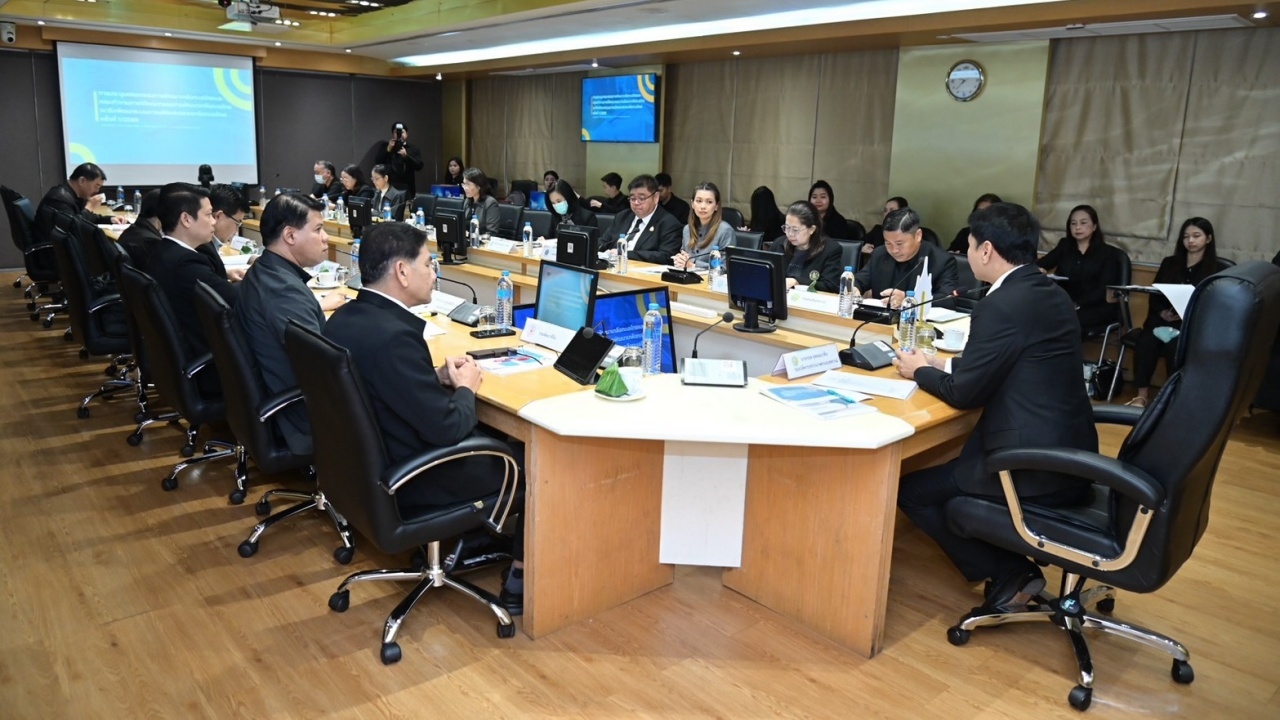
The Ministry of Agriculture and Cooperatives has established a special task force to comprehensively resolve issues related to Thai sea salt, aiming to alleviate the hardships faced by farmers.
Krit Uttamawetin, Deputy Permanent Secretary of the Ministry of Agriculture and Cooperatives, revealed after chairing the first meeting of 2026 to discuss the development of Thai sea salt production and market systems at Meeting Room 134 of the Ministry that this initiative is a policy-driven mission under the framework of the Thai Sea Salt Development Committee. The committee has set forth clear guidelines to implement four measures, aligned with the policy of Deputy Prime Minister and Minister of Agriculture and Cooperatives, Captain Thammanat Prompao. The goal is to mobilize cooperation from all sectors to systematically and earnestly solve the Thai sea salt problem under the "Sea to Government" concept, assigning the Department of Agricultural Extension as the main agency to lead this mission.
Additionally, the meeting discussed measures to address the expected price decline from late January to February. The Department of Agricultural Extension was tasked with developing a management plan and price stabilization measures carefully, while reviewing lessons learned from previous efforts to enhance operational effectiveness.
The Ministry of Agriculture is not complacent regarding this issue and is moving forward to relieve the difficulties of Thai sea salt farmers. It emphasizes integrating the work of all affiliated agencies within the ministry at full capacity. All relevant agencies have been assigned to compile data on sea salt use in their respective production processes, prepare main and contingency plans to address potential constraints, and ensure practical and effective implementation. This approach aims to produce tangible results in resolving the Thai sea salt problem and serve as a model for addressing other agricultural product issues in the future.
Solving the Thai sea salt problem requires earnest implementation of four main measures and adjusting work processes by establishing a special task force to support the Department of Agricultural Extension’s operations. Currently, Thai sea salt production capacity has declined to about 500,000 tons, while demand remains high. Therefore, it is necessary to improve quality and production processes to meet market standards, use credit as the primary mechanism to enhance investment capacity, and promote cooperatives and community enterprises as central hubs for collection and sustainable value-added processing.
The four key measures under the 2026 action plan to stabilize prices and enhance the value of Thai sea salt are: 1. Credit measures to manage production; 2. Promotion of cooperatives and community enterprises as provincial-level collection and sales centers; 3. Accelerated registration of sea salt farmers and creation of a central database; and 4. Development of knowledge and production technology for quality salt to reduce costs and increase product value.
Furthermore, there is a plan to conduct field visits to seven major sea salt producing provinces—Chachoengsao, Pattani, Chonburi, Chanthaburi, Phetchaburi, Samut Songkhram, and Samut Sakhon—from 13 to 31 January 2026. The purpose is to communicate government policies and measures directly to farmers, listen to local feedback, and adjust the action plan to suit the context and needs of farmers. This will lead to sustainable long-term solutions for the Thai sea salt problem.