

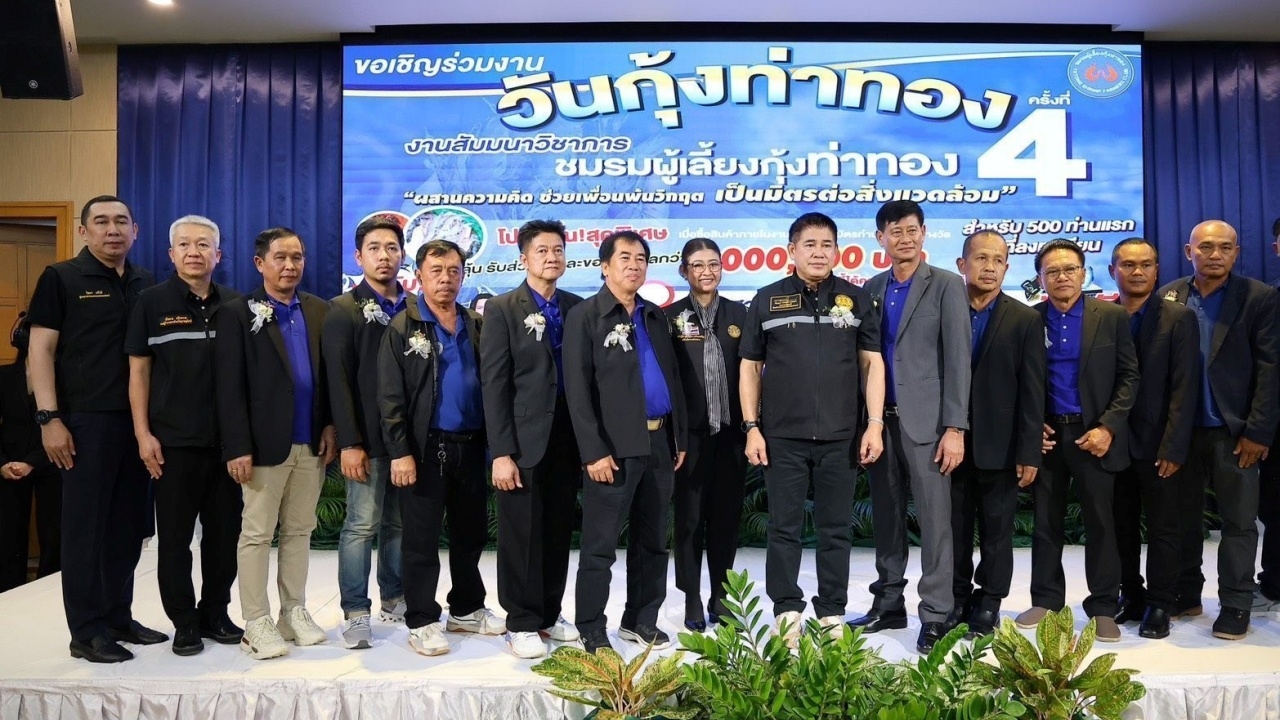
The Director-General of the Department of Fisheries joined the 4th Thathong Shrimp Farmers Seminar, highlighting the "Shrimp One, Fisheries Connect for Sustainability" policy that aims to integrate partnerships to rescue Thailand's shrimp industry crisis toward sustainability.
On Saturday, 17 January 2026 GMT+7, the Director-General of the Department of Fisheries attended the opening ceremony of the 4th Thathong Shrimp Farmers Academic Seminar, organized under the theme "Combining Ideas to Help Friends Overcome Crisis, Environmentally Friendly." The event advanced the Shrimp One, Fisheries Connect for Sustainability policy, integrating cooperation across all fisheries sectors and connecting the entire production chain to address problems and set sustainable development directions for Thailand's shrimp industry.
Deputy Prime Minister and Minister of Agriculture and Cooperatives General Thammanat Prompao presided over the opening, listened to shrimp farmers' issues, and promoted approaches to drive Thailand's shrimp industry under policies emphasizing market-driven innovation to increase income, including the '3 Builds' policy: building income, opportunities, and markets, held at Diamond Plaza Hotel, Makham Tia Subdistrict, Mueang District, Surat Thani Province.
Mrs. Thitiporn Laoprasert, Director-General of the Department of Fisheries, revealed after attending the opening ceremony that Surat Thani Province is the country's top shrimp production area. In 2025, it produced over 50,000 tons valued at more than 10 billion baht, playing a crucial role in the national economy and food security.
However, shrimp farmers currently face multiple challenges, including climate conditions and disasters affecting shrimp growth and health, as well as global market quality competition. Therefore, transitioning to efficient and sustainable farming methods is essential to meet the Sustainable Development Goals.
The Department of Fisheries has policies to drive Thailand's shrimp industry across the production chain by promoting knowledge transfer on innovation, digital technology, real-time water quality monitoring, smart farms, and supporting alternative energy use in farming. It also focuses on farm management through biosecurity systems, developing effective microorganisms to reduce drugs and chemicals, advancing digital systems like the Aquatic Product Document (APD), supporting low-interest loans for marine shrimp farmers, and promoting research on quality aquatic breeds.
Emphasis is also placed on analyzing aquatic raw material quality and promoting knowledge transfer and technology for low-carbon aquaculture to develop safe, quality Thai shrimp products meeting international standards. This enhances Thailand's shrimp competitiveness and reputation globally, building confidence among trade partners and strengthening the industry. The event featured exhibitions of low-carbon shrimp farming technologies and innovations, plus booths showcasing production inputs from private sector operators.
The Director-General of the Department of Fisheries concluded that this seminar represents key collaboration among farmers, government, private sector, educational institutions, and operators across the production chain to integrate fisheries cooperation (Shrimp One) toward sustainability. The Department is committed to promoting and highlighting the strength of low-carbon shrimp farming development to elevate Thailand as a leader in modern aquaculture, balancing economic, social, and environmental factors, ensuring food and occupational security, providing stable income to farmers, and driving sustainable growth of Thailand's shrimp industry.