

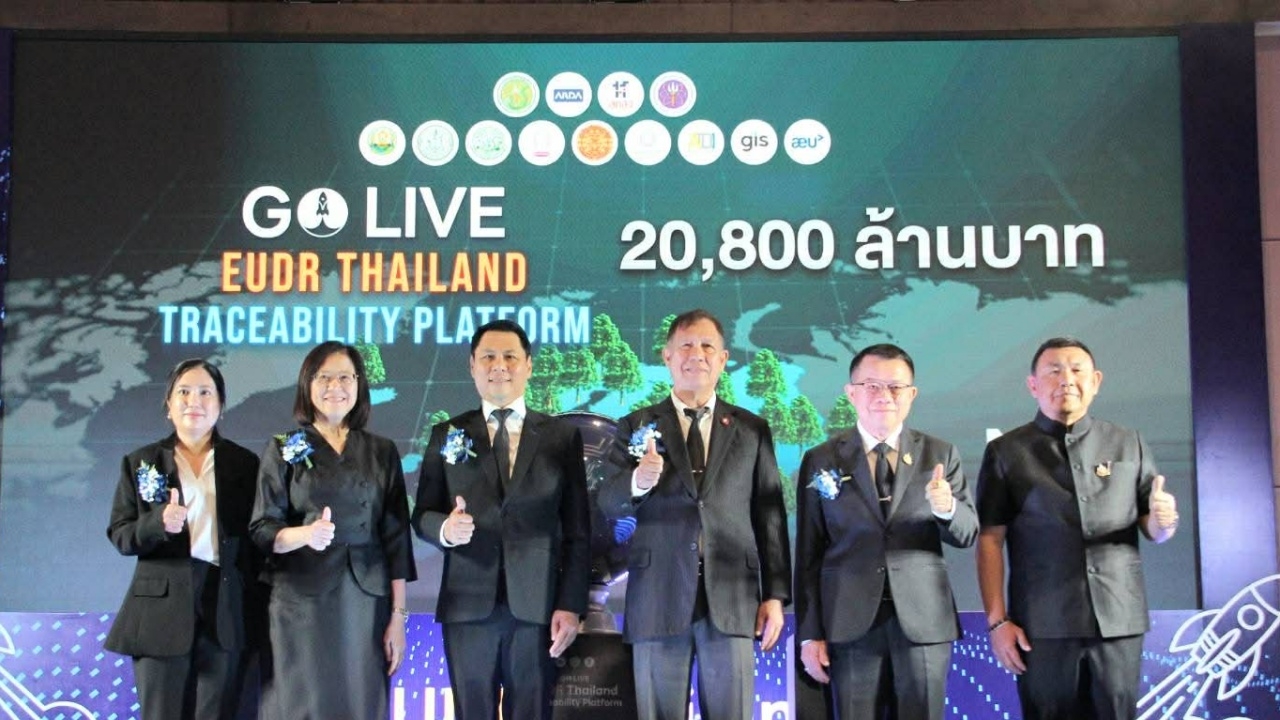
The Agricultural Research Development Agency (ARDA) launched the "EUDR Thailand Traceability Platform," a national-level traceability system designed to comply with European Union regulations governing Thai agricultural exports.
On 21 Jan 2026, reporters noted that ARDA, a public organization under the Ministry of Agriculture, held the opening ceremony for the "Go Live: EUDR Thailand Traceability Platform" event. This marked the official launch of the national traceability platform to meet the EU's European Union Deforestation-free Regulation (EUDR). This represents a crucial step to preserve Thailand's agricultural export market valued at over 20.8 billion baht annually, reaffirming the country's readiness to maintain its low-risk status under EU criteria. Mr. Kris Uttamavetin, Deputy Permanent Secretary of the Ministry of Agriculture and Cooperatives, presided over the event at T.K. Palace Hotel in Bangkok.
Mr. Kris stated that according to reports from the Food and Agriculture Organization (FAO) and the United Nations Environment Programme (UNEP) in 2020, the world lost over 10 million hectares of forest annually between 2015 and 2020, totaling more than 80 million hectares since 1990. In response, the EU implemented the EUDR, requiring imported goods to prove they are not linked to deforestation, with traceable production plot coordinates and compliance with the source country's laws. Although Thailand is classified as a low-risk country, complying with these requirements remains challenging, especially for SMEs and small-scale farmers.
According to UN Comtrade data for 2024, Thailand exports seven agricultural product groups covered by EUDR—rubber, palm oil, cattle, timber, coffee, cocoa, and soybeans—to the European Union, totaling over 1.85 billion USD (approximately 64.9 billion baht). Therefore, developing tools to build a national system is a key mechanism enabling Thailand to adapt promptly to new global regulations and demonstrate environmental responsibility throughout the supply chain. However, practically complying with EUDR requires extensive data, such as production plot coordinates, land rights documentation, and preparing Due Diligence Statements (DDS). Without a standardized central system linking these data, this would increase workload and costs, risking lost trade opportunities, especially for small operators and upstream farmers.
Mr. Thaveesak Thanadechopon, Director of ARDA, explained that to concretely support EUDR compliance, ARDA, under the Ministry of Agriculture and as a Project Management Unit (PMU) managing research funding, supported nine key research projects in 2025. These cover system design for traceability, linking production plot coordinates with satellite imagery, land rights verification, agricultural map standardization, Thai timber law review, market analysis, and training over 1,000 farmers in target areas. The EUDR Thailand Traceability Platform serves as a central hub for accurate and compliant Due Diligence Statements, reducing duplication and errors in documentation. This increases European partners' confidence and helps Thailand maintain its low-risk status continuously. The system is user-friendly, supporting large enterprises, SMEs, and smallholder farmers alike.
ARDA announced that the platform will be available from 21 Jan 2026 via https://eudrthai.com/cms/admin/login. Operators exporting to the EU for the first time will submit a DDS only once. Downstream operators and traders will not need to resubmit but must retain and forward the original DDS reference number. Small-scale primary producers can submit a one-off simplified declaration replacing the need for repeated DDS submissions.
Mr. Thaveesak added that the event also featured an exhibition summarizing key EUDR regulations and platform technologies that accurately collect geolocation data for issuing Due Diligence Statements. Presentations covered the regulation's origins, a database of over 15 relevant laws, and the success of nationwide knowledge transfer networks. He emphasized that 2026 will be a landmark year for Thai agriculture to emerge globally as an environmentally responsible producer. ARDA is confident this platform will be a practical tool to increase income, enhance farmer stability, and protect Thailand's forests alongside sustainable economic growth.