

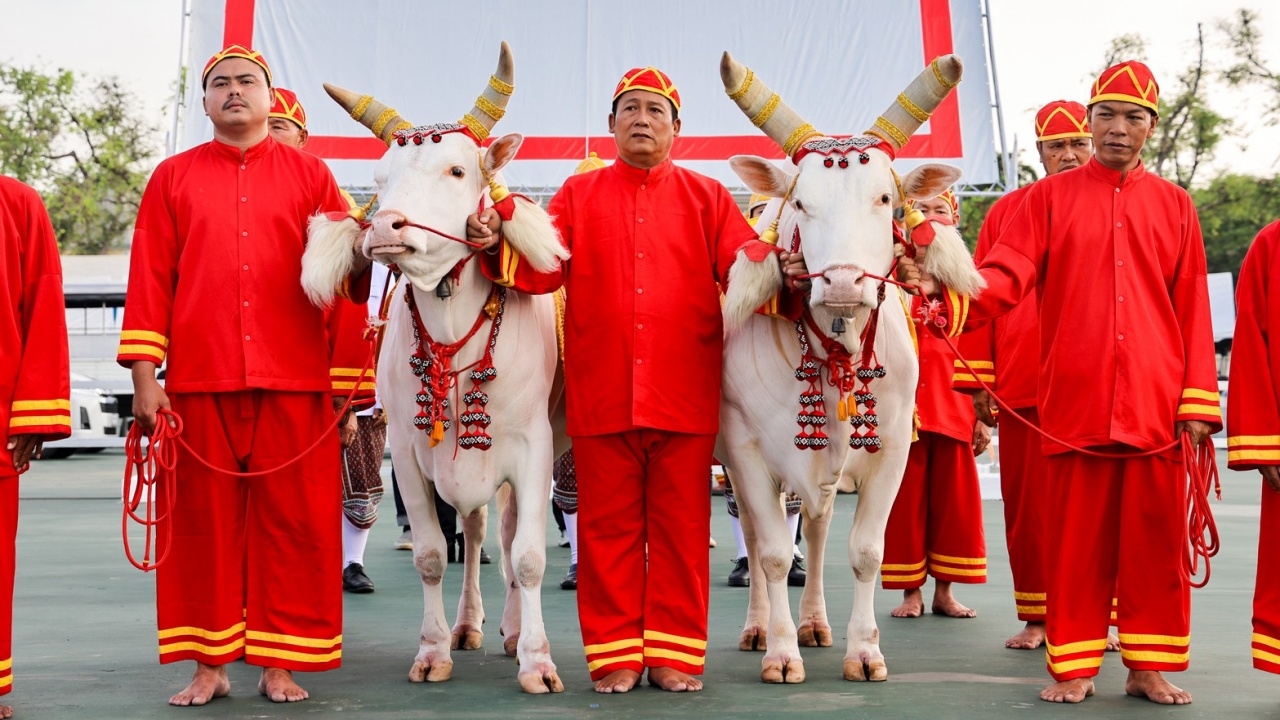
Origins "Phra Kho Phor - Phra Kho Piang" The sacred oxen for the Royal Ploughing Ceremony on Royal Ploughing Day 2026
On Wednesday, 13 May 2026, the event will take place "The Royal Ploughing Ceremony" This royal ceremony has been passed down since ancient times, renowned for its beauty and profound significance to the Thai people, especially those engaged in agriculture.
The Royal Ploughing Ceremony dates back to the Sukhothai period and was last fully conducted according to tradition in 1936. It was then discontinued until 1960, when the Cabinet resolved to revive this royal tradition, which has since been observed annually.

In Hindu-Brahmin belief, sacred oxen symbolize the deity who serves as the mount of Lord Shiva, representing labor and strength, and are the animals tended by Lord Krishna and Lord Baladeva, symbolizing abundance. Therefore, the Royal Ploughing Ceremony has traditionally used male sacred oxen since the reign of King Rama I, representing strength and fertility.
For the Royal Ploughing Ceremony, the Ministry of Agriculture and Cooperatives has assigned the Department of Livestock Development to select the sacred oxen. The Ratchaburi Artificial Insemination and Biotechnology Research Center, under the Livestock Production Biotechnology Bureau, handles the selection. Criteria include excellent physical characteristics: a minimum height of 150 centimeters, body length at least 120 centimeters, chest girth no less than 180 centimeters, matching coat color for both oxen, shiny smooth skin, good behavior—easy to train and gentle, symmetrical beautiful curved horns, bright eyes, flawless ears, long and well-kept tails, correct ceremonial decorations, strong legs and hooves, and a rectangular body profile when viewed from the side.

In 2026, the Department of Livestock Development selected two pairs of sacred oxen for the ceremony:
Both the primary and reserve sacred oxen for 2026 are Lamphun white cattle breed, featuring a pale pinkish-white skin tone and clean white coat without any dark spots or other colors on their bodies. Their horns are white and tapered, with symmetrical beautiful curves. They have bright light brown eyes, pink eyelashes, white noses, white hooves, and long white tail tufts. Their hind legs and hooves are strong and well-developed, and they stand and walk with dignity.
Information courtesy of the Ministry of Agriculture and Cooperatives