

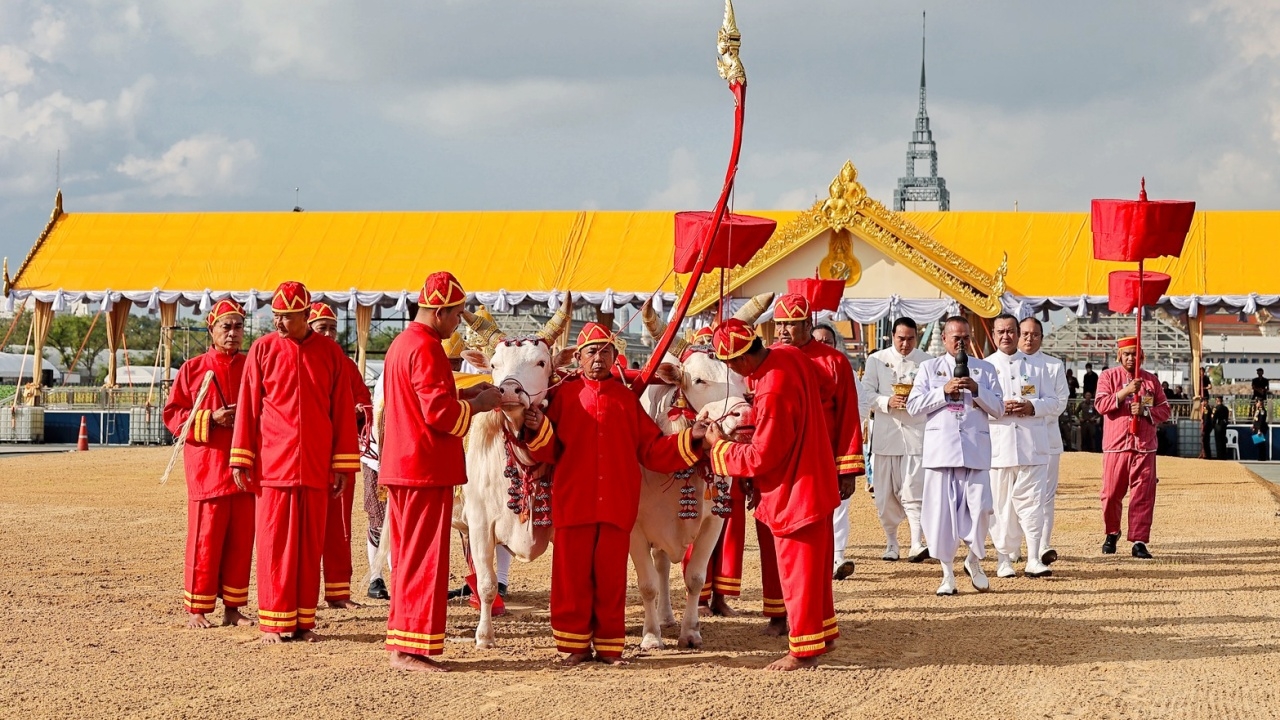
Opening the history "The Royal Ploughing Ceremony and First Rice Planting Blessing" A royal ceremony that has been passed down since ancient times, holding great significance for the Thai people.
On Wednesday, 13 May 2026 GMT+7, an event will be held "The Royal Ploughing Ceremony and First Rice Planting Blessing" This ancient royal ceremony is splendid and highly meaningful to the Thai people, especially those who work in agriculture.
The Royal Ploughing Ceremony and First Rice Planting Blessing combine two rites: the Royal Ploughing Ceremony, a Buddhist rite held on the first day in the ordination hall at Wat Phra Si Rattana Satsadaram; and the First Rice Planting Blessing, a Brahmin rite held the following day at the ceremonial ground of Sanam Luang.
The First Rice Planting Blessing has existed since the Sukhothai period when the capital was Sukhothai. Then, the king did not plow himself but presided over the ceremony.
During the Ayutthaya period, the king no longer presided as in Sukhothai, instead observing a three-day silent retreat and granting authority to Chao Phraya Chanthakuman as his representative, acting with the king’s power. This practice continued until the late Ayutthaya period.
In the Rattanakosin period, the ceremony has been held since the reign of King Rama I, with the first plowing performed by Chao Phraya Phon Thep alongside the swing ceremony. By King Rama III’s reign, the person standing on the swing was considered the first plower. King Rama IV ordered the addition of Buddhist rites to royal ceremonies, initiating the combined Royal Ploughing and First Rice Planting Blessing ceremony known by its full name.
Regarding the purpose of this ceremony, King Chulalongkorn explained in his work "The Twelve-Month Royal Ceremonies" that the first plowing serves as an example to inspire farmers’ confidence in rice cultivation. Though once a necessity for the kingdom, this remains true today, as rice farming is crucial for the livelihood and economy of the country.
Beyond setting an example, the ceremony includes two other aspects: one involves prayers based on sincerity and harmless acts, reflecting Buddhist auspicious rites conducted at Wat Phra Si Rattana Satsadaram; the other involves offerings following Brahmanic traditions, referring to the First Rice Planting Blessing.
The Royal Ploughing Ceremony and First Rice Planting Blessing is held annually in the sixth lunar month, a suitable time to begin rice planting, the main occupation of Thai people. However, unlike other royal ceremonies, its exact date is not fixed but chosen according to traditional auspicious timings within May or the sixth month.
The ceremony is a blessing for crops, with the king praying for the abundance of rice and other food plants. Rice, the staple food, is called "Bupphannacha" in Pali, while other food plants like beans and sesame are called "Aparanna." Together, they are referred to as "Bupphannaparanacha," meaning all food crops.
The crops brought into the ceremony include unhusked rice varieties—both white and glutinous rice—along with 40 types of seeds, each placed in white cloth bags, plus various tubers. All these seeds are viable for planting.
Additionally, unhusked rice used in the first plowing is placed in two baskets—one gold, one silver—consisting of high-quality rice varieties cultivated in the royal project at Suan Chitralada. Some of this royal rice is sown during the ceremony, while the remainder is packaged and distributed to farmers and people across provinces as a blessing and symbol of good fortune for the year’s crops.
Since 1966, the Cabinet resolved to designate the day of the Royal Ploughing Ceremony as "Farmers' Day" to remind those engaged in agriculture of its importance and to encourage their participation in the ceremony for blessings on their occupation, benefiting both themselves and the national economy. Consequently, Farmers' Day is celebrated alongside the Royal Ploughing Ceremony every year.
Information courtesy of the Ministry of Agriculture and Cooperatives