

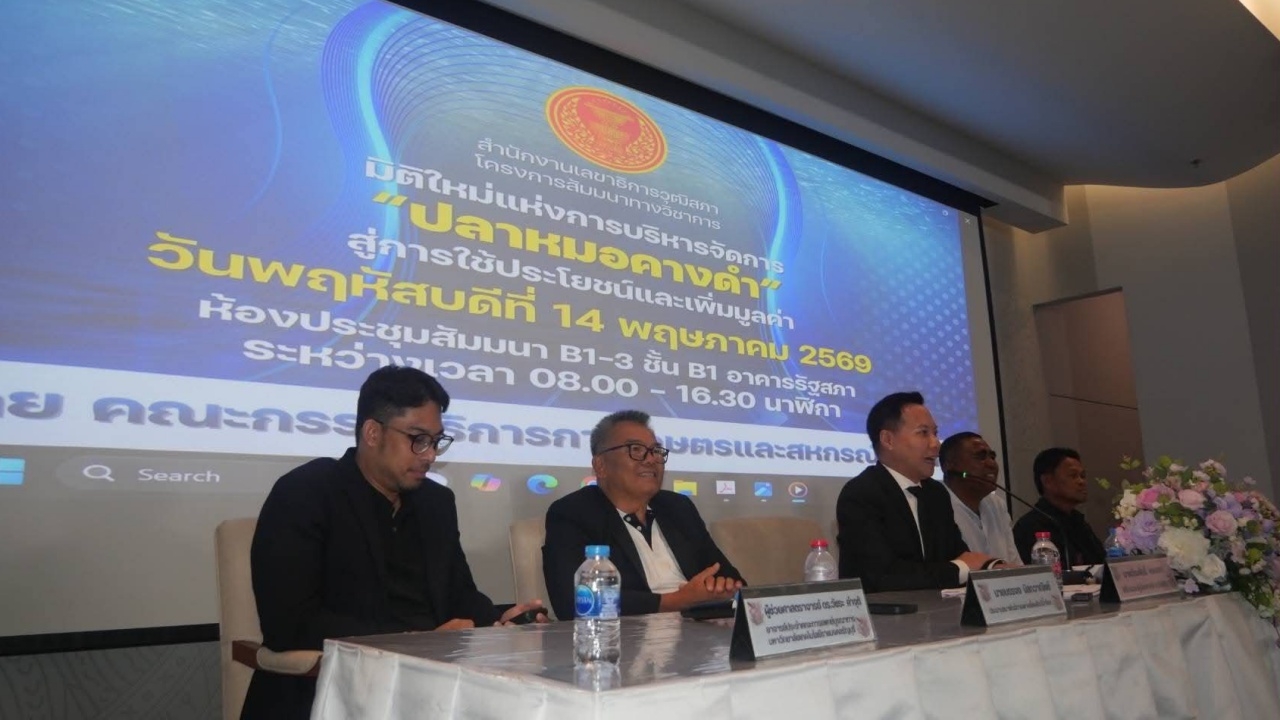
The Senate Agriculture Commission organized a seminar to brainstorm solutions for the black-barred catfish issue, preparing to compile proposals for the government and relevant agencies to add value through processing and generate community income.
On 15 May, reporters reported that on 14 May, Mr. Thawatch Suraban, Chairman of the Senate Agriculture and Cooperatives Commission, held an academic seminar titled“A New Dimension in Managing Black-barred Catfish: Towards Utilization and Value Addition.”The aim was to gather opinions on managing black-barred catfish beyond mere eradication, moving toward systematic utilization after research showed high nutritional value, and to push policy proposals for purchasing and processing to sustainably support farmers and communities at the Parliament Building, with Gen. Kriangkrai Srirak, the First Deputy President of the Senate, presiding over the opening ceremony.
On this occasion, Mr. Thawatch said the key point of this seminar is to move beyond traditional methods and focus on managing existing black-barred catfish to maximize benefits. The commission sees that with appropriate technology and management, these fish can be transformed into valuable upstream raw materials, which will help reduce fish populations in ecosystems while providing additional income for farmers and local fishermen.

He acknowledged the reality that completely eradicating black-barred catfish is difficult. Therefore, the question is how to turnthis crisisinto an opportunity for utilization. The approach includes continuous purchase and use of the fish, such as for making bio-fermentation liquids, supporting women's groups or community enterprises to process products like fermented fish, chili paste, and fermented fish sauce. This is a problem-solving approach. Field visits showed the importance of coexisting with black-barred catfish, especially with farmers using them as bait for white crab farming in several provinces, and shrimp farmers using them to feed benthic organisms, as well as research on extracting calcium from the fish. Moreover, regulations need revision so that black-barred catfish proven not to be invasive can be relocated for use in fishmeal industries. A new image must be created for the black-barred catfish, showing it is not harmful and can be consumed in various ways, depending on perspective and value addition.Farmerswho rear shrimp use black-barred catfish to feed benthic organisms. Additionally, research is being done on producing calcium from the fish. Furthermore, regulatory reforms are needed to allow black-barred catfish verified as non-invasive to be moved outside affected areas for use in the fishmeal industry. It is also necessary to reshape the fish's image to show it is not dangerous and can be consumed in diverse forms, making the difference in perception and value addition.
Reporters added that the key highlights from the seminar concluded that in terms of innovative value-added processing, research data showed black-barred catfish could be further developed in various industries such as producing high-quality animal feed to reduce costs in economic aquatic animal farming, creating bio-fertilizers, and collagen extraction.
Regarding nutritional value, preliminary studies found that black-barred catfish bones contain significant nutrients comparable to some economic marine fish species, presenting a key opportunity for use in the food and health industries.
Concerning the circular economy model, the commission plans to summarize proposals to push the government to establish purchase mechanisms and processing centers locally, transforming the fish into business raw materials that generate local economic circulation.

However, following this seminar, the commission will compile all recommendations and research findings to produce a policy proposal report for the government and relevant agencies to serve as a blueprint for sustainable management of black-barred catfish, turning a burden into a driving force for Thailand's grassroots economy.