

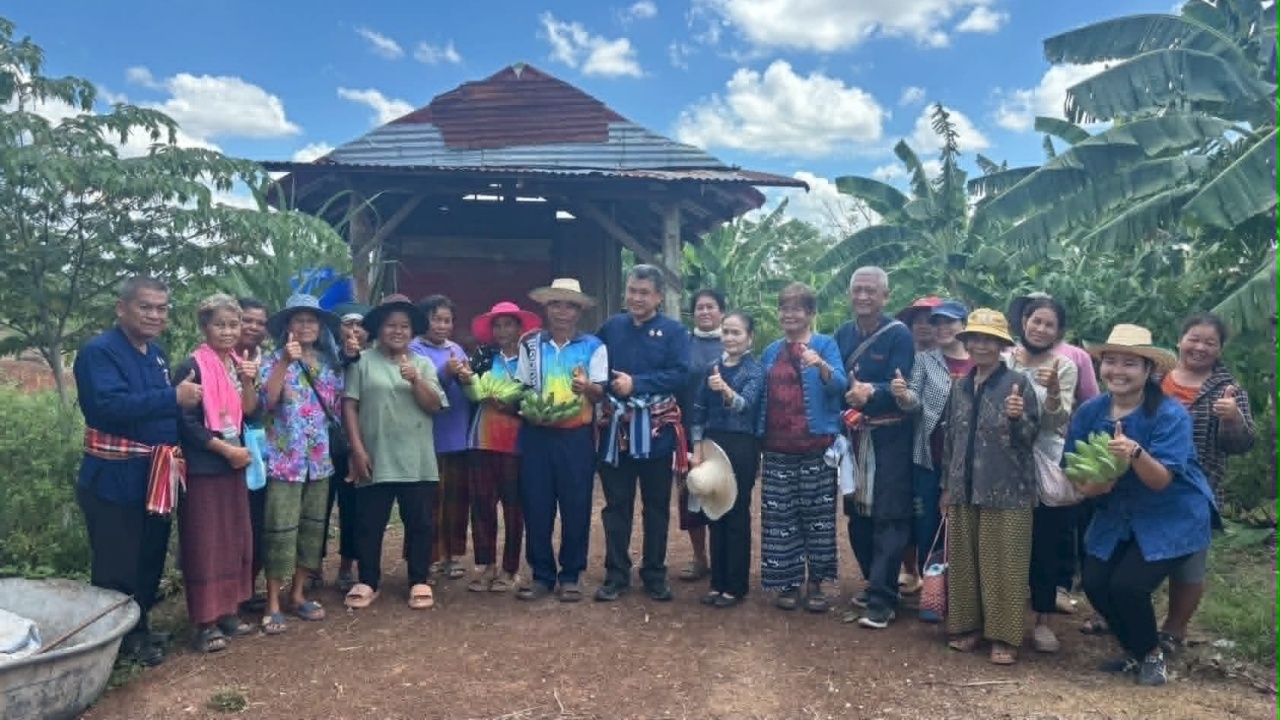
The former Secretary of the Ministry of Interior visited the Khok Nong Na Learning Center in Sakon Nakhon Province to offer encouragement and exchange views, supporting food security, reducing expenses, and increasing income.
On 27 May, Mr. Sutthipong Julcharoen, former Secretary of the Ministry of Interior, said that on the morning of 26 May, he traveled to Sakon Nakhon Province to follow up, support, visit, and encourage the network driving the learning center for quality of life development based on the New Theory applied to Khok Nong Na. The goal is to build food security, reduce expenses, increase income, and share towards sustainability in Charoen Sin District. He was accompanied by Mr. Ong-art Songthummintorn, Sakon Nakhon Provincial Development Officer, along with executives and community development staff from Sakon Nakhon, Ms. Kanjanee Lasrichan, owner of the learning center, Mr. Bancha Rasimin, advisor to the Khok Nong Na network in Sakon Nakhon, as well as Khok Nong Na network members and local residents participating in the activity.
He led the group to visit the progress of the learning center and Khok Nong Na model plots, exchanging knowledge and encouraging the plot owners who apply the Sufficiency Economy Philosophy in their lives and careers. This aims to build food security, reduce expenses, increase income, and promote sustainable self-reliance. The visits included: 1. Mr. Kenchan Kamphromma’s learning center plot at Ban Na Sin Nuai Tai, Village 11, Nong Paen Subdistrict, Charoen Sin District; 2. Mr. Boonpheng Kasopim’s learning center plot at Ban Dong Bang Mai, Village 15, Ban Lao Subdistrict, Charoen Sin District (an expanded plot for raising Barbary ducks); 3. Mr. Kowit Buasri’s learning center plot at Ban Kham Mek Noi, Village 9, Ban Lao Subdistrict, Charoen Sin District (a model plot for raising Barbary ducks); 4. Mr. Saenkom Chanamin, son of Mr. Udom Chanamin, at Ban Sok, Village 8,. Thung Kae Subdistrict, Charoen Sin District (a model plot for raising Barbary ducks); and 5. The Sufficiency Economy School Learning Center at Ban Charoen Sin, Charoen Sin District, owned by Ms. Kanjanee.

Mr. Sutthipong added that on this occasion, he participated in planting trees within a model plot to promote household food security, reduce expenses, and foster community unity, which is a vital foundation for sustainable quality of life development. He emphasized continuing, preserving, and building upon the royal initiatives of His Majesty King Rama IX and King Rama X, focusing on marketing development alongside enhancing existing projects to create sustainable added value.
Additionally, he introduced the “Three Forests, Four Benefits” principle as a sustainable forestry guideline, comprising utility trees, edible trees, and economic trees, to provide benefits in housing, consumption, usage, and shade while conserving soil and water. This also promotes the “Five Levels of Trees” concept, or natural interdependent forest planting, which helps balance the ecosystem, enrich the area, and serves as a key approach to food security, reducing expenses, increasing income, and sustainable self-reliance.
He praised and encouraged all Khok Nong Na plot owners who have taken initiative to develop their land based on the Sufficiency Economy Philosophy. He stressed that sustainable development occurs when the people are the center of change, while the government must engage directly in the field, listen to real problems, and work closely with the people to solve them, thereby raising the quality of life securely and sustainably.

The former Secretary of the Ministry of Interior also said that on the afternoon of the same day, he and his team visited the model village “This House Has Love, Grow Your Own Vegetables” to follow up, support, and observe the implementation of Her Royal Highness Princess Maha Chakri Sirindhorn’s royal initiatives through the activity at Ban Charoen Sin, Village 1, Charoen Sin Subdistrict, Charoen Sin District. This promotes kitchen gardening to build food security, reduce expenses, increase income, and strengthen sustainable self-reliance at household and community levels. He also distributed vegetable seeds and used tires to support creating kitchen garden plots, learning areas, and increasing food production at home, which will reduce living costs and improve quality of life sustainably.
Afterward, he and his team visited the Fang Daeng Center in Hai Yong Subdistrict, Phang Khon District, to follow up on the quality of life development of local residents. They toured the improved area created as a community food source and observed management following the Sufficiency Economy approach. The local people have developed this site as a learning center for food security and self-reliance. During this visit, he advised on product development, value addition, and optimal land management, and presented trees to residents and network members to encourage planting utility, economic, and edible trees according to the “Three Forests, Four Benefits” principle. This will enhance land fertility, provide shade, and strengthen community food security in the long term.
