

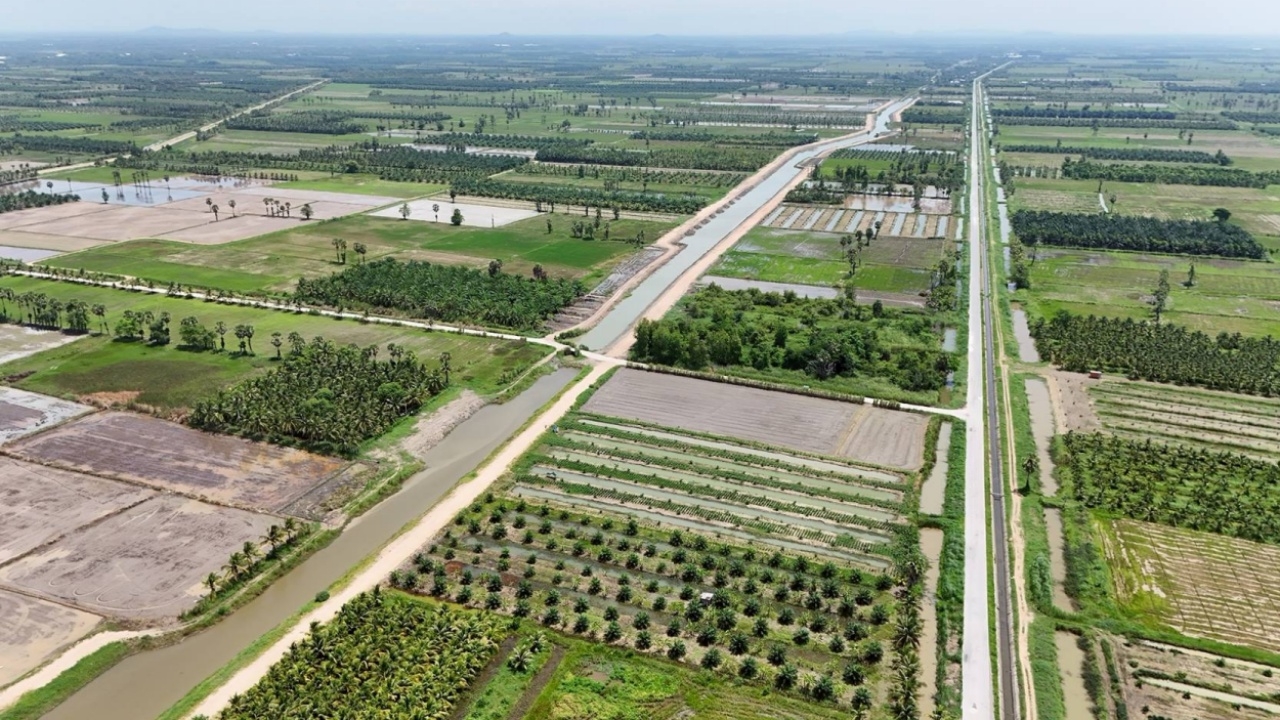
The Royal Irrigation Department is advancing three key projects to resolve flood and drought problems in the Sateng Peninsula, strengthening sustainable water management capabilities.
On 19 Jun 2026 GMT+7, reports indicated that the Royal Irrigation Department is accelerating three major projects in the Sateng Peninsula area of Songkhla Province to address ongoing flooding and agricultural water shortages, while improving systematic and sustainable water management efficiency.
. The Sateng Peninsula area covers four districts: Ranot, Krasae Sin, Sateng Phra, and Singhanakhon. This region has long faced water management issues. During the rainy season, floods often occur due to the low-lying terrain that collects water. Heavy rains in the Songkhla Lake basin cause widespread flooding with high water levels and slow drainage, damaging agricultural land, homes, and residents’ livelihoods.
Meanwhile, in the dry season, this area regularly experiences water shortages for agriculture, impacting crop cultivation and farmers' income. The Royal Irrigation Department has studied systematic solutions, including enhancing drainage efficiency during floods, increasing water storage capacity for dry seasons, and developing irrigation infrastructure suited to local conditions.
Currently, the Royal Irrigation Department is implementing and upgrading three major irrigation projects in the Sateng Peninsula area:

1. Khlong Prem Drainage Canal Project in Wat Son Subdistrict, Ranot District, Songkhla Province.
This area faces limitations in Khlong Prem, which receives water from the Khok Phra pumping station that pumps freshwater from Songkhla Lake into the canal, then transfers it to Khlong Phlao Ek Arthit for agricultural use during the dry season. However, Khlong Prem has not been upgraded to fully support efficient water delivery and drainage, limiting water supply to downstream areas.
The Royal Irrigation Department is upgrading Khlong Prem by increasing its drainage capacity from 100 to 300 cubic meters per second and constructing 14 water intake structures to improve water transport and increase storage in Khlong Phlao Ek Arthit. This enhances efficient management of water from Songkhla Lake, allowing a maximum supply of 10 cubic meters per second to storage areas for agriculture.

2. Khlong Nang Drainage Canal Project with associated structures in Khlong Ri Subdistrict, Sateng Phra District, Songkhla Province.
This project aims to improve drainage in flood-prone areas and support water allocation for agriculture. It involves building reinforced concrete drainage canals and two sets of four sluice gates to control water flow and storage based on conditions. Upon completion, it will alleviate flooding and water shortages for agriculture in Khlong Ri and nearby areas, benefiting approximately 2,200 rai of farmland and over 1,022 households.

3. Khlong Phai Drainage Efficiency Improvement Project in Dan Sanguan Subdistrict, Ranot District, Songkhla Province.
This project increases drainage capacity to reduce flood impacts, expands water storage for farming and consumption, and involves upgrading Khlong Phai with construction of one sluice gate with two channels, three road culverts, 26 water intake structures, and 17 vehicle bridges. When completed, it will improve drainage during the rainy season, lessen flood damage, and enhance water security in the dry season, benefiting about 1,500 rai of land and over 500 households.
Upon completion of these three irrigation construction and improvement projects, water management in the Sateng Peninsula will be more effective, increasing drainage capacity, reducing flood problems during the rainy season, and boosting water reserves for agriculture during droughts. These efforts will alleviate flood and drought issues, secure water resources, improve residents' quality of life, reduce natural disaster impacts, and support long-term agricultural economic development in Songkhla Province.