

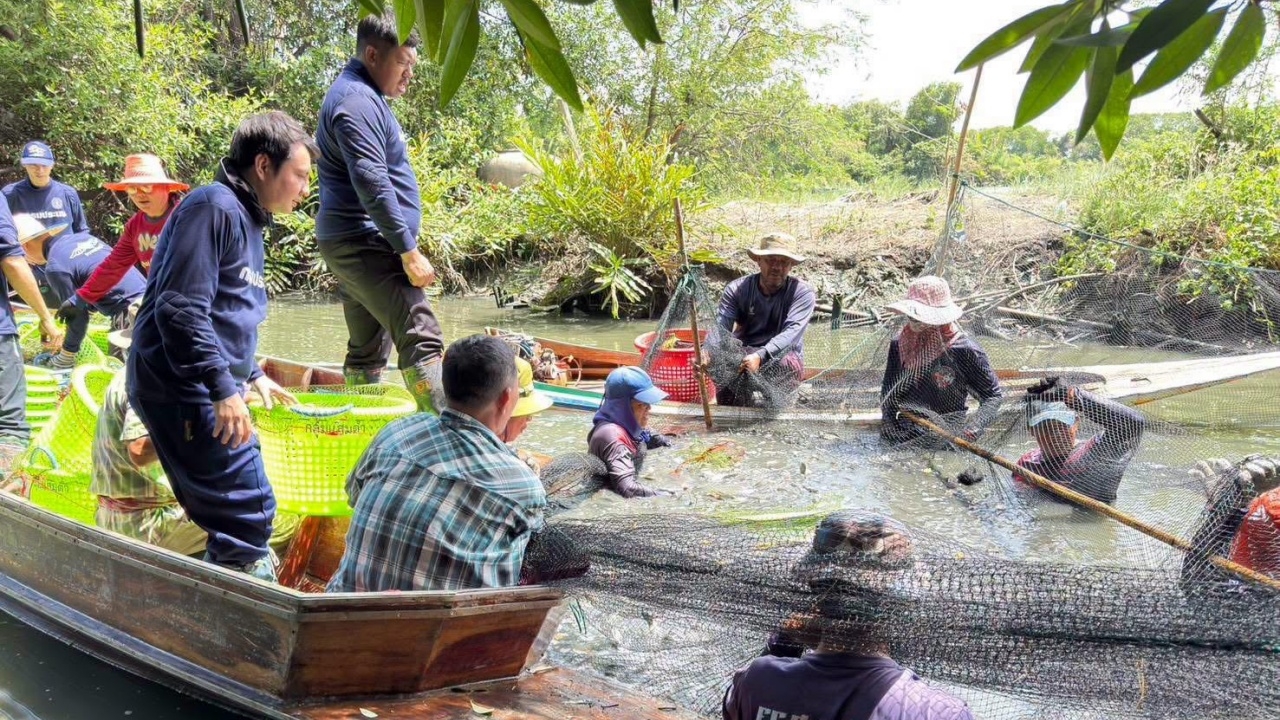
"Department of Fisheries" , confirms the species identification of aquatic animals in products "canned fish" according to international standards and continues to address the problem "Black Chin Tilapia" continuously.
On 16 July 2026, Mrs. Thitiporn Laoprasert, Director-General of the Department of Fisheries, stated that due to public interest and doubts regarding species test results in canned fish products, the department clarifies that the procedures follow international laboratory standards using Morphology Identification and Taxonomy principles. These are the same methods used for aquatic product export inspections and are continuously evaluated by trading partners such as the European Union, the United States, and the Republic of Korea.
For the three sample sets of products sent by the Food and Drug Administration (FDA) on 5 May 2026, the Department of Fisheries conducted expert taxonomic identification and submitted reports back to the FDA on 6 May 2026, finding that
The morphological classification method can distinguish between Nile tilapia and Black Chin Tilapia because these two species have distinct taxonomic characteristics, such as clearly different numbers of scale rows above the lateral line.
DNA sequencing analysis is another scientifically specific technique; however, sample preparation requires complex molecular procedures, takes a long time, and is costly. The DNA sequences are then compared with genetic databases such as GenBank. Both morphological and DNA methods are scientifically and internationally accepted standards.
If other agencies' test results differ from those of the Department of Fisheries, it is scientifically necessary to consider whether the samples come from the same production batch or the same can, because factories may use raw materials from multiple sources per batch. Environmental factors affecting the sample may also lead to different species identification results. Food quality control and raw material traceability fall under the authority of the FDA, which oversees food production under the Food Act B.E. 2522 (1979).
The Director-General added that the Department of Fisheries enforces laws controlling possession and movement of Black Chin Tilapia under the Ministry of Agriculture and Cooperatives' announcement on prohibited aquatic species in possession, B.E. 2567 (2024). The department acknowledges public concern about the Black Chin Tilapia outbreak and remains open to information from the public, academics, and agencies. It assesses population density in natural waters by sampling representative fish from entire watercourses, averaging density per sampled area. Because Black Chin Tilapia school together, high local concentrations may be found in some areas.
Meanwhile, some areas have low or no populations. A May survey covering 204 water bodies in 21 provinces found no outbreaks in two provinces (Prachinburi and Pattani). Low-density infestations (fewer than 10 fish per 100 square meters) occurred in nine provinces (Trat, Chachoengsao, Nonthaburi, Bangkok, Samut Songkhram, Nakhon Pathom, Ratchaburi, Songkhla, and Phatthalung) with averages between 1-8 fish per 100 square meters. Moderate-density infestations (10-100 fish per 100 square meters) were found in 10 provinces (Chanthaburi, Rayong, Chonburi, Samut Prakan, Samut Sakhon, Phetchaburi, Prachuap Khiri Khan, Chumphon, Surat Thani, and Nakhon Si Thammarat) with averages from 11 to 88 fish per 100 square meters.
No areas were found with high infestation levels (over 100 fish per 100 square meters). The Department of Fisheries welcomes joint surveys with the public to obtain more comprehensive data.
Regarding solutions, the Department of Fisheries continues integrated efforts to reduce Black Chin Tilapia populations and utilize them beneficially as human food products (such as dried fish, fermented fish, fish sauce), animal feed (fish meal, bait for mud crabs), and plant fertilizers (fermented biological solutions, biofertilizers). The department is also promoting processing knowledge for consumption (phase 2) at the Fisheries Department market on 14, 21, and 28 August 2026, showcasing recipes like fried fish cakes, rice noodles, samosas, steamed buns, northern Thai sausage, fish croquettes, and dried fish. Additionally, predator fish such as white seabass and other species are used to control Black Chin Tilapia.
Concerning budget for the Black Chin Tilapia issue, the Director-General explained that the department has proposed a 19.35 million baht budget for 2027, covering four sub-activities:
1. Assessing population density and spread of Black Chin Tilapia in natural water bodies.
2. Community net fishing activities.
3. Production and release of predator aquatic animals to control Black Chin Tilapia.
4. Research to enhance biological control techniques for limiting the spread of Black Chin Tilapia.
These sub-activities are part of the Fisheries Resource Management Project and thus are not separately listed in the draft budget bill for fiscal year 2027, but work continues under this plan. The department also plans to seek funding support from various sources to ensure ongoing and effective problem-solving.
However, addressing the Black Chin Tilapia outbreak remains a key ongoing mission based on scientific principles, with close monitoring and evaluation to ensure measures align with conditions and produce concrete results. The department integrates cooperation across sectors to share information, knowledge, and research development, openly accepting suggestions from all parties to improve measures for greater effectiveness, leading to successful control and resolution of the Black Chin Tilapia problem.