

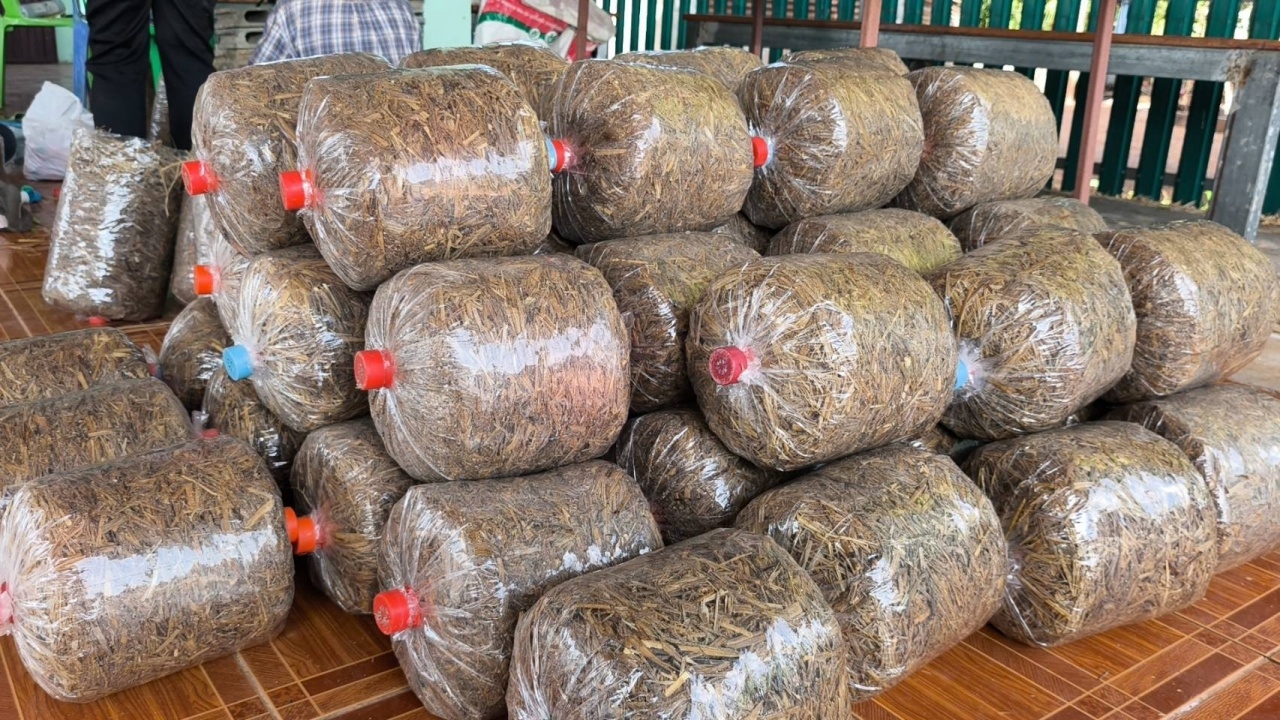
As Korat begins its dry season, villagers in Phimai who are not engaged in off-season rice farming have formed groups to produce "mushroom cultivation blocks" from rice straw for sale. This helps farmers reduce production costs, with reported income reaching as high as 2,000 baht per day.
On 30 Jan 2026 GMT+7, at the community pavilion of Ban Thephasadin, Village No. 5, Nikhom Sang Ton Eng Subdistrict, Phimai District, Nakhon Ratchasima, villagers who are not farming off-season rice due to the dry weather and limited agricultural water have come together to make mushroom cultivation blocks from rice straw for sale, providing supplemental income for their families.

Mrs. Muay Ngan-Keng, 62, a village representative, said that recently she and other villagers have experimented with making mushroom cultivation blocks from rice straw for sale, which has proven successful with many customers placing orders. They use rice straw, often considered worthless by many, to make mushroom growing blocks. The mushrooms yield well, comparable to those grown on sawdust, significantly helping farmers reduce production costs.

The simple process involves soaking rice straw in water for 1-2 hours or thoroughly wetting it with a hose, then draining it. The straw is chopped into sections with a knife. Fine rice bran is sprinkled over the straw pile, followed by lime, gypsum, and Phumite in specified ratios, then mixed thoroughly to increase yield.

Next, the mixed rice straw and additives are packed tightly into plastic bags, pressed down by hand, fitted with a bottle neck at the bag's opening, secured with rubber bands, and sealed with cotton wool and old newspaper, then rubber-banded again—similar to the sawdust mushroom block production method. About one teaspoon of mushroom spawn is added per bag, which is then sealed and wrapped in newspaper with rubber bands. The blocks sell for 20 baht each, with around 100 orders daily, generating over 2,000 baht per day, providing villagers with a good supplemental income.
