

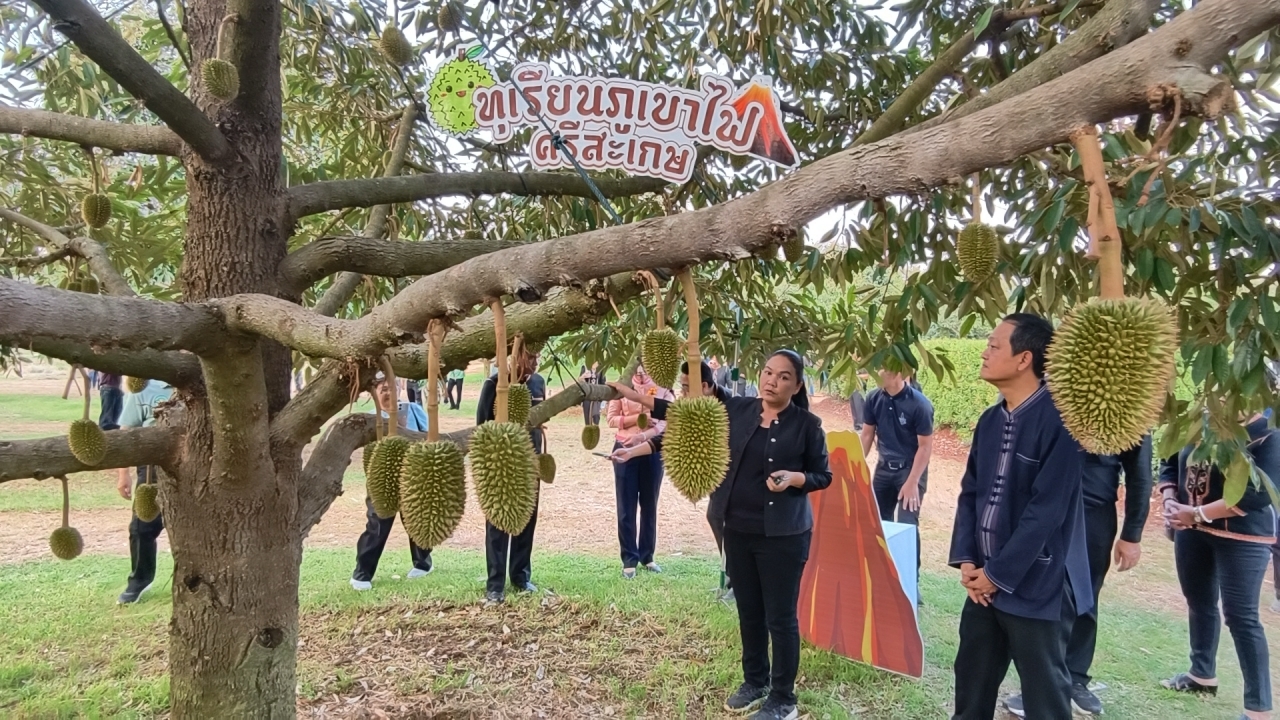
The governor of Sisaket led farmers in pruning, thinning, and shaping volcanic mountain durian fruits. Durian orchard farmers noted that fertilizer and fuel costs have risen, but durian prices remain the same. They appealed to the government to help guarantee prices or expand marketing channels to support them.
At Watchara orchard in Phu Ngoen subdistrict, Kantharalak district, Sisaket province, Anurat Thamprasitjit, the governor of Sisaket, presided over the activity “Cutting Fruits with Heart for Quality Sisaket Volcanic Mountain Durian.” This campaign encourages farmers to manage their durian crops by pruning excess fruits and leaving an appropriate number according to scientific principles. Even if the trees are full of durians, farmers make the tough decision to ensure the remaining fruits develop fully and perfectly. The event also serves to inform and assure consumers that Sisaket volcanic mountain durians are carefully tended from the start. Farmers treat the durians with meticulous care, as if they were their own children, never taking their eyes off them and showing a genuine love for Sisaket volcanic mountain durian. It also signals that the durian season is near. The event included participation from Suchart Klinthonglang, the agricultural officer of Sisaket, heads of government agencies, private sector representatives, and members of the large-scale farmer groups.

Anurat Thamprasitjit, governor of Sisaket province, revealed that Sisaket volcanic mountain durian is a key economic crop for the province and a major provincial development agenda. It has also been registered as a Geographical Indication (GI) product. Sisaket is the largest durian-growing area in northeastern Thailand, with over 20,000 rai planted across three districts: Kantharalak, Khun Han, and Si Rattana. The volcanic soil in these areas is sticky with fine particles mixed with coarse red rocks, providing good drainage and a high level of essential nutrients for plants. This soil condition results in durians with excellent taste, dry flesh, fine fibers, a smooth texture, and a mild aroma, making them highly desired in both domestic and international markets.
The governor of Sisaket added that this year’s durian season runs from March through early August, with the peak harvest in June. Due to rising fertilizer prices and higher fuel costs, it is expected that Sisaket durian prices this year will be higher than last year. The volcanic mountain durian is known for its quality and GI status, reflecting the careful and heartfelt cultivation by farmers. This care contributes to its higher market price compared to regular durians.

Mr. Thotsaphon Srisura, 43, a durian farmer in Kantharalak district near the Thai-Cambodian border, shared that he farms 15 rai of durian and produced about 27 trees last year, earning approximately 2.3 million baht. However, this year durian farmers face many challenges, including the Thailand-Cambodia border tensions, increased fertilizer prices, hotter weather than last year, and rising fuel costs. Many farmers feel that while costs keep rising, wages and product prices have not increased accordingly. This year, durian farmers hope for a wholesale price not below 100 baht per kilogram and a retail price not below 150 baht per kilogram to sustain their livelihoods. They also hope the government will support price guarantees or help develop foreign markets to achieve better prices that cover their production costs.
