

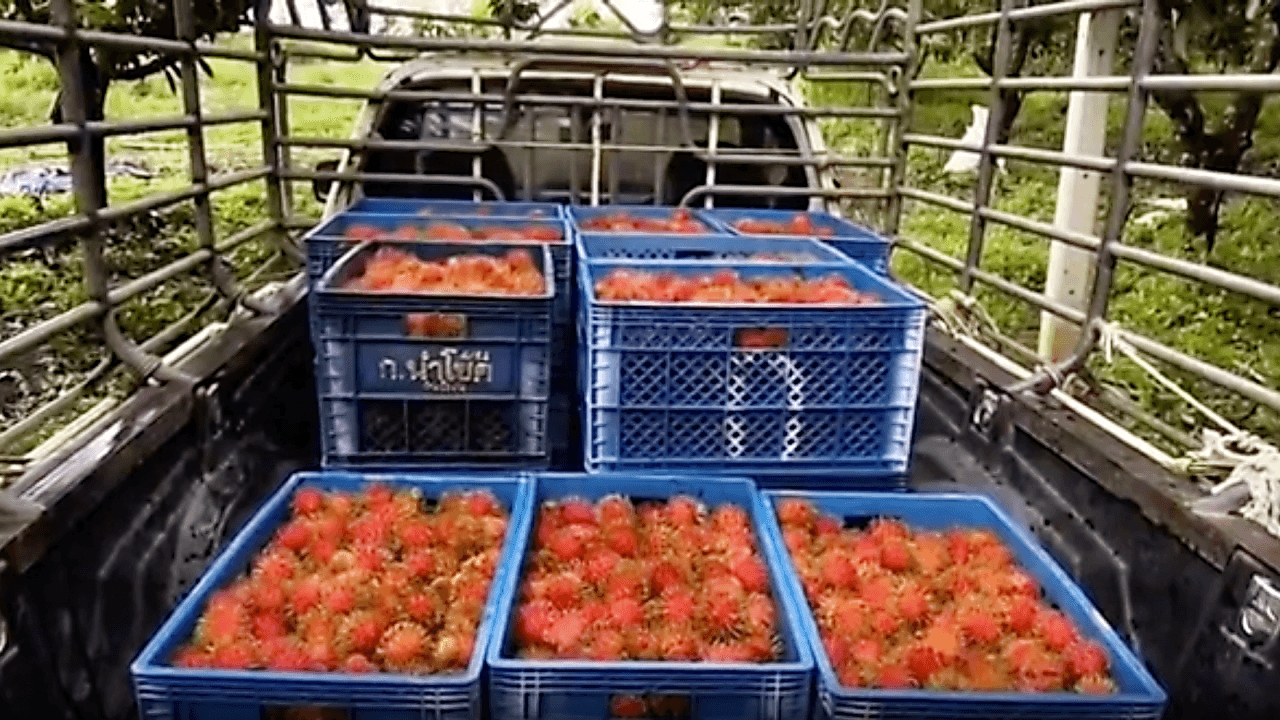
Relevant agencies held an urgent meeting to address the steep drop in rambutan prices to 10-11 baht per kilogram, aiming to support farmers. The latest agreement is to increase market-leading purchase points and coordinate with retail and wholesale stores to boost buying.
On 2 June 2026 at the Satoh Subdistrict Administrative Organization meeting room in Khao Saming District, Trat Province, Mr. Sakorn Nilrat, Deputy Governor of Trat, Mr. Pongpat Sinrai, District Chief of Khao Saming, Mr. Pichanon Ingprasarn, Trat MP, Mr. Pramot Jankrajang, Chief of Satoh Subdistrict Administrative Organization, Mr. Singha Sungsakul, Chief of Praneet Subdistrict Administrative Organization, Mr. Witawat Sunyajan, Chief of Thepnimit Subdistrict Administrative Organization, the Trat Commerce and Agriculture officials, and rambutan farmers convened an urgent meeting. The aim was to solve the problem of falling rambutan prices, which have dropped to 10-11 baht per kilogram, causing farmers’ dissatisfaction and preparations to dump rambutan in protest against delayed government support.
Ms. Waranya Thanomphan, Commerce Officer of Trat Province, said that the Trat Commerce Office has implemented support measures to assist agricultural produce by expanding marketing channels, accelerating distribution beyond production areas, and alleviating the problem of produce concentration during fruit seasons. This is done in cooperation with the Department of Internal Trade, the Ministry of Commerce, and relevant agencies. Activities include opening two market-leading purchase points for Golden Rambutan, targeting 30 tons per day from 30 May to 8 June 2026. The locations are the Trat Provincial Agricultural Business Promotion Cooperative Limited and the Khao Saming Agricultural Cooperative Limited.
Additionally, cooperation has been established with CPAxtra (Makro Lotus) to purchase an extra 5 tons per day beyond normal trade, aiming for an initial target of 100 tons. The department supports 40,000 baskets sized to hold 2-2.5 kilograms. They have also coordinated with Thai Best Products Holding Co., Ltd. to purchase rambutan packed in 500-gram plastic boxes for 7-11 stores at 2.5 tons per day, currently pending CPAll's audit of the packing facility.

Mr. Somchai Chaisaen, headman of Satoh Subdistrict, stated that this crisis is not limited to Satoh but affects Khao Saming and Bo Rai districts. A severe issue is the high labor cost of picking rambutan at 2-3 baht per kilogram, which means selling at the current market price of 10 baht per kilogram leaves farmers with insufficient income to cover fertilizer and pesticide costs. The government’s measure to buy at 2 baht above market price has not stimulated higher prices from intermediaries. Furthermore, the purchase volume of only 30 tons per day is too low compared to actual production, as a single orchard may yield nearly 10 tons daily. Another major problem is that contractors and middlemen exploit contractual loopholes to continuously exploit and underpay farmers.
Mr. Truat Sontheng, village headman of Village 7 in Satoh Subdistrict, described the most critical local problem: contractors who have leased orchards delay harvesting beyond agreed schedules and try to reduce the purchase price. This causes ripe rambutans to remain on trees until they turn black, rot, and fall, damaging the orchard. Farmers urgently need to harvest to apply fertilizer and prepare for the next season. Additionally, a factory buyer in Nakhon Pathom has started refusing rambutan from Trat, instead buying from Chiang Mai and Chanthaburi, due to Trat rambutan being large, with large seeds, and spoiling from delayed harvesting by contractors. Some local traders have also diluted low-grade rambutan sent to factories, damaging the province’s reputation. These problems are worsened by rising fuel costs and border closures.
Mr. Witawat Sunyajan, Chief of Thepnimit Subdistrict Administrative Organization, reported that in Thepnimit Subdistrict alone, Golden Rambutan production reaching the market is about 50-60 tons per day. The government’s help via only two purchase points may simplify agency operations but significantly hinders villagers’ access. The main issue is that purchasing centers in the program reserve privileges or baskets for their regular partner orchards first, leaving small-scale farmers unable to sell their produce to benefit from market-leading price measures. Therefore, they propose that government agencies improve project operations to distribute assistance more widely and ensure villagers truly gain benefits.
Meanwhile, Mr. Singha Sungsakul, Chief of Praneet Subdistrict Administrative Organization, said the recurring hardships of rambutan and mangosteen farmers, which have led to multiple protests in Trat, require long-term solutions. He suggested government agencies such as Commerce and Agriculture coordinate data and jointly register cultivation areas early in the year to gain in-depth knowledge of fruit-growing areas in each subdistrict. He also recommended the government consider setting a minimum price guarantee of 15 baht per kilogram to enable farmers to survive and sustainably resolve the issue, emphasizing the importance of agricultural stability.
Mr. Pichanon Ingprasarn, Trat MP, proposed clearly dividing solutions into two main parts. For the urgent current problem, he acknowledged that the government’s market-leading purchase measure does not yet reach all farmers due to only two purchase points with a daily quota of 30 tons. He urged the Ministry of Commerce to consider increasing quotas and expanding purchase points to affected areas such as Satoh, Thepnimit, and Praneet. For the long term, he requested the provincial Commerce and Agriculture offices to prepare advance estimates to plan product distribution when large quantities enter the market.