

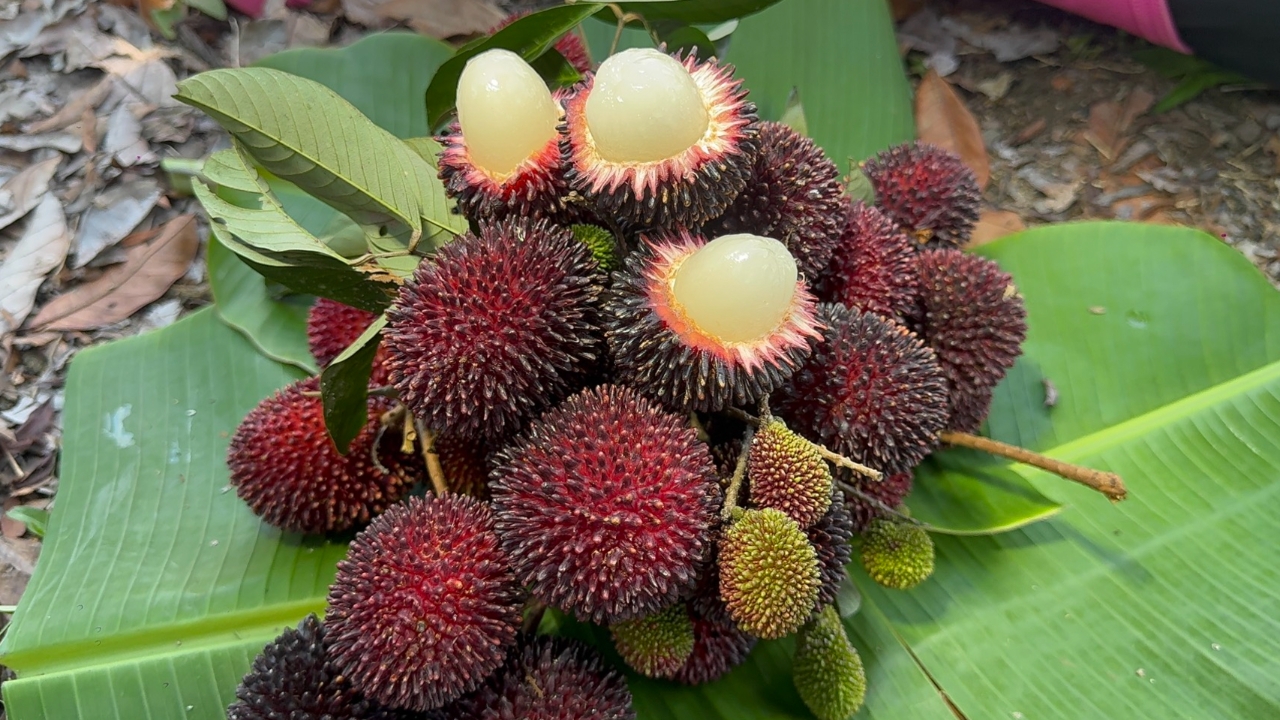
Introducing the "Pulasan Rambutan" or "Pulasan," a rare exotic fruit hard to find in Thailand. Each fruit offers a combined taste of rambutan and lychee, with harvests occurring only once a year.
On 22 Jul 2026 GMT+7, reporters introduced this rare fruit seldom found in Thailand, known as "Pulasan Rambutan," "short-spined rambutan," or "wild rambutan." Resembling rambutan, it originates from Malaysia where it is called "Pulasan." Some locals have started cultivating it in southern Thailand, though it remains uncommon.

The Pulasan Rambutan thrives in humid, watery environments. Many wonder why it is named Pulasan Rambutan: because a single fruit combines the taste and texture of both rambutan and lychee. It is mildly sweet without a harsh throat sensation and offers a refreshing coolness, with crisp, easily separable flesh like rambutan and juiciness similar to lychee.

The Pulasan Rambutan has larger leaves than the local Rambutan, resembling those of the longkong fruit. It has single, unlobed leaves. Flowers appear in creamy white clusters at branch tips, similar to longan flowers. The fruit is oval to nearly round, densely covered with short, firm spines. Immature fruit is green; ripe fruit is deep red with yellowish or black hues. Inside, seeds are covered by white pulp. A well-developed fruit weighs about 9 to 10 pieces per kilogram.

Moreover, once cut or harvested, Pulasan Rambutan fruits remain fresh for a long time without spoiling. In fact, their flesh becomes juicier and their lychee flavor intensifies the longer they are stored.

The flowers and fruits appear from about May to July annually. Pulasan Rambutan trees take roughly three years to begin producing modest yields, reaching full maturity at six years or older. The harvest is abundant but occurs only once per year.

Ms. Puang Makpalang, 58, owner of Pulasan Rambutan trees interplanted in a rambutan orchard, shared that the fruit originates from Malaysia and grows wild there. Her father propagated it by grafting and planted around ten trees over 20 years ago. He once sold them at the Su-ngai Kolok market and shared samples locally. The fruit has even been presented to Her Royal Highness Princess Maha Chakri Sirindhorn. This season is the Pulasan Rambutan season, with juicy, sweet, and crisp flesh—like tasting rambutan and lychee simultaneously. Pulasan Rambutan, or Pulasan, can be stored up to two weeks without spoilage.


