

The "Phichit Sandbox" has been launched as a prototype for low-carbon wet rice fields to upgrade Thailand’s entire rice production system and to create additional income opportunities from carbon credits in the future, thereby enhancing competitiveness in the global market.
Siam Kubota Corporation Limited and the Rice Department of the Ministry of Agriculture and Cooperatives have introduced the "Phichit Sandbox," a model for low-carbon wet rice fields that guides Thai farmers to transition from broadcast seeding to environmentally friendly alternate wetting and drying cultivation methods. This initiative aims to generate additional income from future carbon credits, promoting practical low-carbon rice production in line with the Net Zero 2050 goal and the government’s one million rai low-carbon rice policy. Phichit is designated as the starting point for upgrading Thailand’s rice system, targeting 5,000 rai of low-carbon wet rice fields while advancing environmental, economic, and farmer livelihood dimensions to sustainably enhance Thailand’s global market competitiveness.
Punna Wongsanasanirakul, Assistant Managing Director and General Manager of Sales, Marketing, and Services at Siam Kubota Corporation Limited, stated that advancing the agricultural sector requires simultaneous progress in production efficiency, farmer income, and environmental sustainability. The launch of the Phichit Sandbox as a low-carbon wet rice prototype demonstrates that low-carbon rice production is feasible and scalable nationwide, enabling Thai rice to keep pace with future global changes. It also reflects Siam Kubota’s role as a private sector partner committed to concretely supporting the government’s "One Million Rai Low-Carbon Rice" policy under the Ministry of Agriculture and Cooperatives.

Currently, agriculture accounts for 15% of greenhouse gas emissions, approximately 56.8 million tons of carbon. Siam Kubota believes this project will elevate Thai rice by transitioning from traditional rice production to environmentally friendly cultivation, ensuring farmer security and enhancing the country’s long-term competitiveness. The project focuses on selecting scalable areas, with Phichit Province being a key rice-growing region equipped with suitable geography, irrigation infrastructure, and farmer networks.
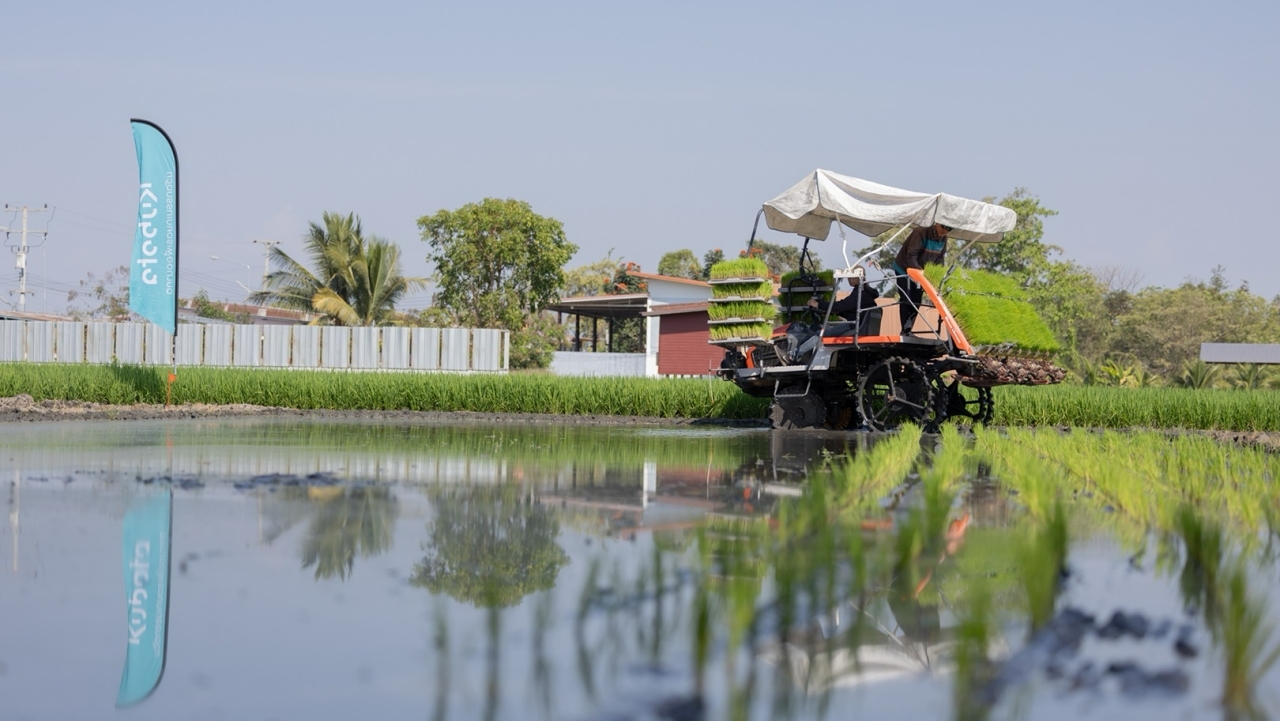
Low-carbon wet rice farming involves changing mindset and production methods, with the core being the promotion of alternate wetting and drying (AWD) to reduce continuous waterlogging and methane emissions from soil. Water management and the use of agricultural machinery such as rice transplanters must be improved alongside knowledge advancement. Promoting low-carbon wet rice farming is not only about environmental concerns but also about income, security, and the future of agriculture.

Farmers participating in the project will receive systematic knowledge, technology, and support to access the low-carbon rice market, linking to certification systems and future carbon credits. This transforms rice farmers into contributors to reducing global warming and provides a sustainable solution to climate change challenges. Major rice-exporting countries now emphasize environmentally conscious farming, presenting Thailand with competition challenges in the global rice market. Therefore, Thailand must move beyond quality and quantity to address environmental issues, aiming for Net Zero by 2050 and advancing Phichit as a "Model Low-Carbon Rice Province" covering over 5,000 rai, with plans to expand nationwide.
The Rice Department has outlined strategies to promote quality rice by reducing costs, increasing yield per rai, and improving rice quality. For low-carbon rice, they have prepared one million rai in community rice centers within irrigation areas to promote AWD to reduce greenhouse gas emissions, chemical fertilizers, and the use of bio-products and microorganisms to decompose rice stubble and straw. This also reduces air pollution and PM 2.5 smog. Policies include establishing certification systems and low-carbon rice labels. Additionally, this approach can reduce rice cultivation costs by at least 10% and increase yields by 20%. Low-carbon rice can command a premium price increase of about 10–20%, creating additional income opportunities for farmers. Measures also strengthen community rice centers and cooperatives to reduce system-wide costs from production through processing to marketing, ensuring long-term benefits for farmers.

Punna added that Phichit Sandbox serves as a model province for low-carbon wet rice farming. The Rice Department, through the Phichit Rice Seed Center, has selected community rice centers to participate and help define activities to transfer low-carbon production technologies and create demonstration plots. The Rice Department supports networks of community rice centers and lead farmers using pilot areas before nationwide expansion. It also transfers knowledge on quality seed production using wet rice methods and low-carbon rice practices to participating community rice centers and interested farmers, while connecting them to premium markets to increase value and income for farmers.