

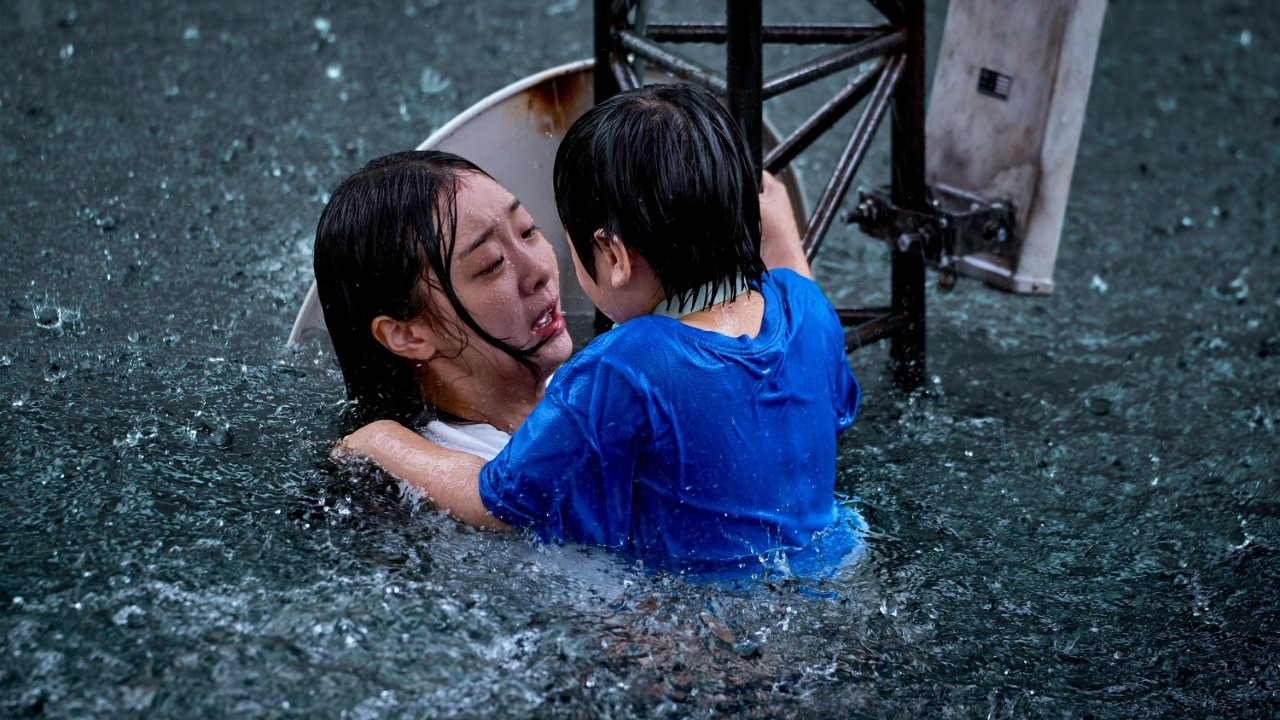
New Korean film The Great Flood (2025) available with Thai dubbing and subtitles, which can be watched online on Netflix. It tells the story of a global flood disaster that has sparked online discussions about its plot, reviews, and ending spoilers. Thairath Online has summarized what the true core message of the Korean film The Great Flood really is. (For those who want to read spoilers of The Great Flood)
The Great Flood is a Korean Netflix film that tells the story of a world disaster when a meteor strikes Earth, causing polar ice to melt and resulting in a sudden, massive flood that inundates cities worldwide. The floodwaters rise to cover condominium buildings dozens of stories high, where Dr. Anna (played by Kim Da-mi), a scientist living with her young son, Jae-in (played by Kwon Eun-sung).
They struggle to survive, receiving help from a security officer from a company who wants to recruit her for a mission to evacuate and save humanity. Dr. Anna is a key researcher developing AI technology crucial for human survival.
She must take her son to the rooftop to be airlifted by helicopter to a shelter, but they face severe flood obstacles along the way. She gradually uncovers truths about the project she is researching, revealing that The Great Flood is not just a typical disaster film but contains symbolic elements for viewers to interpret, blending sci-fi and dystopian themes.

Many viewers may feel confused by the storyline in The Great Flood due to some looping scenes that cause considerable confusion. The main theme presents the concept of artificial intelligence (AI) through a drama set against a global flood backdrop. In fact, Dr. Anna's research team’s main task is to develop AI emotions that realistically mimic human feelings, which involves training AI (Train AI).
The question is how to make AI truly possess emotions and feelings like humans. Humans accumulate what is called experience through life’s joys and sorrows, memories of happiness and suffering, which blend into life experiences enabling decision-making and problem-solving based on prior data and experiences.
Therefore, Dr. Anna synthesizes and replicates these feelings within AI by repeatedly looping experiments during her mission to find her son, aiming to develop AI that can emulate human emotions and feelings. Her son is a synthetic human developed through AI training based on their mother-son bond. The number of experiment loops can be observed through the numbers on the heroine’s shirt.

In summary, the Korean film The Great Flood (2025) features scenes and a storyline portraying repeated event loops to simulate different decisions. This is part of AI research and development (training AI) to give artificial intelligence emotions and feelings as close to humans as possible.