

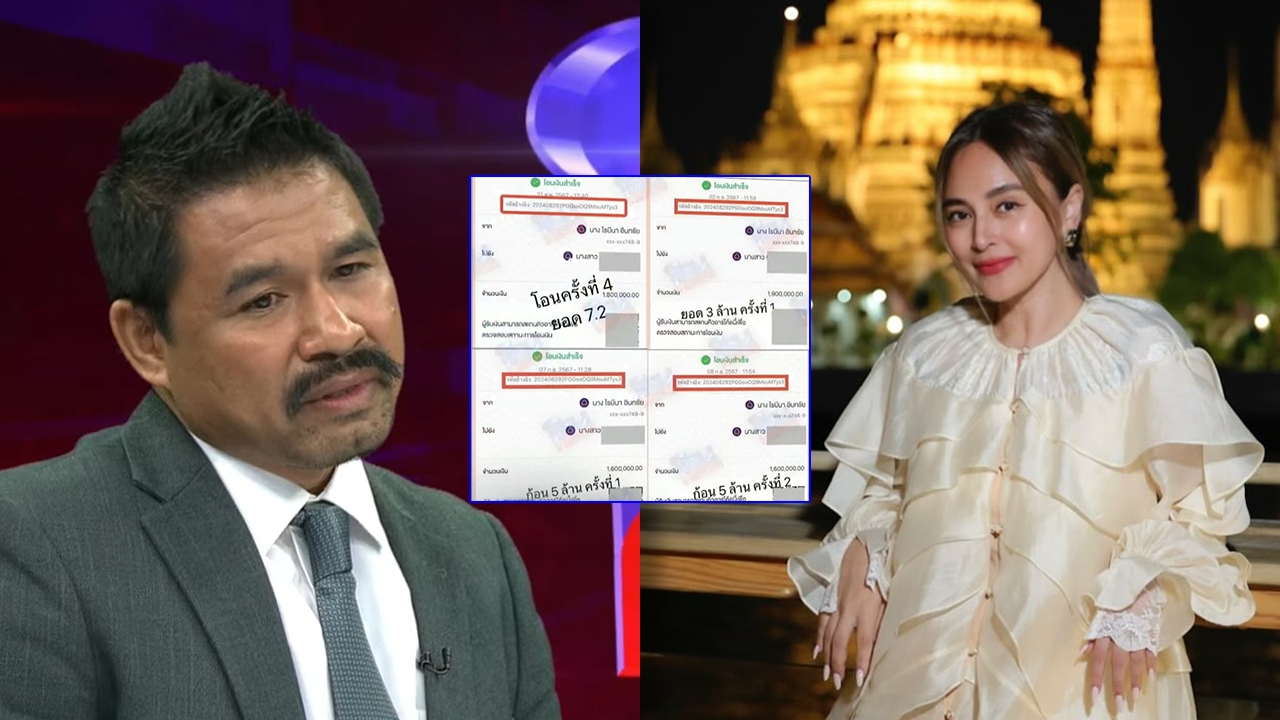
The "Hon Krasae" program on Channel 3 interviewed Lawyer Sawat Charoenphon the legal representative of Kaopod Smithinan, a female entrepreneur who is a victim in the case, Nana Raibina. At one point, Lawyer Sawat spoke about the money transfer slips, saying he had spoken with a person named on Nana’s slips. They arranged to meet near Nonthaburi, where the person brought all the statements.

They checked and cross-checked the dates but found none matching. At that time, he did not suspect anything suspicious and asked if they had all the statements. The person said yes. But upon closer inspection, some codes looked similar, so he believed they might be. After yesterday’s program with Noom, he summarized and found all reference numbers were identical on every slip, but the amounts and dates did not match.
Regarding this issue, Lawyer Saiyut Pengboonchu, Nana’s lawyer, responded that in a defense, it depends on the person providing the money whether by loan or investment. They want something in return, like interest or business investment. If it’s a business investment, loan contracts must be seen. But if it is a real loan, Nana would not face prosecution because the money was jointly used to lend at excessive interest rates, which is illegal. Therefore, they are not legal victims, as the purpose violates the law. Simply agreeing to lend at excessive interest is already an offense, so they cannot be considered victims or prosecuted.
The second angle is whether they trusted a third party Nana cited or trusted Nana herself. If they trusted Nana, the loan was made to her. Because the debt is not with Nana directly, but with the borrower. From this perspective, lenders receive interest and seek further gains, so they want interest; they are eager to get money urgently.

Noom summarized, saying simply that Lawyer Saiyut would defend the case claiming they knew the money was for lending at interest. So this implies collusion with Nana’s side in lending at interest, right? Lawyer Saiyut said, "I raise this as a point to consider." Noom concluded, "You see it as knowingly lending money at interest and receiving interest. Thus, you knew all along and cannot claim at first that Nana received the money to invest. It must be joint action." Lawyer Saiyut said the details depend on how it was done and that is the angle he will fight on.
Lawyer Kaew, Dr. Monchai Jongkairatkul, said that from their perspective, that is correct and depends on their side. But reasonable people should ask why the lenders gave the money. They believed in documents showing the loans were real. These are victims who were deceived and considered investors. Lawyer Saiyut responded that what Lawyer Kaew said is not exactly correct because the transfers were made to the lenders after the original transfer. It was like a joint investment, half each. They forged slips to fake transfers.
Noom asked if he admits the slips are fake. Lawyer Saiyut said the slips are obviously fake—twenty slips with the same number, and no transfers were found, so they are fake. But why forge? To obtain loans. There is only one intention. Noom summarized that Lawyer Saiyut fights with the sole intention of loaning money. Lawyer Saiyut said the intention was to borrow money, to lure the money. Noom summarized from the victim’s side that this side must fight on the basis that the money was not for investment.

Lawyer Sawat said the argument between Lawyer Kaew and Lawyer Saiyut is part of the legal process to fight the case in court. But today, they are stating facts to inform society clearly about the behavior.
Noom asked Lawyer Saiyut about the reasons for forging. Lawyer Saiyut said there are two to three reasons: forging to delay payment; secondly, when Nana arranged for the payer to lend money onward, the payer transferred half the amount, so Nana had to transfer half onward as well. Therefore, the slips were forged to show the transfers had been made. However, the forging was done after receiving money or before receiving money from the owner, which is a detail he will testify about along with chat evidence.
Noom summarized that Lawyer Saiyut’s side says the forgery was to delay payment, but Lawyer Sawat says it was to deceive by faking onward transfers, so that new transfers would be made and Nana could continue onward transfers. From Lawyer Saiyut’s side, these forged slips came later, but Lawyer Sawat says no, the forgery dates back to the initial deception.

Lawyer Saiyut said that just looking at this alone cannot tell the whole story; they must check the exact times the victims transferred money and when Nana sent forged slips back, including times and seconds, to see which slips were fraudulent and what money was received. Lawyer Kaew added there is also the issue of forged documents. Lawyer Saiyut said the forgery was to delay debt payments. He understands Lawyer Sawat’s comments apply only to Kaopod’s case, but Nana forged slips with other groups as well, as there are many victims. Chats with forged slips were sent to delay payments.
. Click to readEntertainment news. Additional information