

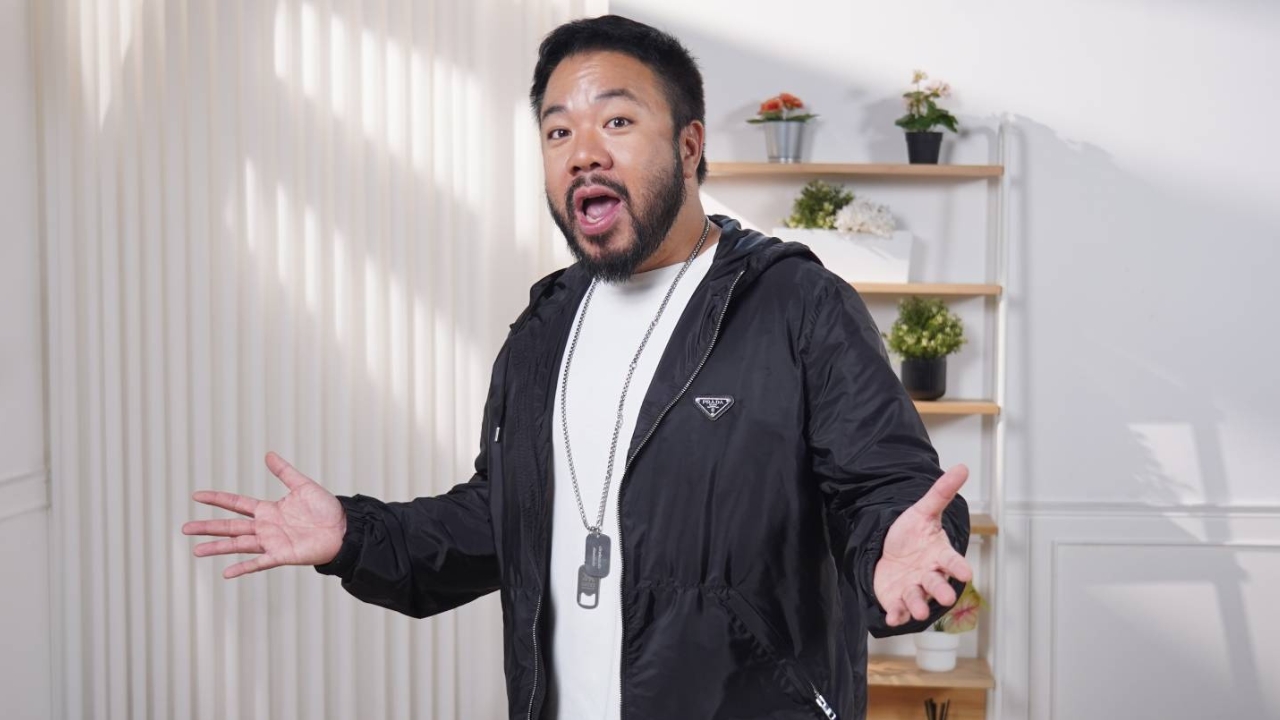
"Talk with Boom" this week reveals another side of "DJ Poom" From a diplomat's child raised abroad to a bold VJ once overwhelmed by nationwide drama, he recounts working seven days a week for 10 years without stopping, damaging his voice so badly he had to be hospitalized for steroid injections to continue performing. He reveals the turning point that ended his fear of drama and how he discovered his ocean in the content world that led to 1,000 episodes and 1 billion views, and the day he could honestly say, "I no longer have to pretend my life is perfect."
How did you become a DJ?
"I cut the cord into the entertainment industry about 23 years ago. This year I'm 46, so that was when I was 23. I had finished school and been in Thailand for about two years. When I was seven, my father was a diplomat, so our family moved to Austria when I was seven.
My father was in Austria for three years and then transferred to England as a diplomatic assistant, not an ambassador. I lived in England from age 10 until finishing school and university there. My father stayed about three or four years, then we returned to Thailand. I attended boarding school and university in England and came back to Thailand at 21."
What did you do from age 21 to 23 before becoming a DJ?
"I helped my mother. I graduated in environmental science. It was a booming field abroad, but I remember my teachers saying in Europe there were many jobs, but in Asia it was still lagging about 10 years behind. So I chose a field that was a bit too advanced for the region."
Did you like it at the time?
"No, I wasn’t interested. During breaks, I interned in this field at Volvo Thailand, which focused on environmental issues, but it didn’t suit me. So I looked for something else. While searching, my mother asked me to help with recruitment. She ran an English language school, and I became a camp leader—like an assistant teacher—leading kids in holiday camps. I really enjoyed spending time with children."
At first, I never thought I’d like kids. When you're young, you imagine who you are or want to be. I want to tell many people who don't yet have a passion or goal, if you don’t know yet, try many things. I never expected to like teaching because I thought I was a rebellious kid who wouldn't enjoy it.
But I found I really liked that work. It led to entering an MTV contest. I had just been heartbroken by a lounge kid. Back then, as a young man fresh from England,
I was like a foreign kid driving a Benz sports car, fit with big six-pack abs, thinking I was so cool. I fell in love with a girl and wanted to provide stability, but I couldn't change her life or take care of her. In the end, I had nothing. I was a foolish kid with everything compared to others my age.
But I wasn’t a man, so I realized I was mistaken. I thought I was cool and smart, but I was a foolish kid spending my parents’ money. It was time to become your own man. I broke up with her and called to say I would try entering a contest.
My first stage was the Channel VJ Search. Competing against 2,000-3,000 people, I wondered where I'd rank. I got eliminated in the top 20. Three months later, MTV held the first MTV VJ Hunt in Thailand. I applied lessons from Channel V and won. That was my cutting the cord moment. Back then, people called me VJ Poom before DJ Poom. VJ meant video jockey controlling music videos.

What was it like when you had the most work?
"After becoming a VJ for a while, I initially got many offers but didn't accept outside work because I was protective of VJ duties. I started with no fame, and for 2-3 months, I declined outside jobs since clients wanted famous VJs like Woody, who was a senior there.
Back then, all VJs were superstars, so clients preferred well-known faces. My first gigs were small, like buffalo fights in Suphanburi, or similar local events. I regretted starting late in this industry; starting earlier would have been better.
But I can’t turn back time. What I can do is work hard. For example, there are 52 weekends a year when others rest. If you work weekends, that’s 104 days. If you don’t stop at New Year’s or Songkran holidays, you can add 5-6 or 4-5 days more. Working nonstop, you can catch up in two years.
This mindset is about catching up and overtaking through hard work without stopping. Songkran was exhausting because I had to maintain a slim figure to perform on stage at Route 66 every year, where I had to show my physique. I had to eat very little, stand on stage all day, get sprayed with water, and use my voice for 6-7 days straight.
Afterward, there was another event called Wan Lai. By day 2 or 3, I’d be knocked out, losing my voice, unable to speak, then hospitalized for steroid injections to open my vocal cords and back on stage the next day. This went on without a break for 10 years, working 7 days a week. My mindset then was to build myself as big as possible.
My live MTV show ran Monday to Friday. I also did events and appearances occasionally. Every Saturday morning I hosted Virgin Radio, and every Sunday live on Nation TV. That was my fixed schedule. One New Year’s Day, DJ Petch had been hosting for 5-6 months and had a fanbase.
Lina, Virgin Radio’s boss, told me we had good chemistry and suggested co-hosting New Year's countdown for two hours. It was our first time hosting together. At that time, I was known as the 'sharp-tongued VJ' and Petchja as the 'energetic DJ'. They saw potential in us but wanted us to stay within limits.
I remember on New Year’s Eve, the sound effect machine broke, and I panicked, saying, 'Oh no, this won’t be fun. What now?' We ran to the kitchen looking for pots and spatulas, turning it into a café comedy. It was chaotic and fun, and our banter was sharp. Suddenly, the ratings soared to surprising highs unseen before. They realized we had potential as a duo if we could be kept in check."
When did you start as a content creator?
"It began unknowingly when Instagram and Facebook started gaining popularity. I began building my social and personal branding by posting photos without thinking it could become a career.
At events, people asked me to post about their events on Instagram. I sometimes worked as an MC or guest or celebrity attending events. Around 15-16 years ago, simply appearing at an event paid about 10,000-20,000 baht depending on the job.
One time, I was told I didn’t need to attend but just promote the event on Instagram for 30,000 baht. I thought, 'What? A post is worth more than my life?' That was my mindset then. This was early in the era when celebrities started business.
At first, celebrities partnered with businesspeople, like doctors offering collagen to stars. I thought about using social platforms to market products. Back then, a sponsored post could pay 50,000 baht.
So I figured if I did personal business, my market value was 50,000 baht per post. Posting once a week would be 200,000 baht a month, or 2.4 million baht a year. That’s a big market value. So I tried making my first product: DJ Poom’s clean food."
Did you do it yourself or have a team?
"I worked with my younger brother. I did it myself for about two weeks, facing many problems but learning a lot. It was my first time running a business. DJ Poom Menu started with clean food recipes I created.
At first, marketing was just holding the food box and giving a thumbs up. Sales were good. Later, many celebrities and influencers began online marketing, leading to an overload of ads.
People got bored of ads, so we had to change strategies. We added testimonials like, 'I lost 4 kg in 2 weeks,' which helped sales. Then marketing needed to evolve again.
I started making cooking videos at home: 'Today I'll make oil-free fried rice,' 'Now frying chicken without oil,' 'Making oil-free omelettes.' I emphasized clean food’s health benefits. I taught for free so people could learn and try, but also offered products for those who couldn’t cook themselves."
Are the followers the same as before?
"When I started Instagram, I was hosting Route 66 every Songkran, showing my six-pack. I got very into health and bought online coaching from abroad. Back then, few Thais had six-packs because nutrition and exercise knowledge was scarce.
I posted on IG inviting people to meet me at Starbucks in Paragon. The place was packed. Then I held seminars for free in a large space given by a fan who owned a club in Thonglor. People came to listen.
That made me a fitness idol. I also did a show with VRZO called What the Fat, educating about exercise and six-packs. So I gained many followers interested in health and wellness. Since I wanted to start a business related to my passion and knowledge, I chose clean food.
My followers included many health and wellness fans, so it fit well. Regarding business, I must say I’m a poor businessman.
Many see me as successful, but that’s not true. Before business, I had money, a Lamborghini, a yacht—money from entertainment after 10+ years of nonstop work. I let my brother manage the business. He studied business and in meetings talked about cutting costs, stock management, and electricity use. I was confused and asked if there was anything I could do to help.
He said just do marketing as best you can. My marketing videos on Instagram were only one minute long, which wasn’t enough to show cooking steps fully. There was no voice-over, just images, so it lacked emotion.
I hired a producer to film and edit longer videos, 5-7 minutes, posted on YouTube. The first videos over 10 years ago were cooking clean food at home. At first, the show had no name because I couldn’t think of one. Later, I got bored and started going to markets to buy ingredients and cook. I felt like a real cook, which inspired the brand name 'Kon Hua Krua' (Head Chef), reflecting that I’m a cook but also a bit edgy. That’s how it started."
When did you realize content creation became your main career?
"I was confused at first because I did it just to market my brand. But what I gained was discovering my true passion. After being behind the camera for over 10 years, I didn’t know what experience I had accumulated. Producing my own content helped me understand everything—presentation, pacing, editing, shots.
There’s a quote by Einstein: 'If you judge a fish by its ability to climb a tree, it will live its whole life believing it is stupid.' I was the fish trying to climb a tree—business, management, accounting—I didn’t get it.
Then when I found content creating, I was like a fish finding the ocean. I was happy making content, not knowing it could be a career, just enjoying it. Despite years in the industry, I wasn’t popular; I had more haters than fans and faced lots of drama, though I never meant harm.
Whatever I did, rumors would attack me unfairly. But with 'Kon Hua Krua,' people saw the real me. After 1,000 episodes and a billion views, my audience knows who I am. I’m glad to have those who truly understand me.
Also, without realizing, I made a lot of money. I remember offering my producer to work without salary and share revenue, but he refused because there was no income at first. I worked blindly for two years without knowing.
Later, reviewing my bank balance, I found over two million baht saved. Sponsors came in as I became famous, so I stopped event work. I earned more from filming shows—nearly 100,000 baht per episode. Just monthly views earned me 800,000-900,000 baht. So I decided to focus on what I love most."
What is your mindset toward drama?
"Now, I’m not afraid of drama at all. At first, it hurt me deeply. I’d never experienced such attacks that hurt my spirit. Suddenly, news misrepresented me, and the whole country misunderstood. When I explained, no one cared because it didn’t engage.
I tried to clarify my intentions, but people still misunderstood. It was painful with much opposition. Back then, I was a small voice. Big pages with millions of followers attacked me, and millions came. When I asked to explain, only 3,000 watched. But now, my followers understand me and know who I am. My voice is big enough to respond.
Pages that once exploited my name daily now hesitate to mention me. Before, they wanted engagement regardless of truth. Now I have a loyal, caring fanbase protecting me. Ultimately, it depends on our mindset. I understand drama better now. I can tell if it’s big or small by my phone’s notifications.
If I wake up making coffee and my phone rings with drama alerts, I won’t answer. I put it down, drink beer, play soccer with friends. Don’t get caught up or feed the fire. When emotions cool, check what happened later in the day.
Then I calmly assess: Is it legal or illegal? If legal, no worries. Wait for a day, then respond. Most drama is people saying what they want to hear. So I tell friends, it’s just that—people not understanding.
Once, I was lucky to be Thai and made news about Thai food joom-jum, but some misunderstood my words. I apologized publicly, and the drama ended. That’s it. Emotions don’t help. Why argue with those who don’t understand? It’s a waste of time. I say sorry if my communication caused misunderstandings and promise to do better next time."
How do you advise other influencers unfamiliar with drama?

"I tell them to do what I do: separate people into two groups—those who understand and those who don’t. Don’t try to change the latter. The world is more divided than ever.
Today, you don’t get neutral news because algorithms feed you only what you believe. Before, newspapers showed both sides. Now, if you invest in gold, you get news that gold will rise; others get news it will fall. People’s thoughts are polarized and manipulated by AI and algorithms."
How do you live with this?
"You must be mindful. Understand that people think differently 100%. Don’t assume your view is 100% right. Culture, upbringing, beliefs vary greatly. Be open but, most importantly, respect different views. Without respect, we can’t coexist."
Besides food, what other businesses have you done?
"DJ Poom Menu clean food; then Zerocal, a healthy zero-calorie, sugar-free drink; Zubzero hair spray; Sinim activewear; Khkshoes rubber footwear; and real estate. I also use media marketing experience to work with many brands. Having sold small items, why not sell big? So I ventured into real estate."
Why real estate?
"My brother and relatives started projects together, already successful with many projects. They brought my brother in, but he wasn’t confident in marketing, so he brought me to help.
We worked together. The first project sold out within a week. Then we split to do separate projects without expert relatives guiding us. I don’t understand management or design, so I let my brother handle that, while I focus on marketing strategy. We set a roadmap and launched full marketing."
What do you enjoy about it?
"I enjoy creating content, brainstorming viral ideas. My main job is making clips go viral because viral content can sell products. Sometimes great ad films look beautiful but don’t get views or shares, so the idea is wasted.
Some clips are short, funny 6-7 second videos that take 6-7 takes to shoot and precise editing cutting 0.1 seconds here or there. It’s an art, like a chef crafting the perfect dish."
How do you strengthen your mind to not fear new projects?
"I’m not afraid of failure at all, 0%. I start every project, except real estate, with little capital. Shoes started with 200,000-300,000 baht; Poom Menu with 100,000-200,000 baht. I think if you want to learn business, spend 2-3 years and hundreds of thousands on university to gain deep knowledge.
Nowadays, online businesses don’t need to start big. I remember when opening Poom Menu restaurant, my friend said a DJ like me should open a big shop in Thonglor with multiple units to reflect the brand image. I said no, I cooked 10 boxes a day in my kitchen, then 20, then 30, and sales grew to 300-400 boxes daily. Grow with your experience and knowledge. Start small. If it doesn’t work, stop and don’t force it."
What if you fear losing face more than money?
"I have nothing to lose (laughs). My brand’s strength is being 100% myself. Earlier shows had luxury brands because young me wanted social acceptance and to appear successful. Now I feel lighter because I can wake up messy, drooling, turn on the camera, then shower—no embarrassment.
People see the real me in all dimensions and know who I am. I never feel shame, failure, or embarrassment. Poom Menu just failed recently, but after 10 years, that’s natural. Accepting reality makes people accept your sincerity. I’m not a skilled businessman but enjoy building brands and trying new things."
Once you accept yourself, others will accept you?
"Exactly. It’s crucial. Many suffer depression, stress, and pressure because they compare themselves to social media’s perfect and wealthy images. Social media is just social media. Everyone struggles to be there. If your lifestyle doesn’t match real life, you’ll be exhausted forever. Accepting yourself lets you grow fastest."
What are your three essential life principles?
"For business, one, have a great product that truly helps people’s lives. Two, have a strong team with good mindset, discipline, and responsibility. If your product and team are great, you can build your brand steadily. For personal life, discipline is key, more than passion. When I was young, I felt passionate one day and none the next, but discipline means doing what you dislike daily as if you love it.
That’s a true champion. Two, knowledge is essential. If you want to excel, learn extensively and practice until you’re an expert. Money and opportunities will follow. Do something 10 times, then 100, then 1,000 to master it.
Three is a good mindset. Many give up or fear quickly, stuck in self-limiting beliefs. With positivity, you won’t feel discouraged. If you want this path, just post 2-3 clips daily and learn from it.
Within a year, you’ll be famous. You’ll improve by adjusting from experience, which is the best teacher. Experience won’t stop teaching until you understand; if not, it keeps hitting you. So if you want fame, keep going."
Click to read
Entertainment newsMore