

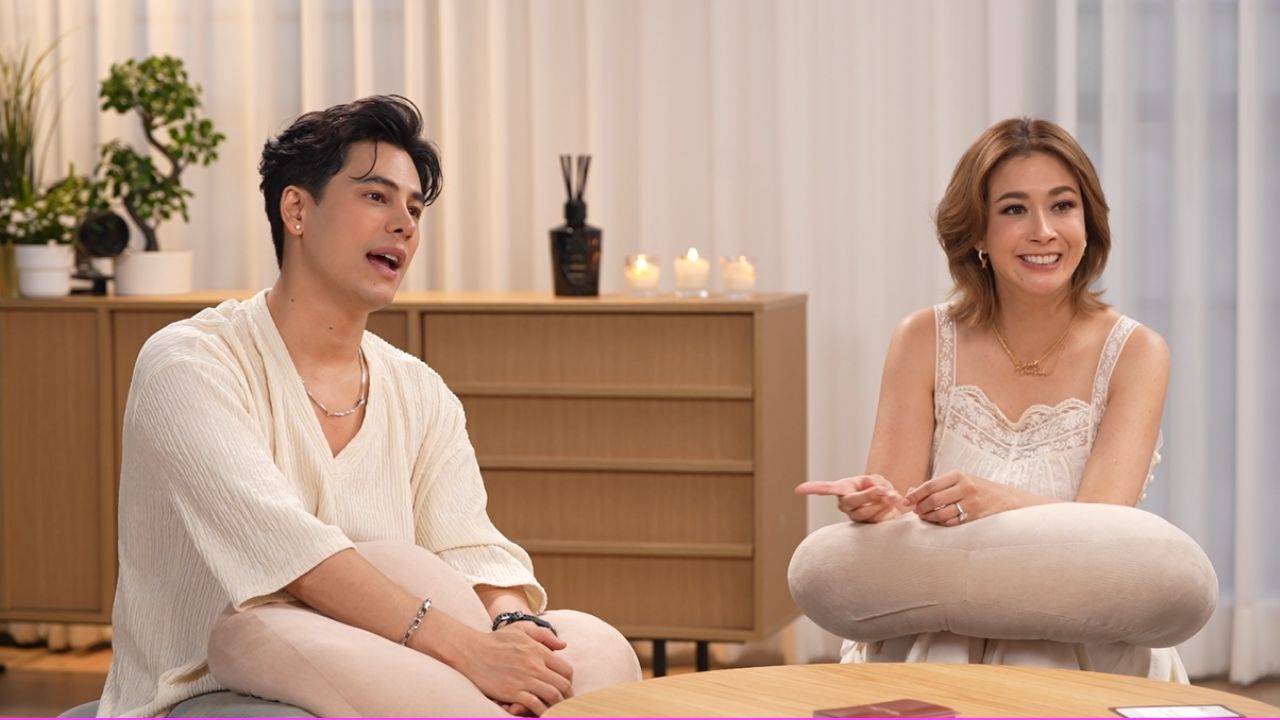
21 years not just of love but of mutual compromise. Cee Siwat Chotchaicharin and Amy Klinpratum They opened up about the realities of married life, which is not always perfect, on the show “WandOland,” revealing a relationship that sets aside ego and chooses to adjust to each other, truly understanding the meaning of 'partner.' Their love evolved from expecting something to giving without expecting anything in return.

Cee and Amy have been together for a marathon 21 years?
Cee Siwat: Isn’t it amazing that we’ve lasted 21 years? (laughs) It’s a very unusual combination. It’s a love that, after a while, can be annoying, yet without it, it feels like death. So, we realize this is real life. We found My Soulmate—someone who shares some similarities but also has some extreme differences.
But now, after 21 years, we’ve journeyed so far that just looking at each other, we understand. The heart muscle is the only muscle without logic; some things are just emotional. So no need for words or reason—just listening is enough. If we keep quiet, everything’s fine.
Has this relationship made you more yourself or more adaptable?
Cee Siwat: The clear answer after 21 years is that I have definitely adapted more. Today, I’m very proud of understanding the meaning of 'partner' or 'life partner.' For a man to vow to spend his life with someone, he must not make himself the center of the universe. I believe humans can’t truly change; you remain who you are.
But if you truly intend to spend your life with someone until your last breath, you have to adjust certain things. I’m the kind of person who, after using the bathroom, folds my underwear into a figure-eight and leaves it there. That’s living alone. But with a partner, if they see that, why not tidy it up? If you bring yourself to the relationship, why not just pick it up? It’s a small thing, just a moment in the shower, but it can become an issue.
If you live with someone else and they don’t like something, why not change? It’s not a big deal. So, is refusing to change a statement of your true self, or just an ego declaration? Today, I feel this relationship is one where I adapt more.
At what point did you change your mind about the need to adapt?
Cee Siwat: The clearest moment was when my mother passed away. I realized that on that day, nothing is worth compromising more than time. Losing someone you love makes you truly understand not to waste time on things that don’t benefit you.
I felt this person has been with me through good and bad, seen everything, yet stayed. So what more could I want? That day, I decided not to lose her. It was time to adjust. If you’re committed to living with someone, you have to be water, not the container.
Amy Klinpratum: I’ve become more myself. Before, in relationships, I was always trying to please the other person. But with Cee, he makes me feel fully myself, and he still loves and likes me. It took time; I only really became myself after marriage. I’ve never met a man like Cee—he doesn’t beg, doesn’t care, and I wanted to win, to change him.
But living together isn’t about winning. He made me adjust even when I didn’t realize it. I have a big ego, thinking, 'I’m like this; you have to love me as I am.' But being too much myself made him uncomfortable. I kept suppressing myself. Now, it feels comfortable; I’m myself. If he wants to remind me, he dares to. I feel I’m more myself now.
At the same time, I do adjust. Before, I would force myself to adjust for his happiness but wasn’t happy myself. Now, I adjust in balance. I’m okay adjusting, but if it’s too much, I say, 'This is all I can do.' Over time, trying more becomes easier. What I thought was adjustment wasn’t real—it was just to show I was adjusting. Now, it’s genuine adjustment.

If there’s one reason that might make you leave this relationship, what would it be?
Amy Klinpratum: If he stopped loving me—that’s the only reason. If love and care remain, there might be ups and downs or mistakes, but if he still loves me, we can go on. Someone who’s lost love won’t tolerate anything, gets annoyed easily, we get irritated, don’t forgive, and live together with annoyance.
But if we love, we keep trying to stay together, adjusting and seeking solutions. If someone loses love, they stop trying and don’t care anymore. We’ve talked that if that day comes, if love is truly gone, don’t force it—it’s a waste of time. But if we find a way to go together, we’ll work on it. When love remains, both care and try together.
If one person loses love while the other still loves, the latter ends up always pleasing, doing good, but it’s never enough. Nowadays, people break up because patience and effort are too little. Being with someone isn’t easy; it requires effort and trying. Love means giving time and adjusting. After 20 years, we’re still adjusting, so time is needed. If love remains, anything is possible.
How does saying 'I love you' the first time compare to saying it most recently?
Amy Klinpratum: Loving someone without expecting anything in return is something I only recently understood as true love. Before, I loved someone to be loved back, did good hoping they’d reciprocate. Now, I love without expecting love back. I’m happy just to love and do things for him.
Cee Siwat: As I said, 20 years ago, I valued that phrase deeply. If it wasn’t true, I wouldn’t say it. Early on, during 1-2 years of dating, did I truly commit? No. I expected something to make her comfortable and happy, but I wasn’t 100% genuine then.
Today, I can say I have no expectations. When I say 'I love you,' it’s 100% genuine. Every morning or when I leave for work, I say to Amy, 'I love you,' and she doesn’t have to say it back. It means no matter what happens, no matter how the world falls apart, this person will always be with you. I don’t remember when I first said I love you, but love on day one and love now are completely different.
Amy Klinpratum: Sometimes I wanted him to say it, almost forcing him, but when he says it on his own, it means so much more—like with marriage. We dated for nine years but I never asked when he would marry me. If he’s ready, he’ll come himself. Everyone pressured me, 'Why aren’t you married yet? Why hasn’t Cee proposed?'
But when the time comes, I don’t want him to propose if he’s not feeling it himself. So, we never talked about marriage in nine years. I felt it meant much more if he came to me on his own, just like saying 'I love you'.
Cee Siwat: I want to tell this woman I love her. If something happens to me, if I leave this world, she must be sure that I told her I love her every day. I don’t know what will happen, but if I leave, everyone should know this man truly loved this woman.

Amy Klinpratum: People often ask if we ever get bored. We do, but we find our own ways—doing separate things and then coming back together. No one loves each other all the time. When it’s too much, I might go hang out with my friends. It doesn’t mean I don’t love him.
Before, I thought we had to do everything together, be best friends always. No, we need time apart, time with friends. He has his world, I have mine. When we come back together, we love each other. But if we’re always together, it doesn’t work for us.
Cee Siwat: We work as a team, one unit. We don’t focus on expectations because many couples give up when they don’t work as a team. Sometimes one tries to adjust while the other doesn’t, thinking, 'I’ll do this; why won’t you?' Often unspoken, it’s an expectation that the other will see and change.
When the results aren’t what you want, you feel exhausted. Why should loving someone be this hard? How long must I endure this person? How long must I keep adjusting to meet expectations?
It has to be a joint effort. You need your own way. Amy and I can’t be together all the time. She can’t drink with her husband because she finds him annoying; she needs to be with friends. I play games. We don’t have moments just drinking happily together. We find our balance along the way.

Can you share when it’s okay to go separate ways in some matters?
Amy Klinpratum: Before, I wanted to do everything with my partner—party, stay home drinking wine together. My parents enjoy each other’s company, having a glass of wine and relaxing. But I ended up drinking wine alone—that’s how I relax. I tried to make him be like that.
At first, when I went out with friends, I wanted him to come, to have fun like me, to be happy like me. But when he came and wanted to leave quickly, I felt like I was forcing him to have fun. So now, if he wants to come, he does. I never pressure him.
Click to readEntertainment news. More