

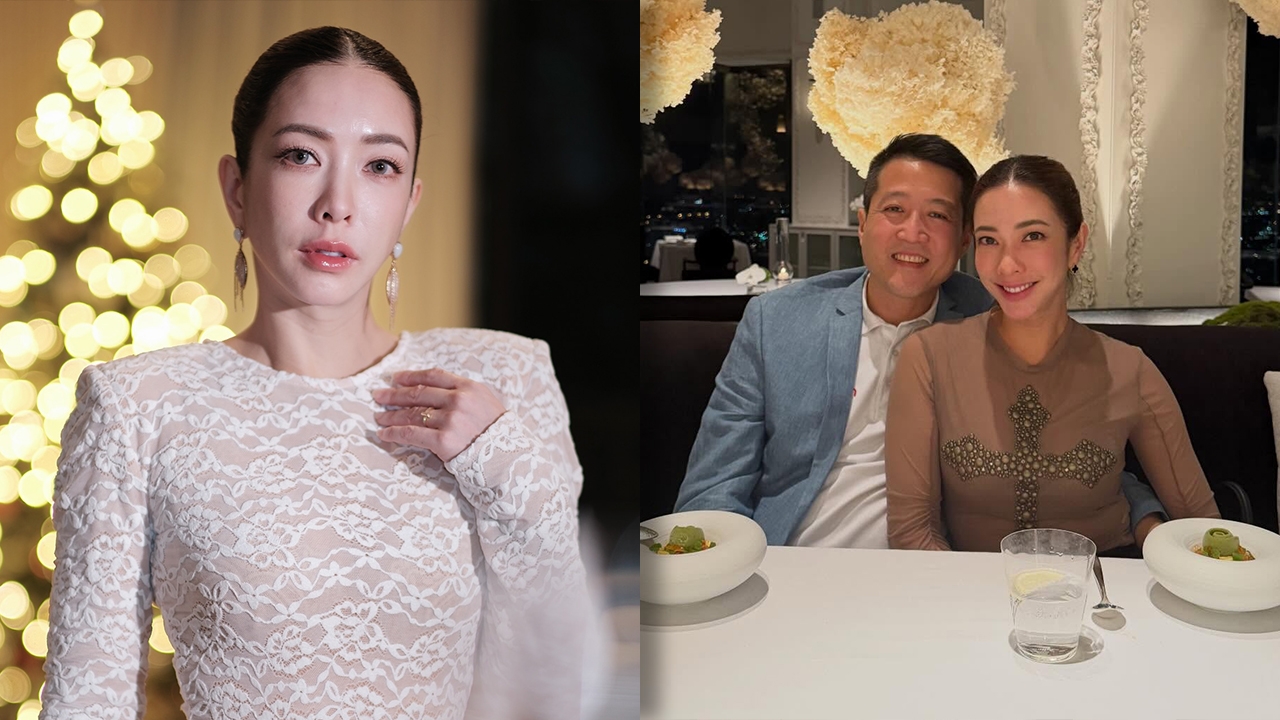
Opening Up About Her Experience with Stress Paeng Ornjira Paeng Ornjira spoke candidly about the accumulated stress that led her to break down crying during a live stream. She also brought along her young daughter, Lea, to share updates on her adorable development. Additionally, she recounted an incident where her daughter made her cry and addressed rumors about whether they were really moving the family to Singapore. This was shared on the “Kuy Zab Show” on One 31 channel, hosted by Benz Pornchita and DJ Puttichai.

At age four, Lea is developing her own personality. How would you describe it?
Paeng: She even picked out this outfit herself. In my mind, I thought, "Mom wears this much, can you match me a bit?" But when I asked her to change, she refused. She even chose her own shoes.
Has she started disliking having her photo or video taken?
Paeng: Yes. If we want to take pictures or videos of her, she won’t allow it. Many friends have also told me not to film or do certain things with her because I don’t want to stress out.
Is she more like her father or mother?
Paeng: If judging by looks, probably a mix. But personality-wise, she’s more like me.
Lea refuses to eat fruit since she was a child?
Paeng: She still doesn’t eat fruit, but she does eat vegetables. I don’t know why; she has never liked fruit for as long as she can remember. When she was little, we tried pureeing fruit for her, but once she understood, she refused to even taste it.
Could this affect her growth or nutrition?
Paeng: I asked the doctor about this. The doctor said if she eats vegetables, not eating fruit is still okay.
Are you still getting offers for work in the entertainment industry?
Paeng: Even if offers come, I’m hesitant to accept. It would mostly be reviews like this. For other types of work, I think she needs to be older because she’s not someone who enjoys it.
Previously, there was an incident where you cried during a live stream?
Paeng: That was during school break when I took my daughter on a trip. My husband had a lot of work, and I wanted to take Lea on a Disney cruise with her friends. So I decided to go alone, without a nanny. At that time, she was also fussy.
After the cruise, there were many things—my husband's work to attend to, other tasks—and it all felt overwhelming. It lasted about two weeks. It was stressful. We were supposed to stay in Singapore longer, but I asked to return earlier.
When I got back, I had some time to breathe. I did a live stream as usual, selling products. Then some comments popped up asking why I looked tired. I had been trying to hide it, not realizing how stressed I was. I tried to keep the home atmosphere positive by smiling, even though I was stressed. I didn’t realize it until someone’s question caused it to all explode.

Did the comment hit a sensitive spot?
Paeng: Yes, it felt like I hadn’t spoken about it or looked at myself to see if I was okay. When asked, I realized I was overwhelmed and couldn’t stop crying. I kept crying without thinking it was a big deal, but maybe it looked like I cried a lot, so it became an issue.
Usually, after crying, you feel better. But this time, it didn’t go away? Normally, after exercise, I would feel happy and good, but I started feeling shaky and tearful even when the wind blew. I realized I wasn’t okay.
It was accumulated stress?
Paeng: Yes, accumulated stress. Deep down, I think I’m a bit of a perfectionist. When things don’t go as planned—wanting my daughter to be happy and smiling, wanting her not to be stubborn, wanting my husband to understand, wanting to do many things—but when it doesn’t happen, I kept it all inside. So I decided to see a psychiatrist because I felt something was wrong.
Paeng: Yes. I was afraid that taking medicine would affect my stamina for running, so I didn’t take it. I tried to rest enough, got massages and therapy. After trying many approaches, I felt better and chose not to take medication. I also saw several psychotherapists, who don’t prescribe medication but listen and help identify what’s wrong.
From what you heard, it could lead to depression?
Paeng: Yes.
Did you get tested?
Paeng: They said I have anxiety but not full-blown depression. So they gave me medication to take if I couldn’t manage long-term. But since I’m still coping, I prefer not to take medicine continuously.
When you’re going through this, the support of those close to you is important?
Paeng: Yes.

Does your husband understand what you are going through?
Paeng: He doesn’t fully understand what I’m experiencing, but he gives me space. I told him that some of my stress comes from him.
I heard you took your husband to see a doctor with you—both of you together?
Paeng: After talking with psychiatrists and psychotherapists, they divided my stress into parts related to being a wife and being a mother. But some stress also came from my husband and daughter. After many talks, I realized it would help a lot if the person closest to me understood what I’m going through.
Sometimes when I’m stressed, he doesn’t understand and is confused, asking 'What’s wrong with you?' even though I know what my problem is but he doesn’t. So I thought, why not go together? At least hearing from a third party, he’d understand. Sometimes when I talk, he might see my issues as insignificant or trivial, like we see things from different perspectives. So I brought in a mediator.
So he went too?
Paeng: Yes, because his wife seemed overwhelmed.
After that, how did he change? Does he understand you better?
Paeng: It helped him understand himself too. Like, how we communicate differently—he speaks one way, I another—and why we don’t understand each other. I also understand that he comes from a different background than I do, so we value different things. Communication was difficult. I felt I was the one always giving—to my husband and daughter—but I was running out of energy. Sometimes I needed him to fill me up a bit too. When I broke down crying, I felt empty with nothing left to give to them, completely drained.
If he could 'fill you up,' could it be by giving money?
Paeng: That would be perfect. Just adding to the wallet makes me happy. No need for anything else—just transfer money and that’s it.
After bringing your husband to see the doctor, you requested some time alone for 4-5 days?
Paeng: Not exactly going away to be alone, but I had to travel abroad for some business for 4-5 days. It came at a perfect time when I was really at my limit. I boarded the plane feeling happy, like I was getting a break. While there, I exercised, ate, met friends, and shopped.
I realized what I’d been missing was my own happiness. I forgot what made me happy because I kept giving—to him, to others. I remembered that before this phase, I once asked to have just one green tea, but it wasn’t allowed.
I didn’t ask for much—I could eat with you, eat with friends, talk about work—but just one green tea, and I couldn’t get it. When I finally went alone for 3-4 days, I could have the green tea I wanted, exercise when I wanted, do what I wanted. It felt like I recharged.

Did you really get back to being yourself?
Paeng: Yes.
At that time, did the roles of wife and mother become so important that you lost yourself?
Paeng: Yes.
Ultimately, what did you learn about what to do next?
Paeng: This was what the psychotherapist told me: If you aren’t full yourself, how can you give to others? If you’re unhappy, find small sources of happiness. For me, at that time, I forgot that being with my child was happiness. The therapist asked if there’s something unrelated to my child that makes me happy.
I thought about it and realized that just listening to music or soaking in hot water made me happy. Walking alone, eating what I like—these are happiness. That day, I went home, ran hot water, soaked in the bath, listened to music, and my daughter went to play at a friend’s house. I felt so happy.
When you came back, how was Lea? How was playing with her friend? But when you felt down, you had no energy and tried to recharge, but it was forced and didn’t work. It felt like a withered pig carcass—that’s the feeling.
How are you now? Is your mental state 100% better?
Paeng: It’s better, maybe 70-80%. These things don’t fix overnight. Even if my husband goes with me to therapy, you can’t change a person in one day.
Today, there’s still irritation, dislike, and problems, but at least we have ways to solve them and a way out. My husband is kind; being Christian, he takes me to church. The church offers marriage courses, and we do everything to improve our relationship. I feel there’s a way forward.
Are you afraid of going back to the old state?
Paeng: It will come back. It’s inevitable. It’s not like once I’m strong, it won’t happen again. A marriage isn’t like dating for 1-2 years; it lasts 10-20 years. Stress will return, but on those days, we have to ask ourselves how to solve the problems again.
Are you planning to move the whole family to Singapore?
Paeng: Actually, it was my husband’s plan. He wants our child to know she is Singaporean—not just Thai—so she can learn the culture and live with her grandparents. He wanted to move when Lea turns six.
Have you tried living there yet?
Paeng: Yes, during school breaks.

How was living in Singapore?
Paeng: Lea already has allergies, like to animal fur and other things, but not severe. However, during the last two-week stay in Singapore, she suddenly developed rashes and swollen eyes and had to go to the emergency room because she couldn’t breathe. We took her to the doctor.
We noticed that every time she goes to Singapore, she has allergic reactions, though not as severe as the last time. We asked the doctor what she’s allergic to, and they said it’s a change in air quality. We don’t know exactly what it is, so we’re afraid to move there permanently. I talked with my husband, and we agreed to wait until we know more about her allergies before moving.
You mentioned an incident where your daughter made you cry?
Paeng: Disneyland seems to have a curse because every time we go, I end up crying. I never went as a child—my parents never took me—so I wanted to take my daughter. But my husband was busy with work, so I decided to take her alone.
She was almost three, and everything happened so fast during the activities. I wanted her to do everything, carrying her, running, piggyback rides. She got tired and started fussing, acting out.
We went to look at toys, and I told her that if she wanted one, she had to apologize to mommy. She refused, saying no, no apology, and we didn’t buy any. I felt sad, but she’s just a child. At that moment, exhausted and giving my all, I started tearing up and crying, though I didn’t really understand why.
Anything you want to say to your daughter?
Paeng: Love. I don’t know how to express it. I told her, Lea, Mommy loves you more than herself. I love you so much.
Click to readEntertainment NewsMore