

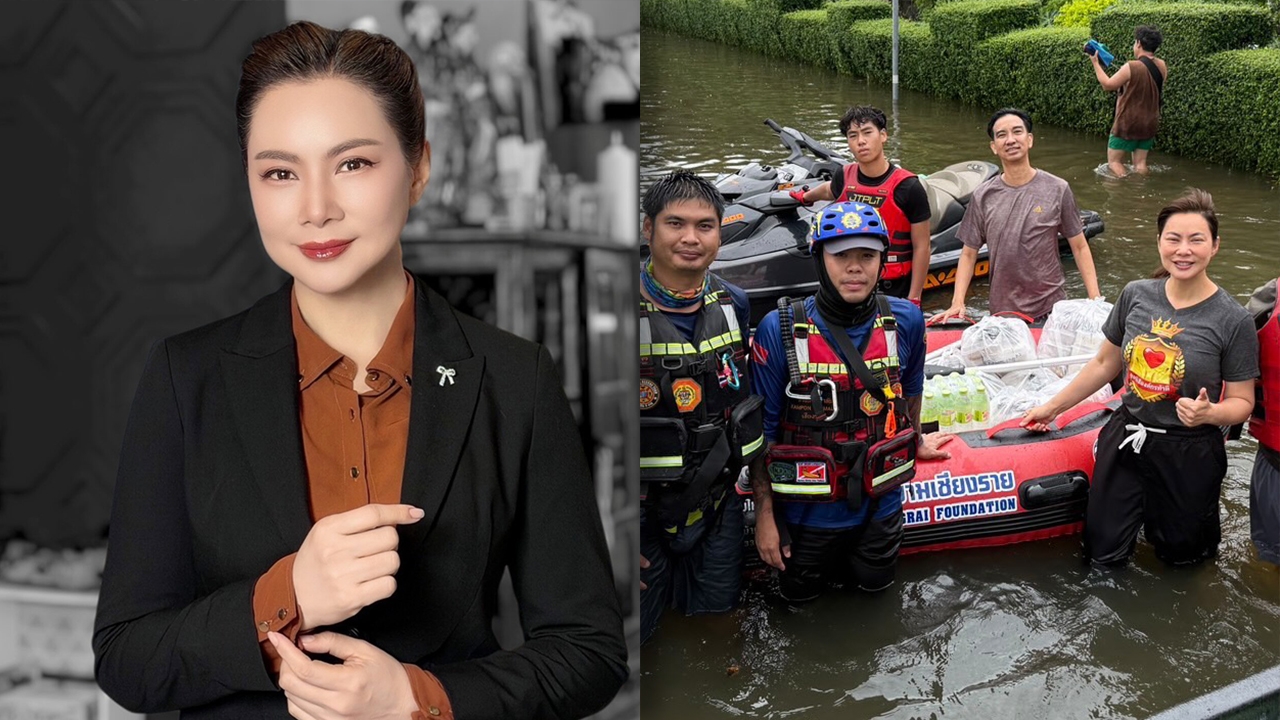
Fully committed to flood relief efforts is Bum Panadda Wongpudi, chairperson of the Good Deeds Organization Foundation, who has been on the ground assisting flood victims in Bangkok and coordinating teams in various affected provinces. Recently, she spoke with Thairath Entertainment about the many obstacles encountered in helping those affected, as well as critical supplies still in short supply.

Can this be called a major flood disaster?
Bum Panadda: From our perspective, as team leaders working in each province, we do call it that. But some officials may hesitate to use that term, possibly due to budget issues or concerns about public image and management. But in reality, since it's a natural disaster, we have to acknowledge it. Right now, it’s happening in many places—several provinces simultaneously, including Bangkok itself, where people have been without food for several days. If this isn’t a major flood disaster, I don’t know what else it would be called.
But I have to explain why management is so difficult, especially in Bangkok. Suppose I’m going to pick up Jack Green at his home or at Thairath. When picking him up at Thairath, the problem is the roads are blocked with stalled cars. With water levels about waist-high, only 6-wheel trucks, 10-wheel trucks, or GMC vehicles can navigate.
Or some alleys, like in Ladprao, the water reaches about chest level (she gestures raising her hand to her chest). So boats are needed. But for boats to get through, a towing vehicle is required first. However, those vehicles can’t get in because three lanes are blocked with stalled cars. They have to weave through, but large 6- or 10-wheel trucks can’t maneuver like that. Then tow trucks have to find other vehicles to tow first, but not all vehicles can be reached because others are stuck, and there’s nowhere to park since everything is flooded.
Some cars have been stalled for 2-3 days, so owners wait for the water to recede before retrieving them. Thus, large vehicles can’t reach people to evacuate. Many wonder why in some areas it seems there are no officials—it's because they physically cannot get in.
So the main obstacle is the vehicles?
Bum Panadda: Yes, it’s like in Hat Yai or certain areas I tried to help in Zone 8. At that time, access was blocked because cars were parked on bridges. It’s the same in Khlong Chan—cars were parked and couldn’t back out because there was nowhere to go.
When vehicles can’t get through—not even large ones—and small vehicles are out of the question, boats have to be used, coming from other districts. But once boats arrive, people along the way ask for rides to get food or other needs. Then by the time we reach cases, like bedridden patients, how do we skip those people?
This is the problem I’m facing now. I coordinate with a volunteer civil defense group, but I still take cases myself. The volunteers help too. For some elderly cases, I have to notify the Ministry of Defense to send soldiers for assistance. This kind of coordination is necessary.
Today, for example, Tac Pharanyu is in Ladprao, I’m in Khlong Chan, and another team is in Rangsit. When a case comes in, we send it to whoever is closest (better to coordinate locally?). Yes, but the problem is that picking up Jack Green from Thairath and delivering him to a condo in Happy Land can take half a day because crossing districts isn’t straightforward like usual. One case can take half a day.
So don’t be surprised if officials sometimes just drive past. If you live in a two-story house, officials might ask to pass first—they prefer to help single-story houses first. Just yesterday, there was an elderly woman stuck with her head trapped under the roof, barely breathing (gestures at neck level).
Where was that in Bangkok, Khon Kaen or another area?
Bum Panadda: It was in the surrounding areas. We prioritize single-story houses first. You can imagine. In Rangsit, no one talks about it, but it’s very serious. And the northern floodwaters are coming. So yesterday, we focused on single-story homes first. The provinces are just as badly affected. I can’t call in provincial teams to help because Kabin Buri and Nakhon Nayok are also severely flooded.
The problem in Bangkok is that many roads are impassable. When a case is accepted, sometimes the patient refuses to stay at a shelter and wants to go to their child’s house, crossing districts. Our kitchens operate from several points spread around. I currently have six points, but it’s still not enough. What is most lacking is drinking water; it’s urgently needed but unavailable.
Do you think the government will help ease the burden since Anutin already visited yesterday?
Bum Panadda: They must help—that’s their duty. But how they will assist and manage is another matter. The flood insurance is supposed to start on 1 October, but I’m not sure. In any case, I urge every household to take photos of their flood-damaged homes.
I don’t know how the government will manage this—they probably have their plans. But we are doing our best. From what I hear, people are barely sleeping, maybe two hours, then taking cases and dispatching help. We’re trying hard. As for whether this is a major flood disaster for me, the water levels may not be as high or severe as in 2011, but the widespread hardship is just as bad.
I heard last night you went to Romklao Housing Estate where people were cheering. Were they waiting for food?
Bum Panadda: Yes, they were waiting for their first boxed meals. We’re doing our best and just found kitchen points with people to prepare food. We’re accepting many helpers, but they must be trustworthy—no one who takes money and disappears. That’s not acceptable.
Did you meet P’Ploy at the housing estate? She and Tac must be exhausted. Did you talk?
Bum Panadda: Not much, just met briefly. I told them we never meet under normal circumstances (laughs). Besides us—Tac Pharanyu, me, P’Ploy Nakorn, Bin, Tide, and Wave Sarin—we meet only during these flood relief efforts.
Based on what you’ve studied, is the water receding? The rain hasn’t stopped, and the northern dams in Rayong are close to breaking. Will it improve in the next couple of days?
Bum Panadda: I can only hope and pray. I want it to ease and improve, especially in Bangkok. Government offices are closed, but the private sector isn’t, so how can people go out through the floodwaters? I worry about everyone, frankly.
Elderly people are stuck at home with food running out, and help can’t reach them fast enough. I really want to get in there today, to be on-site directing teams and coordinating cases. We need a central command center with a hotline for citizens so we can allocate resources, set up kitchens, and assign teams for distribution. Yesterday, a team reported that some subdistrict administrative organizations refused to allow food distribution and told rescue teams to wait for the district chief's approval (which province was this?). It was in a province outside Bangkok.
I hope the situation resolves soon. I send my support, but there’s much talk about the Department of Disaster Prevention and Mitigation (DDPM)?
Bum Panadda: They are working. Their vehicles are high-clearance and helpful for rescue, but mostly they stick to roads and transport people to designated points.
Is the warning system sometimes too slow? But from what I heard from Khun Jesada, Bangkok authorities said they issued warnings?
Bum Panadda: They did issue warnings, but perhaps the language made people think it was just ordinary rain and didn’t expect such severe flooding. Maybe the figures need adjusting slightly. I suggest holding new meetings to revise those numbers.
For example, if the expected rainfall is 300 mm, can we call it a major flood disaster? In Bangkok, flooding occurred with only about 120 mm. So maybe the perspective and management need tweaking. Don’t rely only on numbers but on reality—this level means flooding and impacts people's lives.
How does this flood differ from Hat Yai? You mentioned the flooding is more widespread.
Bum Panadda: It’s more extensive. It’s not just Bangkok but Rangsit, Pathum Thani, Nonthaburi—all flooded. One advantage is the internet signal hasn’t failed, unlike in Hat Yai where communication was poor and it was hard to know which homes to help. Here, we can still call and confirm locations to coordinate rescue. That’s a plus.
How many more days do you expect to assist?
Bum Panadda: Five days. Remember, if rain continues, water will remain for about two more days. If rain stops, water should recede in 2-3 days. But I say five days because after that, we need to rehabilitate, relocate patients back home, and care for elderly people living alone. Just yesterday, there was an 83-year-old woman living alone who needed support.
But if the rain continues, water levels will stay the same because there’s no drainage. The areas around Rangsit are all flooded and exhausted.
What if northern floodwaters come?
Bum Panadda: Some areas like Ayutthaya, Singburi, and Suphanburi will be severely affected.
Let's hope the rain stops?

Bum Panadda: I can’t even plant lemongrass (smiles).
About the jet skis in Phetchaburi New Cut?
Bum Panadda: That’s so reckless. How could they think that was a good idea? They should bring those jet skis to help distribute supplies. Come here and use them to deliver food into alleys instead of speeding around and wasting fuel. That’s not smart—it’s showing ignorance.
They admitted at the police station that they thought it would bring happiness during the floods?
Bum Panadda: Why create trouble? It’s better to do good deeds. I’m too tired to scold anyone now. Use jet skis for helping people. We desperately need boats to deliver supplies. Anyone with jet skis who wants to help is very welcome, thank you so much.
Should people with jet skis be warned not to ride around there? The waves can damage homes?
Bum Panadda: Yes, windows are broken, and offices have expensive equipment inside. Please don’t ride jet skis for fun. I’m begging you.
Any words of encouragement for Bum Panadda? If you’re unwell, please rest. Let us know if you need help coordinating.
Bum Panadda: Thank you very much.Click to readEntertainment News