

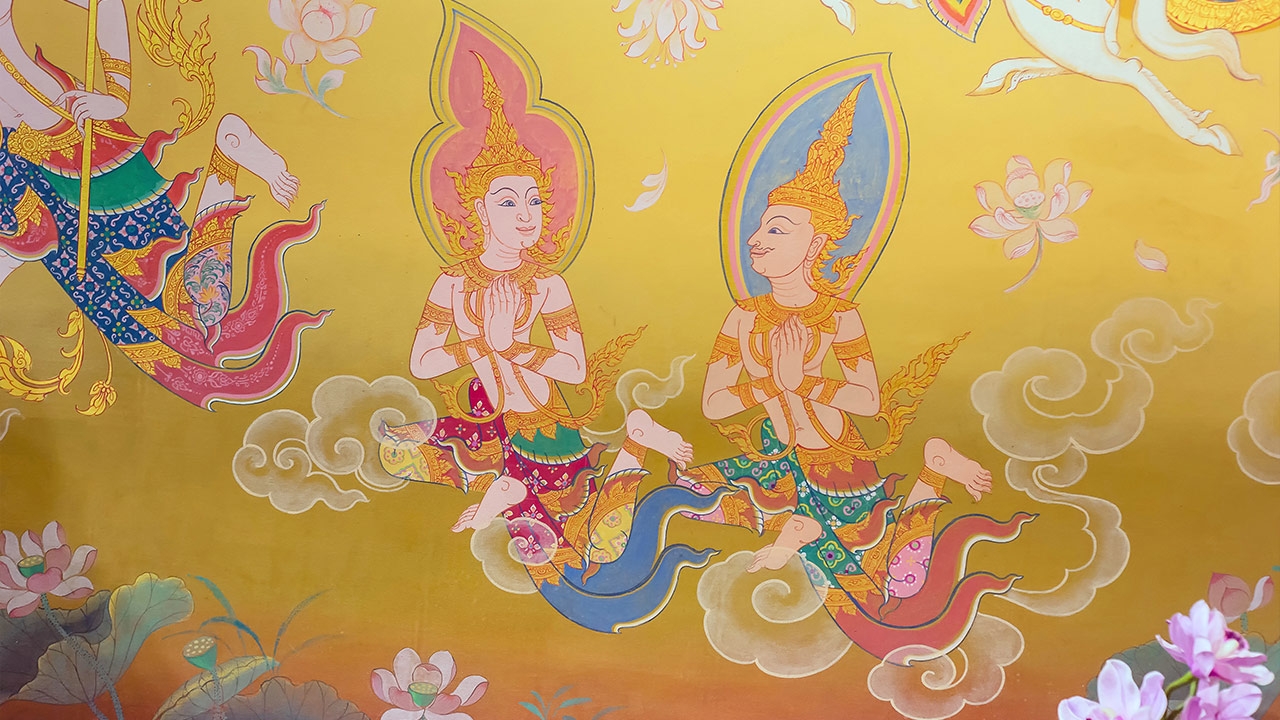
The Assembly of Deities chant offers protection from dangers and harm and calamities encountered.
In Buddhism, the Assembly of Deities chant is a crucial prelude before the Buddhist chanting ceremony, symbolizing the compassion of the Buddhist community in sharing the Dharma with the deities of the ten thousand worlds. This chant exists in two versions: the 7-legend and the 12-legend forms, both passed down for generations to bring auspiciousness...
(Recite the Namo phrase three times)
The Assembly of Deities chant This is the opening chant inviting the deities to join in listening to the protective Buddhist scriptures, to participate in the ceremony, wishing them happiness, freedom from suffering, and protection from harm.
“Sathavo me sunantu” — Listen, all noble members of the Buddhist community, the auspicious time has come.
“Dhammassa vanagalo” — I invite you to come and attentively hear the Buddha’s teachings together.
“Ayam phatanta” — Behold, you exalted beings, superior to humans and deities, I invite you to assemble here in unity.
“Dhammassa vanagalo” — I invite you to come and attentively hear the Buddha’s teachings together.
“Ayam phatanta” — Behold, you exalted beings, superior to humans and deities, I invite you to assemble here in unity.
“Dhammassa vanagalo” — I invite you to come and attentively hear the Buddha’s teachings together.
“Ayam phatanta” — Behold, you exalted beings, superior to humans and deities, I invite you to assemble here in unity.
Currently, there are two versions commonly recited as follows:
Saratchang, Saseng, Saphan, Narintang, Parittam Nupavo, Sata, Rakkha Tuti, Paritwana, Metta, Sametta, Phatanta, Avikkhittajitta, Parittam Phanantu.
Sakke, Kame, Ja, Rupe, Kirisikhara, Te, Chantalikhe, Vimane, Thipe, Ratte, Ja, Kame, Taruwanakahane, Kehawatthumahi, Khetate.
Phumma, Jayantu, Thewa, Chalathalavisame, Yakkha, Kandhappanaka, Titthanta, Santike, Yang, Muniwaravajanang, Sathavo me sunantu.
Dhammassa vanagalo, Ayam phatanta, Dhammassa vanagalo, Ayam phatanta, Dhammassa vanagalo, Ayam phatanta.
Samanta, Jakkavaresu, Atarakachantu Thewata, Satthammang, Munirajasas, Sunantu, Sakkamoggatang. Sakke, Kame, Ja, Rupe, Kirisikhara, Te, Chantalikhe, Vimane, Thipe, Ratte, Ja, Kame, Taruwanakahane, Kehawatthumahi, Khetate, Phumma, Jayantu, Thewa, Chalathalavisame, Yakkha, Kandhappanaka, Titthanta, Santike, Yang, Muniwaravajanang, Sathavo me sunantu, Dhammassa vanagalo, Ayam phatanta, Dhammassa vanagalo, Ayam phatanta, Dhammassa vanagalo, Ayam phatanta.
It is usually recited before various ceremonies and is the chant monks recite prior to chanting the protective Buddhist scriptures. The purpose is to invite the deities to listen to the teachings. This chant is traditionally recited at ceremonies, with the deities invited at the start and respectfully sent off at the end. For daily home chanting or before bedtime, it is not necessary to recite the Assembly of Deities chant; simply dedicating merit, spreading loving-kindness, and remembering the deities and sacred beings is sufficient.
To become a deity, one must possess fundamental virtues: hiri, a sense of shame towards all wrongdoing, refraining from evil both privately and publicly.
Ottappa, the fear of the consequences of wrongdoing, which prevents misconduct in body, speech, and mind, both in secret and openly. Remembering the virtues of the deities brings auspiciousness to practitioners, especially those with a devotional temperament.
Nevertheless, the Assembly of Deities chant can be recited anytime one desires auspiciousness; even at home, it can be done simply by setting the mind in meditation.