

Mantra for worshiping Luang Pu Thuat This mantra is considered auspicious. It is believed that chanting it brings protection from all dangers. Traders often chant it regularly, believing it helps remove obstacles, smooth business, increase profits, and relieve debts.
The spiritual power of the Luang Pu Thuat worship mantra is believed to enhance blessings. Many carry small statues of Luang Pu Thuat with them or place one in their car to prevent accidents and dangers. Some even pin amulets on infants’ clothes for protection from misfortune.
Thairath Online presents the Luang Pu Thuat worship mantra along with its translation and the powerful spiritual benefits believed to be granted by chanting it.
Luang Pu Thuat was a historical monk from southern Thailand, honored with the ecclesiastical title granted by King Ekathotsarot in the Ayutthaya era as " Somdet Phra Ratchamuni Samiram Khunupamacharn ". Luang Pu Thuat has long-standing legends of sacred miracles passed down through generations.
Thais may refer to him by various names such as " Luang Pu Thuat Stepping on Seawater to Make It Fresh " and " Luang Pu Thuat of Wat Chang Hai ". Many Thais deeply respect and believe he was an enlightened monk possessing extraordinary powers.
History of Luang Pu Thuat It is believed he was born around 1582 CE in Sathing Phra District, Songkhla Province, originally named "Poo," son of Mr. Hu and Mrs. Jan. A tale tells that as a baby, while his parents were harvesting rice, he was tied to a tree. A large king cobra wrapped around the cradle. His parents prayed for protection, and the snake loosened its grip, leaving a clear orb on the child’s body (now kept at Wat Phako in Songkhla).
At about age seven, he became a novice monk and later traveled to study Buddhist scriptures in Nakhon Si Thammarat before heading to Ayutthaya. During this journey, miracles of Luang Pu Thuat are told. While aboard a junk ship caught in a monsoon, the crew ran out of drinking water and blamed the monk, planning to abandon him.
Luang Pu Thuat dipped his left foot into the seawater, which miraculously turned fresh and drinkable. Everyone drank to survive. The captain and crew apologized and invited him to continue to Ayutthaya, giving rise to the legend of " Luang Pu Thuat Stepping on Seawater to Make It Fresh ".

Luang Pu Thuat resided at Wat Phako in Sathing Phra District, Songkhla Province, his birthplace. Locals sometimes call him " Somdet Phako ". Later, he lived and served as abbot at Wat Chang Hai in Khok Pho District, Pattani Province.
Thus, it is concluded that both " Luang Pu Thuat of Wat Chang Hai " and " Luang Pu Thuat of Wat Phako " refer to the same person, with names varying according to where he lived.
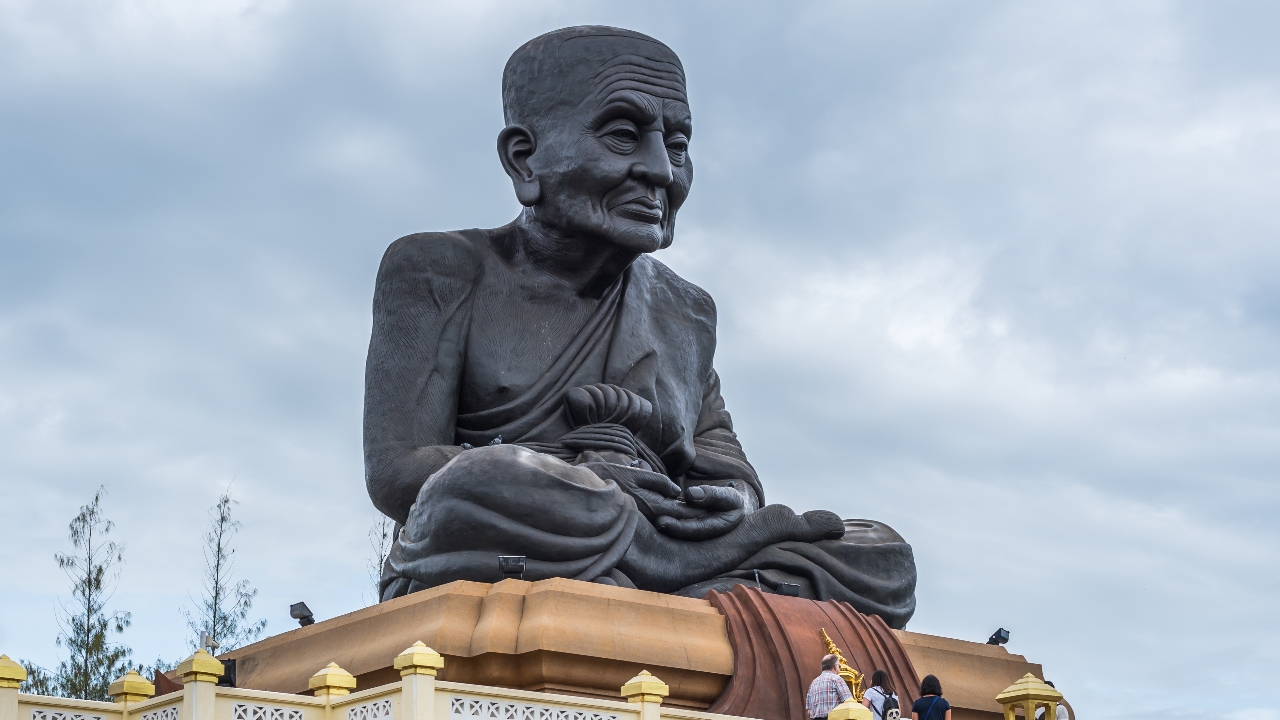
Today, many replicas of Luang Pu Thuat statues are created for worship across Thailand. The largest is called " Luang Pu Thuat of Wat Huay Mongkol ", an outdoor statue at Wat Huay Mongkol, Hua Hin District, Prachuap Khiri Khan Province, standing 11.5 meters tall and 9.9 meters wide at the base.

Namo Tassa Bhagavato Arahato Sammasambuddhassa (repeat 3 times)
Namo Bodhisatto Aksantimaya Itipakava
Namo Bodhisatto Aksantimaya Itipakava
Namo Bodhisatto Aksantimaya Itipakava
"I respectfully pay homage to Somdet Luang Pu Thuat, the Bodhisattva, the fortunate one who dwells within me."
The Luang Pu Thuat worship mantra is believed to possess universal spiritual power, bringing auspiciousness and great sacredness, especially protection from evil and danger. Southerners often pin small Luang Pu Thuat amulets on infants’ clothes to ward off misfortune.
Additionally, when traveling, many chant the mantra or carry Luang Pu Thuat amulets, believing it prevents accidents and ensures safety. Businesspeople also worship him to enhance prosperity, smooth business, and gain confidence to overcome debt and build wealth.
Moreover, in the south there is a belief in " Ai Khai ", the spirit child guardian deity of Wat Chedi, Sichon District, Nakhon Si Thammarat Province. Ai Khai is said to be a disciple of Luang Pu Thuat who followed him to Ayutthaya but died en route near Wat Chedi. His spirit watches over the temple as promised to Luang Pu Thuat.
Related news articles