

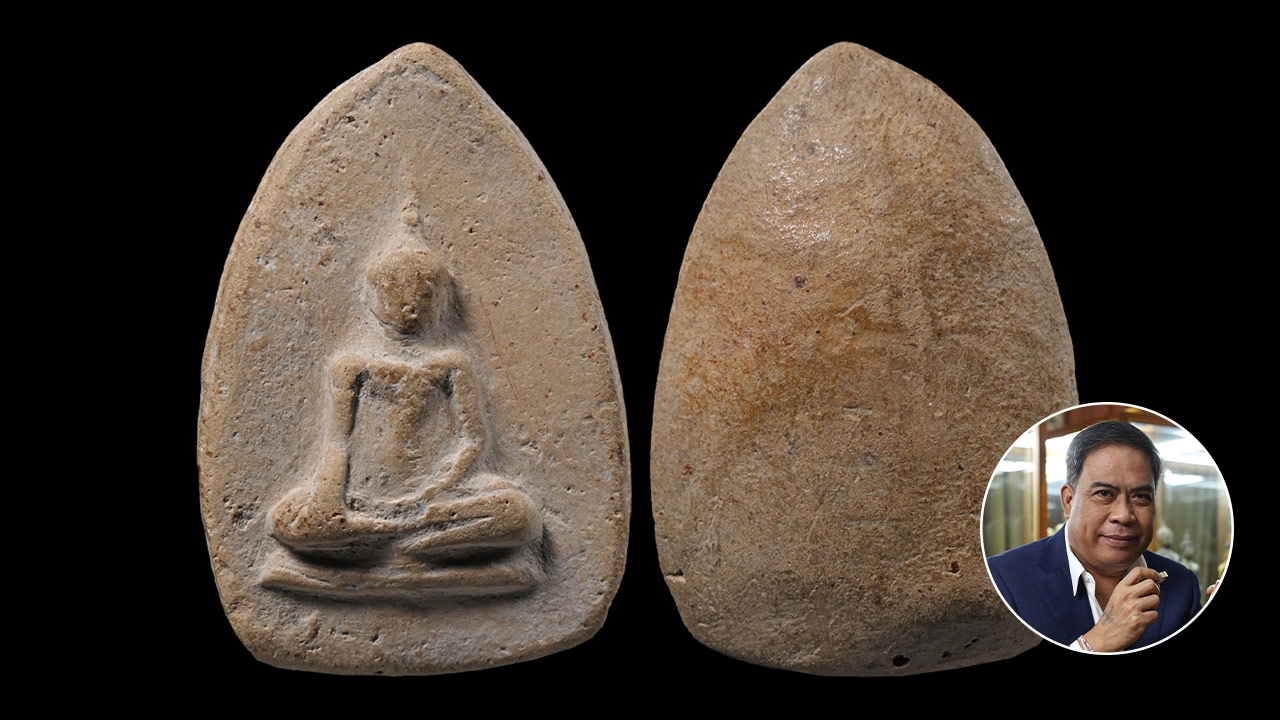
"Whoever has me will not be poor"—a sacred amulet from the land of the wealthy plains (Nakhon Chum)....
1
Phra Nang Kamphaeng amulets, unearthed in Kamphaeng Phet province, are mostly found around the Thung Setthi area. This amulet is one of the more commonly discovered types, with many caches across Kamphaeng Phet, both in the Thung Setthi (Nakhon Chum) area and in the provincial town. There are several mold types, all equally popular.
Phra Nang Kamphaeng amulets depict the Buddha seated in the Mara Vichai posture, usually on a straight-edged pedestal. The surface of the amulet is smooth without any arch-shaped lines, but the edges vary in style.
Most edges are cut into triangular shapes, with some having wing-like sides resembling lotus petals, called "Phra Nang Kamphaeng Lotus Petal." Some have rounded or pointed edges, referred to as "Phra Nang Kamphaeng Smooth Jasmine Bead".

The name "Smooth Jasmine Bead" comes from the resemblance to a type of seed called "ma-luen" (a small seed). Those with bases marked by lines are called "Phra Nang Kamphaeng Grid Base." Amulets found in the provincial town include a cache with slender, pointed shapes, mostly black, resembling "ma-klet" seeds, called "Phra Nang Kamphaeng Ma-Klet." The triangular-shaped amulets are further divided into "Phra Nang Phaya Deep Mold" and "Phra Nang Phaya Shallow Mold."
Phra Nang Kamphaeng amulets have been found in the caches of Wat Boromthat, Wat Phikun, Wat Chang Lom, and nearly every cache in Kamphaeng Phet province. These amulets come in various materials: baked clay, silver alloy, lead alloy with red rust (very rare), and various herbal-based materials including silver-faced, gold-faced, and plain herbal types.
The baked clay versions are more popular than others. The clay amulets of the Kamphaeng Phet family have a distinctive thick, soft texture with a thin surface layer. Unhandled amulets have a fine dusty patina on their surfaces. Some, affected by moisture in the caches, show patches of black mold, which adds a unique beauty.


2
Amulets that have been handled and exposed to sweat develop a smooth, soft texture, widely recognized as a hallmark of Kamphaeng Phet amulets, often likened to tamarind paste in texture.
Phra Nang Kamphaeng is the most commonly found amulet among the Kamphaeng Phet family, which makes its price lower compared to others in the same group. However, its Buddhist artistry is excellent, representing Sukhothai-style craftsmanship from Kamphaeng Phet.
Scholars classify this as a distinct branch of Sukhothai art. The faces have prominently broad temples tapering gradually to the chin, forming an oval shape unique to this style. The torso features broad shoulders, a narrow waist, and a gracefully curved figure. This artistic style exists only in Kamphaeng Phet.
Although many Phra Nang Kamphaeng amulets existed in the past, genuine ones are now hard to find, especially well-preserved pieces. This is because facial details—such as eyebrows, eyes, mouth, nose, and ears—are very fine lines, and the delicate, soft baked clay material tends to wear down over time, making pristine examples rare.
3
The spiritual powers of Phra Nang Kamphaeng are consistent with other Kamphaeng Phet amulets, excelling in attracting loving kindness, popularity, luck, wealth, progress, and protection from dangers. Phra Nang Kamphaeng holds legendary status, like the "Silver Leaf Script" and "Phra Soom Kor" amulets.
"Whoever has me will not be poor."