

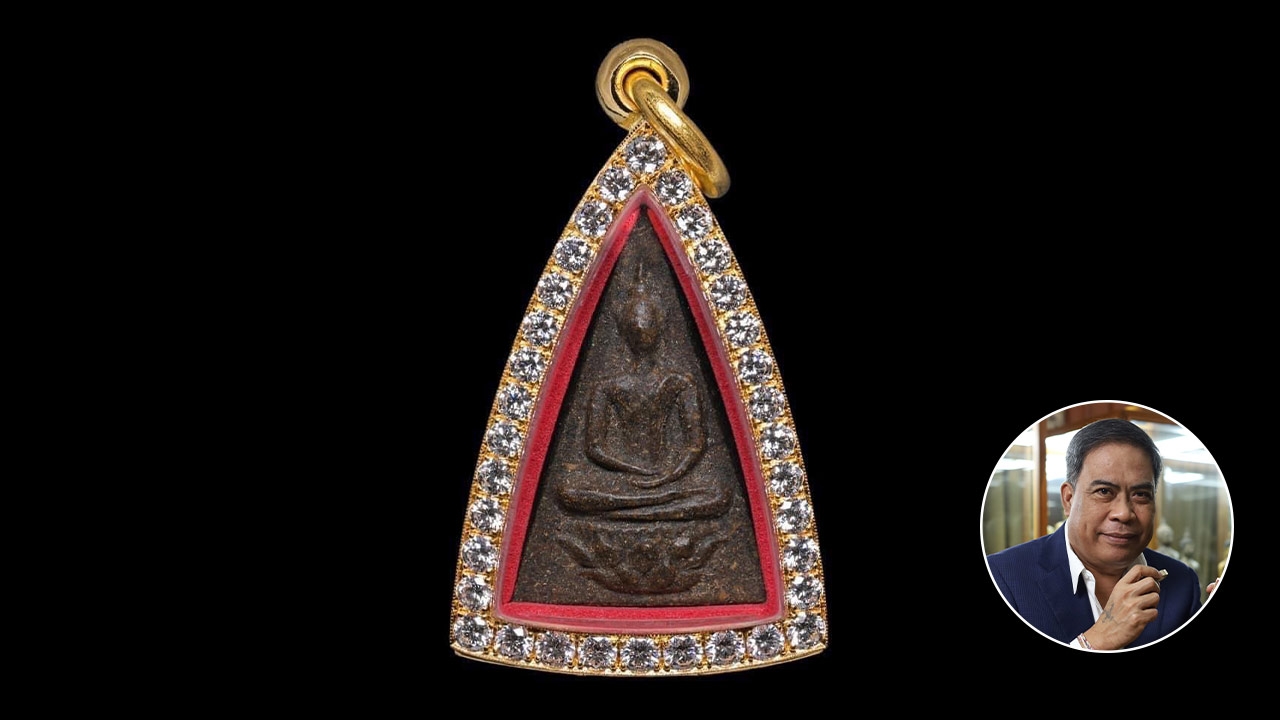
Phra Nang Phaya is a revered amulet closely associated with the identity of Phitsanulok Province.
Phra Nang Phaya is a terracotta amulet found at Wat Nang Phaya in Phitsanulok Province in 1901 CE. It has long been renowned alongside "Phra Somdej." The influence of Phra Nang Phaya has led to other triangular-shaped terracotta amulets being prefixed as "Phra Nang Phaya," even though they have no connection to Wat Nang Phaya. It is considered one of the highly popular Benjapakee amulet sets.
Phitsanulok Province has been prosperous since ancient times, especially during the Sukhothai and Ayutthaya periods. Many Thai kings resided here, such as King Maha Thammaracha Lithai and King Naresuan the Great. The city also houses important and sacred Buddha images, the most renowned being "Phra Buddha Chinnarat." Additionally, the city holds significant ancient amulets, including "Phra Phaya."


The Phra Nang Phaya amulet from Wat Nang Phaya in Phitsanulok features Ayutthaya-era artistry and age, though the exact reign during which it was created is unclear. It is speculated to have been made during the time of King Maha Thammaracha and Queen Wisutthikhasat (mother of King Naresuan the Great) around 1552–1557 CE, as these rulers governed the region during that era.
The Wat Nang Phaya amulet cache was discovered at the ruins in front of the temple. The amulets were found buried underground during excavation for a temple pavilion construction in 1901 CE. King Chulalongkorn (Rama V) visited Phitsanulok to cast a replica of Phra Buddha Chinnarat to enshrine at Wat Benchamabophit in Bangkok. The province then presented some newly found Phra Nang Phaya amulets to His Majesty and his entourage, marking the beginning of their widespread recognition.
There are many different molds of Phra Nang Phaya amulets, available in large and small sizes. The amulet community categorizes them into seven molds as follows:
1. Curved Knee Mold
2. Straight Knee Mold
3. Straight Knee Mold (Hand Dropping on Knee)
4. Large Raised Chest Mold
5. Sangkhati Cloak Mold
6. Small Raised Chest Mold
7. Angel Mold


These amulets are crafted in the Ayutthaya artisan tradition. The overall style shows a seated Buddha in the Mara Vichaya posture within a triangular frame. Most do not display facial details, with the sangkhati robe lines quite distinct. The material is terracotta, sometimes showing mineral inclusions. Color varies depending on firing conditions and preservation. Frequently touched amulets tend to have a softer texture. Some are coated with lacquer or tree resin, making the texture firmer. The sides are trimmed with chisel marks; the frame may be close to or distant from the Buddha image. Some amulets have asymmetrical trimming.
Finally, I wish you and your family enduring happiness and prosperity.