

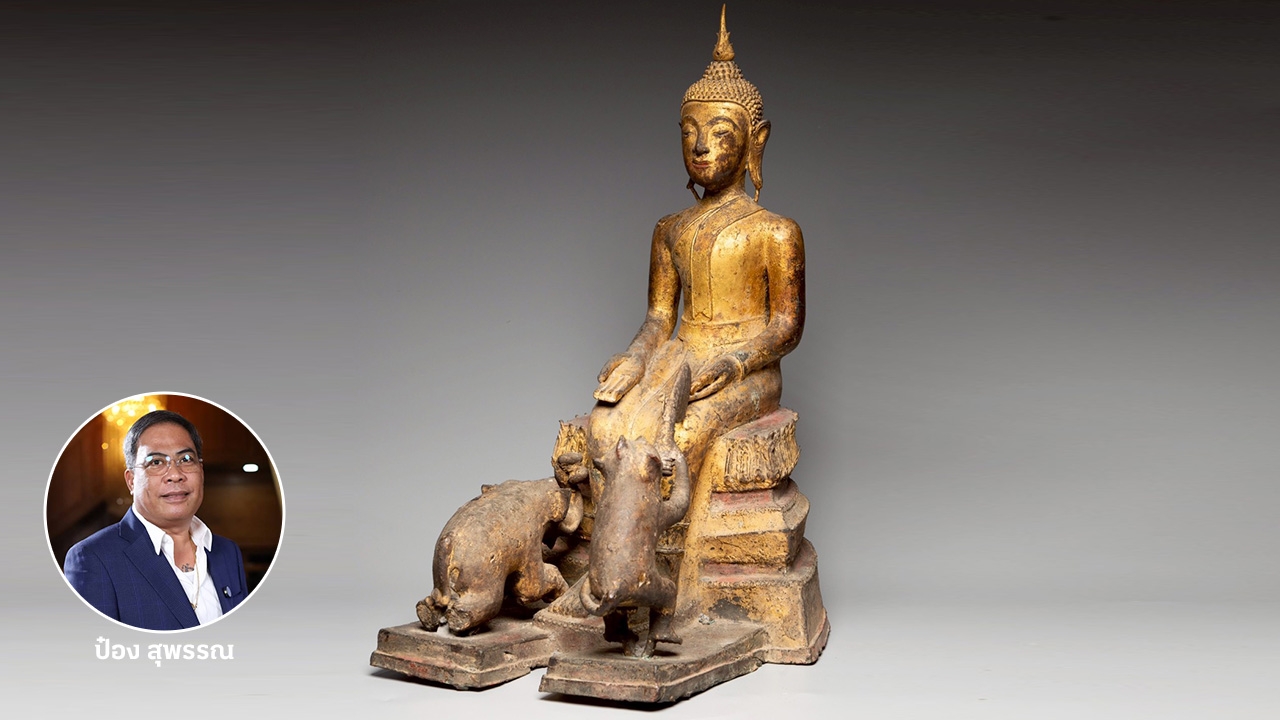
The distinctive feature is the Buddha seated on a rock (sometimes with legs dangling), accompanied by the royal elephant Palilai offering a water container, and a monkey presenting a honeycomb. This representation is based on the Buddha's time spent during the rains retreat in the forest, where animals served him.
(Corresponding to Wednesday night posture).
This posture is often depicted as a royal Buddha image (wearing royal regalia) featuring prominent U Thong and late Ayutthaya artistic styles, such as the principal Buddha image at Wat Pa Laiyok in Suphanburi, which serves as a revered symbol of the community.


Key characteristics of the Pa Laiyok Buddha posture.
* Posture: Seated on a rock, sometimes with both legs dangling (the dangling legs posture).
* Elements: Includes a crouching elephant using its trunk to hold a water container and a monkey holding and offering a honeycomb beside the Buddha.
* Ayutthaya-era art style:
* Commonly depicted as a royal Buddha image (with large or small royal attire), especially prevalent in late Ayutthaya period.
* Incorporates blended U Thong artistic styles, exemplified by the Luang Pho To image at Wat Pa Laiyok.
* Meaning: Represents peace, kindness, compassion, and harmonious coexistence with nature.
* Worship: This image corresponds to Wednesday night (6:00 p.m. to 6:00 a.m.).


Famous Pa Laiyok Buddha images.
* Luang Pho To, Wat Pa Laiyok Worawihan, Suphanburi Province: A large image over 23 meters tall, created in the early U Thong style.