

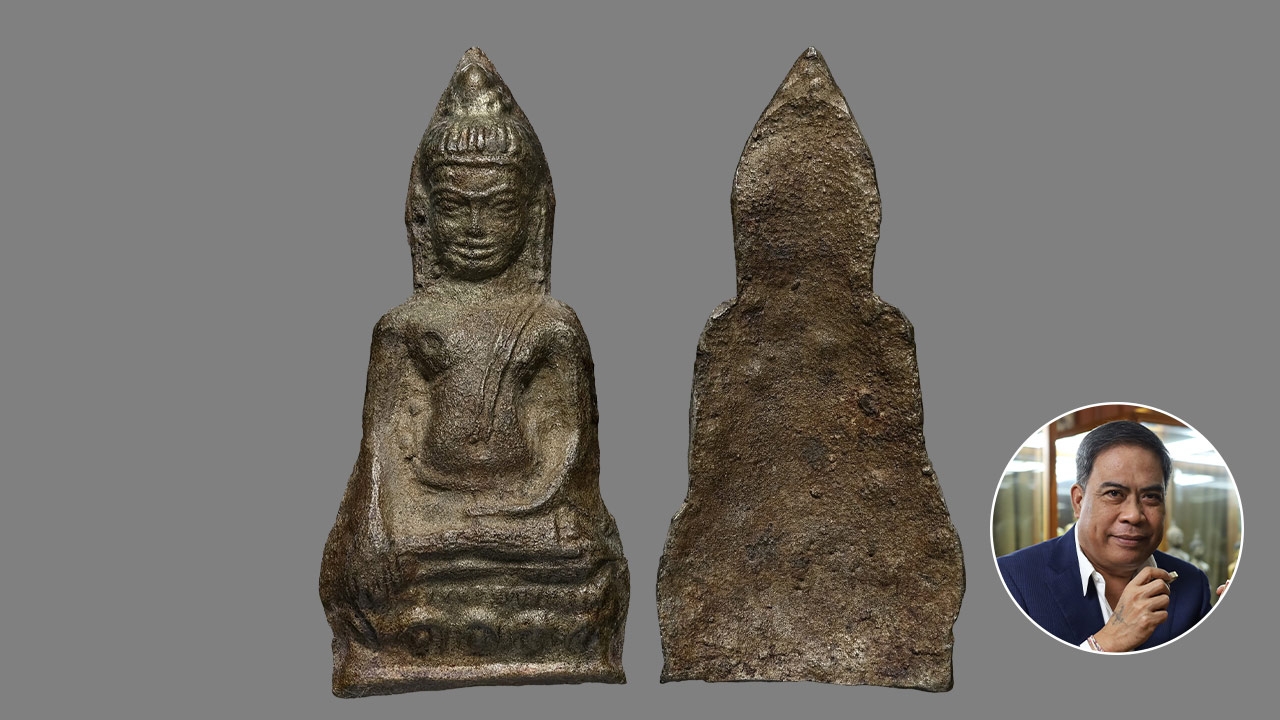
One of the five great sets of bronze amulets.
History of Phra Hoo Yan: When discussing seated amulets from Lopburi, the top rank goes to Phra Hoo Yan of Lopburi. For standing amulets, the top is Phra Ruang with patterned back cloth. Phra Hoo Yan originated at Wat Phra Si Rattana Mahathat, first unearthed around 1997 CE, known as the "old batch." The initially unearthed amulets had a black surface with small white mercury spots in the crevices, which fade with use.
Subsequently, further finds were limited until 1965 CE, when a large batch was discovered near a small stupa in front of the main prang of Wat Phra Si Rattana Mahathat, called the "new batch." Some speculate that the old and new batches were made at different times: the old batch first, the new batch later.
However, I believe that if these were made at different times, the molds and defects would differ. Yet, the old and new batches come from exactly the same mold, despite being found in different locations. Some argue it’s unlikely the same mold was reused for the new batch.


If the mold was bronze, over time it would rust and corrode, causing imperfections in any new amulets made, yet the new batch is even sharper and clearer than the old. If the mold were clay or another material, it would degrade over time, preventing sharp details. Redoing the mold would cause size and defect variations, which are not observed.
Several types of Phra Hoo Yan have been unearthed, including the Large type (commonly called the Large Demon Face type).
Medium type.
Small type.
Double-layer lotus petal type.
Double-layer lotus petal with rays type, and the tiny type.
These are quite rare. Regarding spiritual power, Phra Hoo Yan is famous for invulnerability, following Khmer traditions, and also excels in charm and kindness. Besides Wat Phra Si Rattana Mahathat, it has been found at Wat Intaram and Wat Puen, though in different types. The spiritual power is the same across all batches. The Phra Hoo Yan amulets are estimated to be over 700 years old, with the Wat Puen batch slightly younger than that of Wat Phra Si Rattana Mahathat.

