

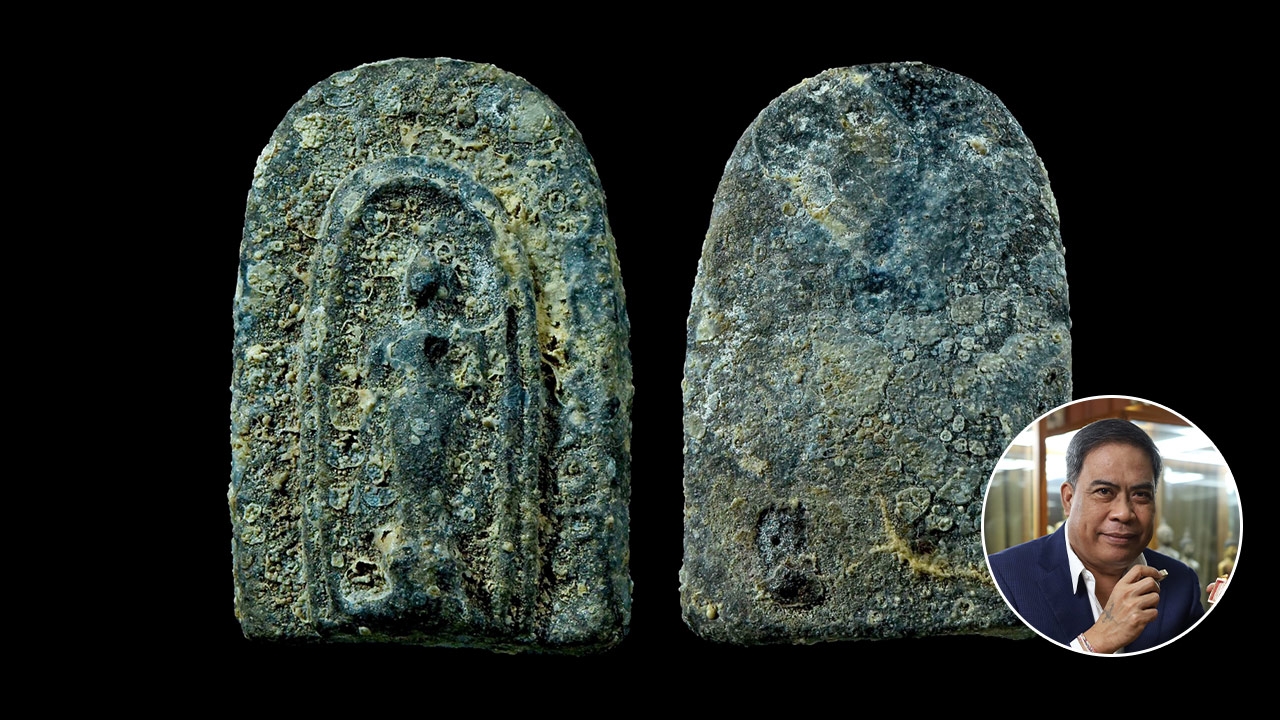
History of Phra Buddha Footprint Pilan (Phra Somdej Pilan)
Phra Somdej Pilan of Wat Rakhang is a sacred powder amulet mainly made from burnt palm leaf powder, typically gray in color. The correct full name is “Phra Somdej Phra Buddha Footprint Pilan,” created by Mom Chao Somdej Phra Phutthachan Tat Saneewong. This amulet is one of the longstanding creations of Wat Rakhang. Mom Chao Somdej Phra Phutthachan Tat Saneewong was a royal prince of the Rear Palace and ordained as a royal novice monk at Wat Phra Sri Rattana Satsadaram. He served as the Dharma instructor at Wat Rakhang and studied Pali scriptures directly under the revered Somdej Phra Phutthachan. He was the highest-ranking monk student of Somdej Phra Phutthachan. Later, during King Rama IV’s reign, he was granted the ecclesiastical title Mom Chao Phra Phutthupabat Pilan—a title reserved exclusively for royal monks—and his final rank was Somdej Phra Ratchakhana Mom Chao Phra Somdej Phra Phutthachan. He was then appointed abbot of Wat Chetuphon.


Phra Somdej Pilan of Wat Rakhang, properly called Phra Somdej Phra Phutthupabat Pilan, was created by Mom Chao Somdej Phra Phutthachan Tat Saneewong during his tenure with this ecclesiastical title at Wat Rakhang. He was the foremost disciple of Somdej Phra Phutthachan Toh Prommarangsi. From the time he assisted Somdej Phra Phutthachan in creating Phra Somdej amulets, he began producing his own amulets around 1868 CE, two years after Somdej Phra Phutthachan began making Phra Somdej. However, he never worked alone but invited Somdej Phra Phutthachan to co-create and requested five sacred powders from Somdej Phra Phutthachan to mix into the main materials. Thus, older generations who knew this history called these amulets “the two Somdej amulets,” while the general amulet collectors refer to them as “Phra Somdej Pilan.” After Somdej Phra Phutthachan passed away, he enshrined these amulets in a chedi located southwest of the ordination hall, dedicating the merit to his teacher.
Phra Pilan amulets come in various molds, all crafted by royal artisans. Each mold is exquisitely detailed and ornate, far beyond the capabilities of ordinary craftsmen. The most esteemed mold is the Doorway Arch type, with the amulet’s color tending toward grayish-black—some say greenish-black—with a firmly attached white waxy residue, which aids in authentication (counterfeit amulets’ residue tends to flake off easily). The first excavation of amulets from the sealed deposit occurred in 1928 CE.


“Somdej Phra Phutthachan” was originally named “Mom Chao Tat Saneewong.”
He was the son of Krom Luang Seneeborirak (Prince Daeng) of the Rear Palace and was born in 1821 CE during King Rama II’s reign. He was ordained in 1842 CE and resided at Wat Rakhang.
In 1870 CE, he became abbot of Wat Rakhang, succeeding Somdej Phra Phutthachan (Toh Prommarangsi), who was elderly at the time. Somdej Phra Phutthachan (Tat) passed away in 1900 CE.
The creation of Phra Somdej Pilan amulets is believed to have occurred around 1864 CE, during his tenure as Phra Phutthupabat Pilan. At that time, Somdej Phra Phutthachan (Toh Prommarangsi) was still alive.
It is therefore assumed that Somdej Phra Phutthachan (Toh) blessed and consecrated the amulets with loving-kindness and rituals.
Phra Somdej Pilan of Wat Rakhang: Physical Characteristics
These amulets include both seated meditation postures on various bases and standing postures.
Classification of Molds
Phra Pilan amulets come in many molds, but the commonly recognized types are as follows:
1. Doorway Arch Mold
2. Large Crystal Cover Mold
3. Small Crystal Cover Mold
4. Large Flame Mold
5. Medium Flame Mold
6. Small Flame Mold
7. Large Square Bodhi Leaf Mold
8. Small Square Bodhi Leaf Mold
9. Small Square Bodhi Leaf Crystal Cover Mold
10. Blessing or First Sermon Mold
11. Mokkhala - Sariputta Mold
12. Tiny Fingernail Mold
13. Closed Eyes Mold
14. Flour Droplet Mold
15. Mini Somdej Mold
The traditional spiritual benefits attributed to these sacred objects are chiefly their power to attract loving-kindness, popularity, and prosperity.