

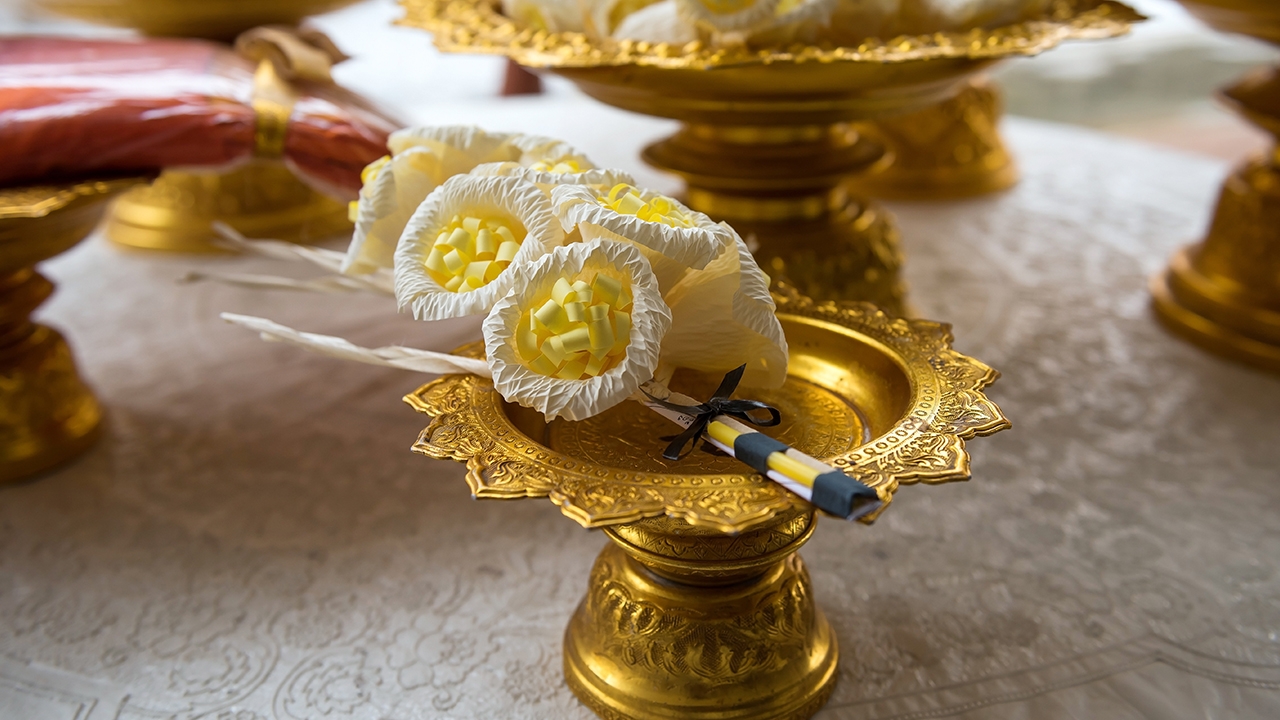
Listening to the Abhidhamma chanting at funerals serves as a reminder of the impermanence of life. The primary chant used is the "Seven Abhidhamma Scriptures," which form the core of Buddhism. These scriptures deeply discuss the states of existence (mind, mental factors, form, and nirvana) and are divided into main chapters as follows:
The chant most commonly heard is the opening chapter of the first scripture (Sangkhani), which is well known among Thai people.
Kusala dhamma akusala dhamma upayakata dhamma
This means: wholesome states exist, unwholesome states exist, and neutral states exist.
Each chapter chanted by the monks carries a summarized meaning intended to remind the living.
Chapter 1: Dhammasangkhani – the grouping of dhammas (good, bad, neutral)
Chapter 2: Vibhanga – the classification of dhammas into parts, such as the five aggregates
Chapter 3: Dhatukatha – grouping dhammas according to elemental states
Chapter 4: Puggalapannatti – definitions concerning different types of persons
Chapter 5: Kathavatthu – answers to doctrinal questions for correct understanding
Chapter 6: Yamaka – paired questions and answers on dhammas
Chapter 7: Patthana – the 24 conditional relations that cause phenomena to arise
If you are to preside at the ceremony and invite the monks to begin chanting, you should recite:
Yassa sappantarayehi, parittang tang panama he
(Used for general ceremonies; for a simple dhamma invitation, use "Brahma ja loka...")
The chant we hear from the monks is called the "Abhidhamma," a high-level dhamma concerning "pure states" without involving notions of self or personhood. The main chant commonly used is:
Kusala dhamma – wholesome states (leading to happiness)
Akusala dhamma – unwholesome states (leading to suffering)
Upayakata dhamma – neutral states (neither good nor bad, e.g., physical form or conditions)
Why chant this? Legend holds that the Buddha recited this to honor his mother in the Tavatimsa heaven, repaying her kindness with the most refined dhamma. Today it is chanted at funerals to honor the deceased and remind the living.
Attending a funeral is not merely a tradition but an opportunity to "see oneself in a mirror" through three main perspectives:
1. Impermanence (anicca): regardless of wealth, status, or rank, everyone ultimately reaches the same point. "Death is the most impartial justice in the world."
2. The importance of the "present": seeing life as short, we ask ourselves, "Have I done good for my loved ones today?" or "Am I wasting time on trivial matters?"
3. The true inheritance is "goodness": when a person passes away, what remains is not wealth but reputation and the good deeds remembered by others.
"Dear ceremony chairman and honored guests, today we gather to express our love and final farewell to (name of the deceased)."
"Throughout the time that (name of the deceased) was with us, (he/she) was a person who (mention virtues such as kindness, diligence, beloved by family). (He/She) created merits and served as a role model in life..."
"The body may depart, but the goodness will remain in our hearts forever. May the power of the Triple Gem guide (his/her) spirit to the peaceful next realm."
If invited to offer the funeral cloth:
1. Walk up to the crematorium when the master of ceremonies announces your name, maintaining a respectful demeanor.
2. Show respect: bow or prostrate (if senior) before the coffin as a farewell gesture.
3. Place the cloth: take the monk's robe prepared by staff and lay it on the tray before the monks (or on the sacred thread as arranged).
4. While the monks examine the cloth, stand quietly with hands folded during the chant "Anicca wata sankhara..."
5. When the monks take the cloth, bow again and then step down from the crematorium.
The word "Bung Sukul" means "dusty" or "covered with dust."
In the Buddha's time, monks collected cloths that wrapped corpses left in cemeteries, washed and dyed them to make robes.
Today, offering cloth symbolizes dedicating merit, reminding that our bodies will ultimately be left behind, leaving only our good deeds.
However, attending funerals is not merely sad or frightening; it is a classroom of life teaching us not to be careless, helping us understand that all things are natural and ordinary.