

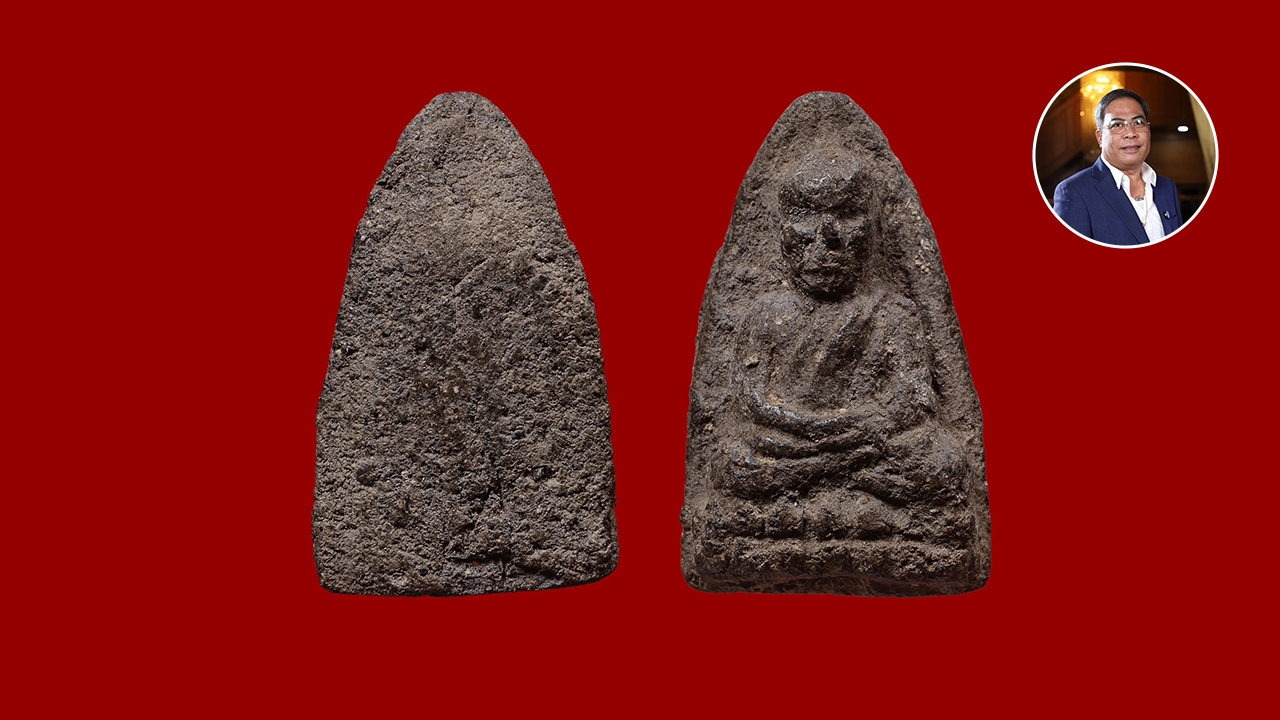
The origin story of “Giant Grandmother's Herb” (known popularly as กากยายักษ์) refers to sacred soil and herbs used as the main components in crafting amulets and talismans, especially the Luang Pu Thuat amulets from Wat Chang Hai. These amulets are legendary for their powerful protection and are believed to miraculously guard against disasters.
Buddhist merits:
They are believed to possess comprehensive spiritual powers, especially "protection from danger," guarding against serious accidents.
Produced in 1954 by Luang Pu Thim, this amulet is highly famous and sought after. The Luang Pu Thuat amulet in sacred herb material from 1954 consists of 108 sacred powders and translucent white powder. Some pieces have a fine, compact texture, others are coarser and fluffier. The core is dark grayish-black, with black mineral particles, known as “Giant Grandmother's Herb,” spread throughout the amulet. The front depicts Luang Pu Thuat seated in the diamond meditation posture on a lotus base, while the back is slightly rounded and smooth.


Regarding spiritual benefits, those who live morally and possess this amulet are believed to gain charisma, luck, invincibility, protection, and success.
Wat Chang Hai, located in Khuan Nori Subdistrict, Khok Pho District, is a historic temple over 300 years old. It is the original temple of Luang Pu Thuat, as he was its first abbot and his relics are enshrined there.
Luang Pu Thuat, famous for turning seawater fresh by stepping on it, is one of Thailand’s most renowned monks. He was an arya monk with great psychic power and many miracles, and legend says he could transform salty water into fresh water.
Luang Pho Thim Thammatharo was born on 21 August 1912 in Ban Na Pradu, Pattani Province. In his youth, he studied under Phra Kru Phattharaphornkowit (Phra Daeng Thamotho). At 18, he ordained as a novice and later as a monk at Wat Na Pradu, receiving the monastic name Thammatharo. After two years of study, he went to study at the Mu Chalin Thawapi Vihara and then returned to teach Buddhist scriptures at Wat Na Pradu. In 1941, he became acting abbot of Wat Ratchaburana, or Wat Chang Hai, and was appointed abbot in 1950. He received continuous ecclesiastical promotions and was appointed preceptor in 1966.
Recite Namo three times.
Namo Bodhipanno Mahalarop Parimitta.
Namo Bodhisatto Akantimaya Itipakava.

