

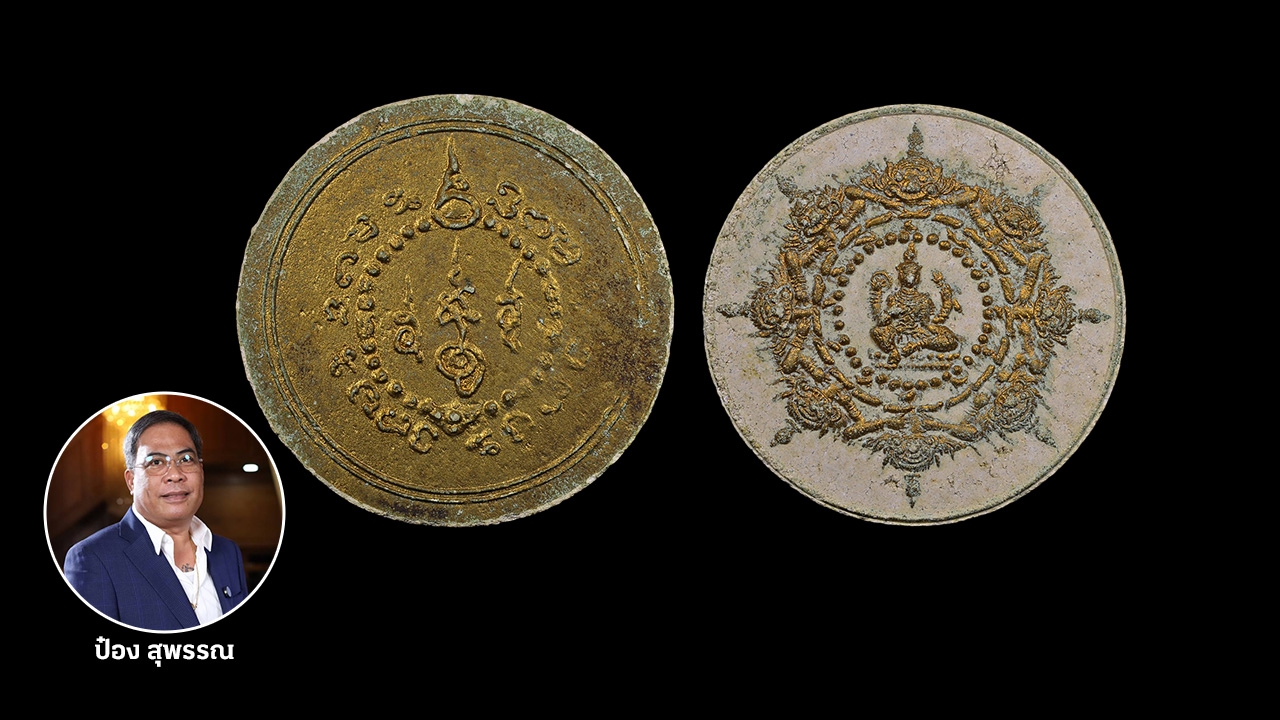
The Jatukam Ramathep amulet is a sun-moon powder type crafted in a circular cycle form, following the ideal art principles of Srivijaya. It features Rahu swallowing the moon, positioned around all eight directions, encircled by a wheel symbol surrounding the twelve zodiac signs. At the center sits a two-headed, four-armed deity statue adorned with weapons. The creators at the time interpreted this as a symbolic representation of the Bodhisattva Avalokitesvara, embodying the figure of Jatukam Ramathep, king of the Srivijaya kingdom.
The back is engraved with yantras representing the heart of the earth, the human heart, and the core mantras governing the elements, according to Srivijaya spiritual beliefs.


The Jatukam Ramathep amulet was made for the eye-opening ceremony of the city pillar in Nakhon Si Thammarat province, held from 3 to 5 March 1987, corresponding to Thursday, the 7th lunar day of the 4th month, Year of the Tiger. The powder composition includes the following auspicious materials: Takian thong wood from the city pillar, shell and limestone powder, soil from the four sacred Buddhist pilgrimage sites, soil from seven cemeteries, minerals from seven mines, cooked rice from seven fields, powder from one-eyed coconut shells, 108 types of flower pollen, 108 auspicious herbs, sugarcane sugar, wild honey, bananas, salt, diamond powder, water from four sacred wells, sacred powder (itthije), sandalwood oil, silver, gold, and tin.
People of Nakhon Si Thammarat hold the belief that the Jatukam represents the city’s guardian deity. The term “Jatu” means four, and “Kam” (kam-ma) refers to a territory or home. Together, they signify not just the four directions of a territory but specifically the four directions guarded by the Four Heavenly Kings (Chaturmaharaja). Thus, Jatukam denotes the position of the supreme rulers of the four directions, protected by these kings. The city guardian deity thus symbolizes a position of authority, established by ancient scholars as the Chaturkam, the ruler of the four directions.
The term “Ramathep” combines “Ram,” derived from Rama, an avatar of Vishnu who incarnated as a great king, and “Thep,” meaning deity. The meaning implies a royal figure who is also a divine being. As the city guardian, “Ramathep” equates to “ruler of the city,” synonymous with governing or sitting over the city—thus, a ruler or king.
It is believed that originally Jatukam Ramathep was a king during the Srivijaya kingdom era, officially named King Chandrapanu, the second ruler of the Srithammaracha dynasty. He was said to have a dark complexion and was a formidable warrior king. After firmly establishing the Srivijaya kingdom, he was honored with the titles “Black King of the Southern Seas” and also “Phaya Phangphakan.” Later, he mastered the teachings of the Jatukam tradition and devoted himself to merit-making and spiritual vows to become a Bodhisattva, aiming to relieve the suffering of all beings.

