

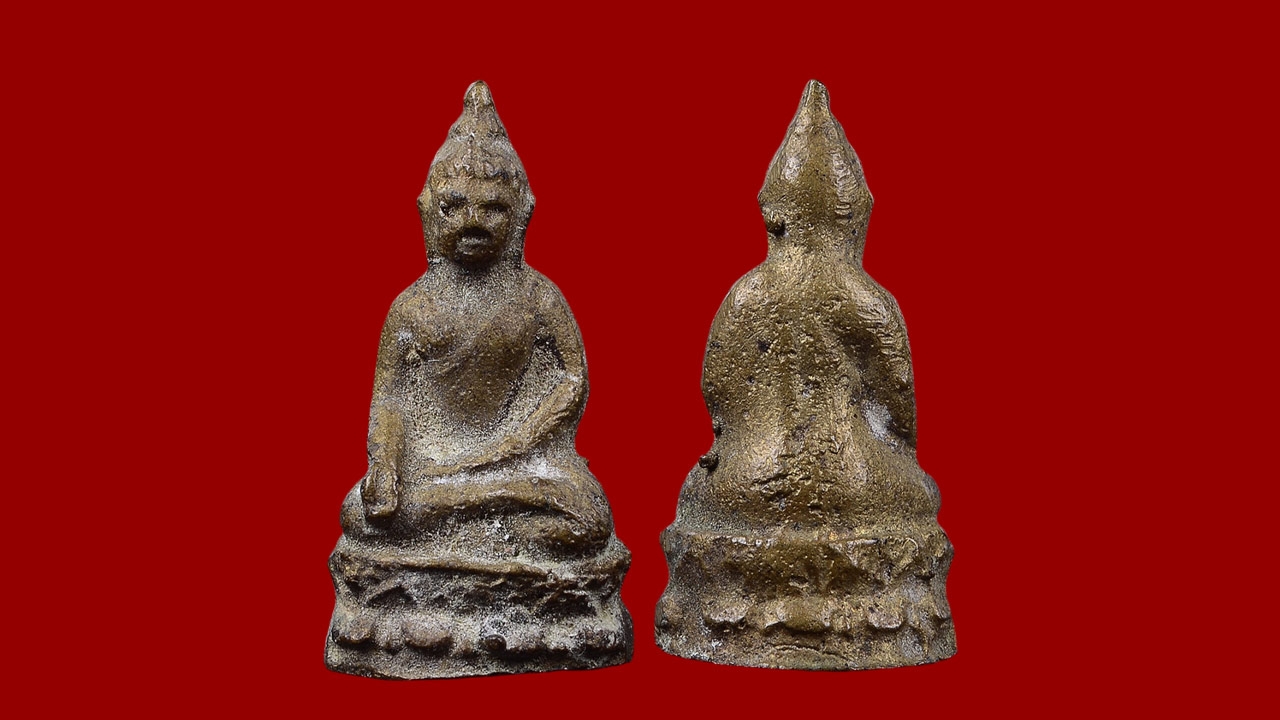
The primary function of Phairi Phinas is to eliminate all enemies and dangers, both visible and invisible. It protects against ill-intentioned and malicious people and enhances fortune in success, luck, peace, and popularity. Devotees believe it causes wrongdoers to suffer the consequences of their own bad karma, keeping the wearer safe and mindful.
Phairi Phinas is one of the most significant Buddha images in Thai history due to its connection with King Rama IV and a critical event during his monkhood, when he faced an adversary claiming to be his enemy.
Phairi Phinas is a stone Buddha statue with a lap width of 1 cubit 4 inches and a total height including the halo of 1 sok. It sits in the blessing posture, resembling the Mara Victory posture, but with the right hand palm facing upward. It rests on a double-layered lotus pedestal with inverted and upright lotus petals.


The artistic style resembles Javanese Buddha statues influenced by Indian Pala art. The face is fairly round, with a large forehead, arched eyebrows, eyes glancing downward, a prominent nose, a slight smile on the lips, long earlobes reaching the shoulders, and a head with spiral hair curls. There is a flame halo above the head and a mandorla behind. The body is plump and solid, with a short robe draped over the left shoulder. This sculpture is interpreted as a representation of Dipankara Buddha, associated with the southern direction in Mahayana Buddhism. Historically, this Buddha image was presented to King Rama IV during his monkhood at Wat Bowonniwet.
In 1848 (B.E. 2391), during this period, Mom Kraisorn declared himself an enemy to the King even though he was a monk. Eventually, Mom Kraisorn met his downfall, like a thorn being removed. The King then named this Buddha image 'Phra Phairi Phinas' (the Buddha who destroys enemies).
Later, in 1853 (B.E. 2396), the birth year of King Rama V, King Rama IV performed the royal merit ceremony called “Phong Phon Phairi.” Whether due to the miraculous sacredness of the Buddha image or a good omen, shortly afterward King Rama III ordered the arrest of Mom Kraisorn on charges of attempting to gather followers for rebellion and sentenced him to death by royal execution with sandalwood cudgel on 13 December 1851.
These events seemed to show the Buddha image’s miraculous power in protecting the King from malicious enemies. Thus, the King established the name “Phra Phairi Phinas” for the Buddha image and inscribed his handwriting under its base. Currently, Phairi Phinas is enshrined inside Wat Bowonniwet Vihara, specifically in the prang niche on the south side of the second level of the main chedi. In 1964 (B.E. 2507), the prang was renovated with iron bars added to the window openings and mosaic walls. King Rama IX and Queen Sirikit attended the gold leaf application ceremony on 29 August 1965.
In 1945 (B.E. 2488), Somdet Phra Wachirayan, abbot of Wat Bowonniwet, was appointed Supreme Patriarch. In 1952 (B.E. 2495), upon his 80th birthday in November, King Rama IX performed royal merit ceremonies in his honor.


After the birthday celebration, a ceremony to cast a Buddha statue was held on 4 April 1953 (B.E. 2496) to bestow great longevity blessings to the Supreme Patriarch. The statue, about 3 cubits wide, was installed at the eastern corner of the vihara pavilion. On this auspicious occasion, a set of Phairi Phinas amulets was created, consisting of:
1. Phairi Phinas Buddha statue
2. Phairi Phinas Kring amulet, square lotus design
3. Phairi Phinas Kring amulet, pointed lotus design
4. Phairi Phinas Chaiwat amulet
5. Phairi Phinas medallion
6. Holy water vessel
The Phairi Phinas amulet set created at that time represents a sacred embodiment of the Buddha’s spiritual power. It is highly revered by King Rama IX. The name “Phairi Phinas” remains popular among amulet collectors. Created by the Supreme Patriarch, the head of the Sangha, these amulets were made for an important auspicious occasion, fully consecrated with Buddhist ceremonies. Devotees believe that worshiping these amulets brings great blessings, peaceful life, protection from disasters, triumph over obstacles, and causes hostile enemies to be destroyed and powerless against the wearer.
Main Buddhist Powers
* Protection: eliminates enemies, guards against malicious people, and shields from all harm.
* Fortune Enhancement: increases popularity, success, luck, and prosperity.
* Peace: helps calm the mind, promotes stability, and enhances mindfulness.
