

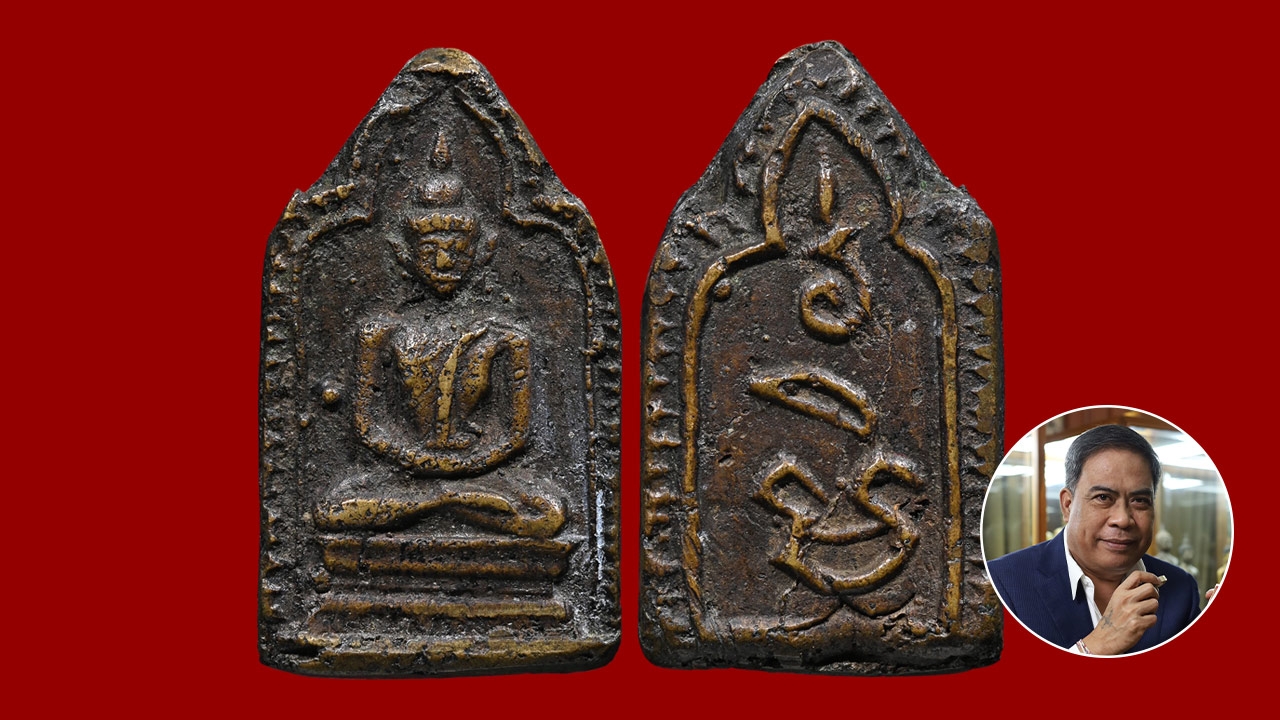
Luang Pho Tha of Wat Phaniang Taek in Nakhon Pathom Province created the 2nd edition around 1907 CE (B.E. 2450). It was issued as a merit-making item during the gold-leaf covering and sacred boundary stone burial ceremony at Wat Phaniang Taek, with the casting ceremony held at the temple itself.
Overall, the medal is an ancient-style cast piece shaped as a pentagon. It comes in both versions—with an integral loop and without. Its dimensions are approximately 3.5 cm tall, 1.5 cm wide, and 0.5 cm thick. The metal has a brass-like golden tone. The front depicts the Buddha seated cross-legged on a smooth base, with a somewhat elongated figure (some say modeled after the temple's principal Buddha image). Facial details are clearly defined. The back features raised edges outlining a pentagonal frame, with exterior incised lines and internal raised lines inside the pentagon, along with raised Khmer characters "อุ" and "มิ".


This 2nd edition casting medal is believed to have been made shortly after the first edition, with modifications including an integral loop for easier use. The Khmer character on the back was altered by adding the vowel "ิ" to form "มิ", eliminating the need for manual inscription as was done on the first edition.
The casting medal of Luang Pho Tha from Wat Phaniang Taek has been renowned for its invulnerability and protective power since ancient times and remains so today.
Luang Pho Tha of Wat Phaniang Taek in Nakhon Pathom was ethnically Lao Song. His ancestors migrated from Laos during the reign of King Rama III.
He was born around 1832 CE (B.E. 2375) in Nong Suea Village, Bo Phak Kut Subdistrict, Photharam District, Ratchaburi Province. He was ordained as a novice monk at age 15 at Wat Photharam in Ratchaburi.
At age 20, he was fully ordained at Wat Wong Khong in Photharam District, Ratchaburi. He practiced Vipassana meditation and went on forest retreats annually. Around 1857 CE (B.E. 2400+), he became the abbot of Wat Phaniang Taek.
The temple was formerly called Wat Prathum Khongkha, located in Mab Kae Subdistrict, Mueang District, Nakhon Pathom Province.

Locals described Luang Pho Tha as very strict, earning him the nickname "Luang Pho Suea" (Tiger Monk). In the past, during temple events, local and visiting toughs often fought violently, but such incidents never happened at Wat Phaniang Taek due to respect and fear of Luang Pho Tha's authority and sternness. During these events, fireworks were common; one year, he placed his hand over a firework tube, preventing it from launching, causing it to explode, yet he was unharmed. Villagers then called him “Luang Pho Phaniang Taek,” which led to the temple's current name.
Luang Pho Tha was granted the ecclesiastical title "Phra Kru Uththarakarn Bodi" during the reign of King Rama V, before 1908 CE (B.E. 2451). Only one photograph of him exists, dated R.S. 127 (1908 CE).
Luang Pho Tha passed away around 1915-1916 CE (B.E. 2458-2459) at approximately 80 years old.
