

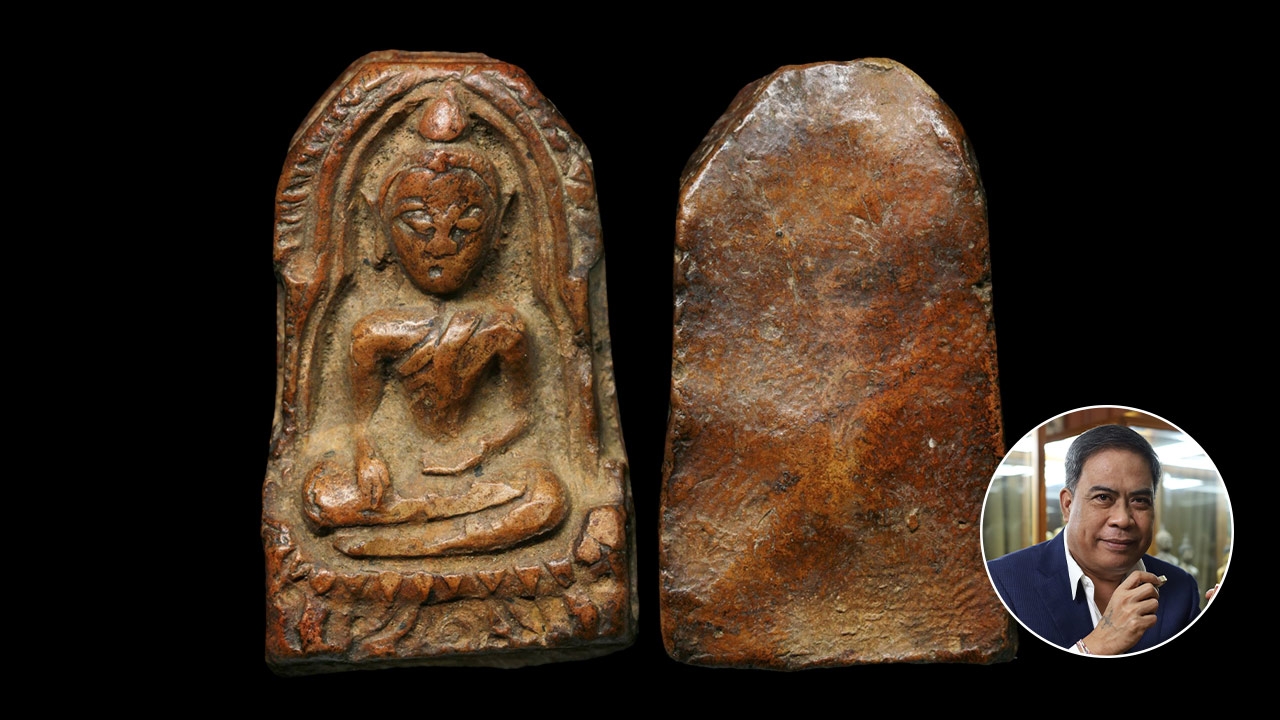
Luang Pho Nong created many types of baked clay amulets in large quantities, with help from disciples and local villagers. It is estimated that production began around 1918. He would perform Buddhist consecration ceremonies during the firing process, with many famous monks of that time participating, including Luang Pho Pan of Wat Bang Nom Kho.
Luang Pho Nong's amulets come in many molds, such as the arch print, front camp Khun Paen, Somdej, Leela, sugar cane shield, plank pose, perforated leather, and floating moon molds. Among these, the arch print and front camp Khun Paen are the most popular and command high prices today, though they have become quite rare.
The amulets are especially renowned for their powers of protection, stability, and great popularity for charm—offering a well-rounded efficacy.


Luang Pho Nong Indasuwanno of Wat Mai Amphawan (Wat Khlong Madan), Suphanburi Province.
He was born in 1866 in Ton Tan Subdistrict, Song Phi Nong District, Suphanburi. At age 24 in 1890, he was ordained at Song Phi Nong Temple, with Phra Athikan Chan of Wat Thung Khok as preceptor, Phra Athikan Dit as sermon master, and Phra Athikan Sut as witness.
After ordination, Luang Pho Nong traveled to Bangkok to study, staying with his uncle, a high-ranking monk titled Chao Khun with a ninth-level Pali degree, to learn Buddhist doctrine. However, seeing the monks’ affluent lifestyle in the city, he felt it was not the path to liberation, so he respectfully left and returned to live his retreats at Song Phi Nong Temple, then later at Wat Thung Khok to study Vipassana meditation with Phra Athikan Chan, his preceptor.
After two rainy seasons studying Vipassana with Phra Athikan Chan, he went on to study under Luang Pho Niam of Wat Noi in Bang Pla Ma District until he gained deep knowledge and earned Luang Pho Niam’s trust. Luang Pho Niam often entrusted Luang Pho Nong to advise other monks. When Luang Pho Pan of Wat Bang Nom Kho came to study with Luang Pho Niam, Luang Pho Niam told him, “After I pass away, if you have doubts, ask Nong; he can stand in for me,” showing great confidence in Luang Pho Nong.
After mastering teachings from Luang Pho Niam, Luang Pho Nong returned to reside at Song Phi Nong Temple. One day, feeling uneasy, he went to see Luang Pho Niam, who, before Luang Pho Nong could speak, reassured him, “Ah, you’re imagining it yourself. There’s nothing wrong. Go back.” This comforted Luang Pho Nong, who then returned to Song Phi Nong Temple.
Later, Luang Pho Saeng of Wat Khlong Madan in Song Phi Nong District recognized Luang Pho Nong as his successor and invited him to reside at Wat Khlong Madan. After Luang Pho Saeng passed away, villagers appointed Luang Pho Nong as abbot. While at Wat Khlong Madan, Luang Pho Nong consistently ate vegetarian meals, paid respect to the Bodhi tree each morning before alms rounds, and offered alms as charity upon return. He also brought his elderly mother to live at the temple, caring for her until her passing.


Luang Pho Nong was strict in following Buddhist discipline, instructing monks, novices, disciples, and villagers to uphold morality, earning their deep respect. He regularly practiced Vipassana meditation in the cemetery, lived simply without accumulating wealth or accepting money, and established many community benefits for the Sangha. He was known to foresee events in advance; for example, when Luang Pho Pan planned an unannounced visit, he instructed disciples to prepare in advance, saying a senior monk would come today. Luang Pho Nong served as abbot of Wat Khlong Madan until his death on 25 December 1934 at age 68, after 44 years as a monk.
