

Thairath Online
Thairath Online

A Complete Summary! The Core Beliefs of Buddhism, Christianity, Islam, and Brahmanism

Belief18 Jun 2026 21:00 GMT+7

Share

A Complete Summary! The Core Beliefs of Buddhism, Christianity, Islam, and Brahmanism

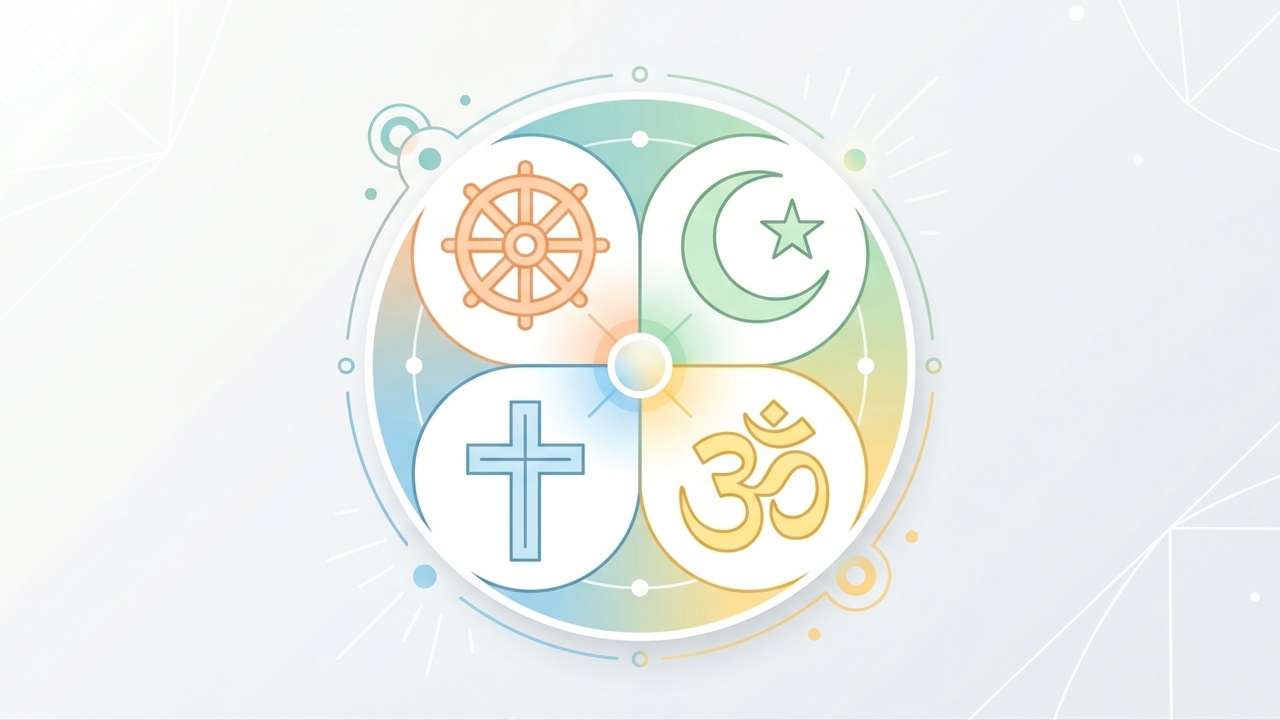
An introduction to the essence of belief and the teachings of the four main religions: Buddhism, Christianity, Islam, and Brahmanism-Hinduism. A brief, easy-to-understand summary tailored for the younger generation to apply in daily life perspectives.

In an era of rapidly flowing information, many young people begin to question the meaning of life and what anchors the spirit. "Religion" is therefore not just about rituals but also a philosophy embedded in everyday life.

Thairath Online takes you to understand the core beliefs and teachings of the four main religions—Buddhism, Christianity, Islam, and Brahmanism-Hinduism—in a concise, easy-to-understand manner to help us live together harmoniously in a diverse society.

Buddhism: Understanding nature and the reasons behind actions.

Buddhism originated in India with the Buddha as its founder. Its core does not emphasize praying to a god but focuses on "actions" (karma) and understanding the nature of life.

  • The Four Noble Truths The noble truths teach about suffering, its cause, its cessation, and the path leading to the cessation of suffering.
  • Good deeds bring good results; bad deeds bring bad results. Every action has consequences, teaching people mindfulness and responsibility for their own actions.
  • The Middle Way (Majjhima Patipada) Living life neither too harshly nor too loosely, emphasizing moderation and mindfulness in daily life.

Christianity: The power of love and forgiveness.

Christianity is the world's largest religion, with Jesus Christ as its prophet. The belief centers on one God, the creator of the universe. Its most prominent teaching is about "love."

  • Love and forgiveness Teaching love for God and loving others as oneself. Forgiveness is the key to freeing humans from hatred.
  • The Trinity God is one but manifests in three persons: the Father, the Son (Jesus), and the Holy Spirit.
  • Sacrifice Belief that Jesus Christ sacrificed his life on the cross to redeem humanity's sins.

Islam: Faith integrated with daily life.

Islam is a religion encompassing both faith and systematic daily practice, with Muhammad as its prophet, worshiping one God, "Allah." The word Islam means "submission" to God's will.

  • The six articles of faith Including faith in Allah, the scriptures (Quran), and the Day of Judgment.
  • The five pillars of practice Obligations for all Muslims: declaration of faith, praying five times daily, fasting during Ramadan, giving zakat (obligatory charity), and performing the Hajj pilgrimage.
  • Equality Islam teaches that all humans are equal; no one is superior except those who fear God.

Brahmanism-Hinduism: Reincarnation and life's duties.

One of the oldest religions, without a single prophet, evolving from beliefs in the Indus River basin. It is polytheistic but fundamentally believes all gods are manifestations of the supreme God (Brahman).

  • Trimurti The combined power of three great gods: Brahma (the creator), Vishnu or Narayana (the preserver), and Shiva (the destroyer).
  • Law of karma and reincarnation The cycle of birth and rebirth depends on past and present karma.
  • Moksha The ultimate goal is liberation from the cycle of rebirth to unite the soul with the supreme God.

Although Buddhism, Christianity, Islam, and Brahmanism-Hinduism have different origins, prophets, and rituals, at their core, all share the same goal: to guide humans to do good, avoid evil, love one another, and serve as spiritual anchors so we can live peacefully and beautifully together in a diverse society.