

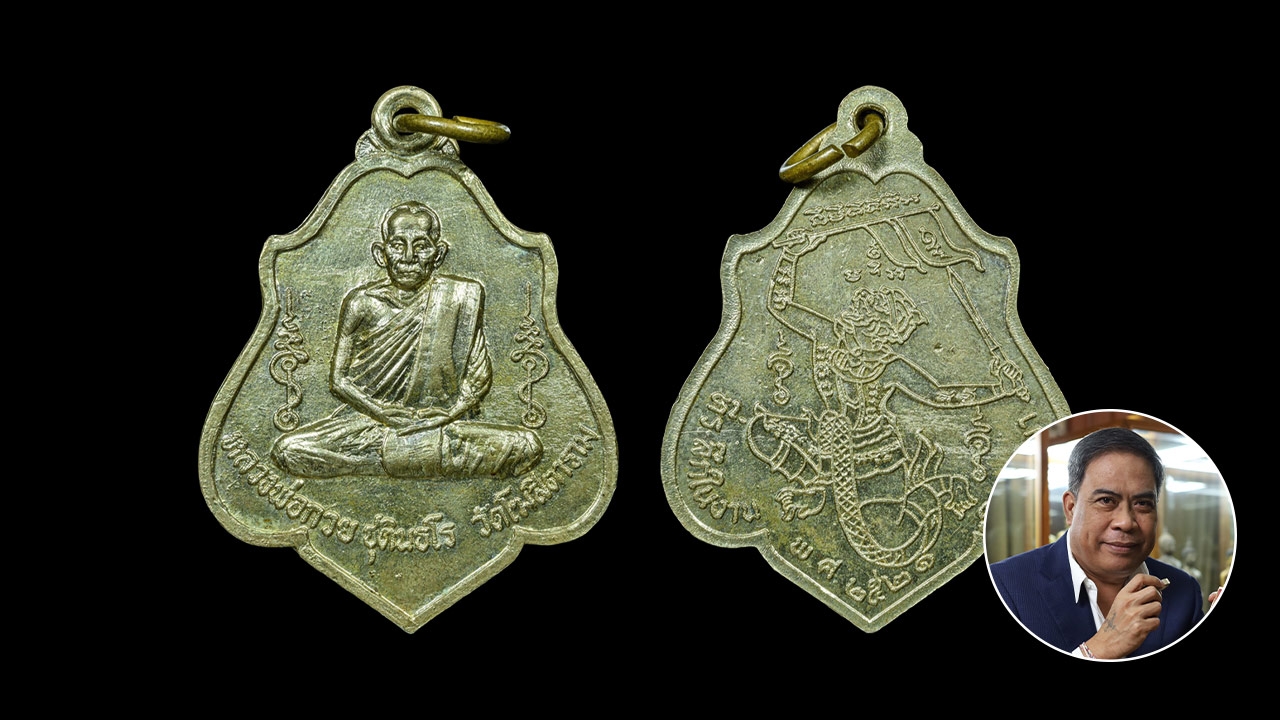
The Hanuman reverse coin from the 1978 boundary marker embedding ceremony, made of alpaca metal, is one of the most popular coins of Luang Pho Kuay. It is full of spiritual power, akin to having a Hanuman tattoo from the master himself. Both the shape and design of the coin are beautiful. Nowadays, well-preserved examples are rare, and all such coins are renowned for their powerful efficacy. This Hanuman reverse coin from Luang Pho Kuay at Wat Khositaram in Chainat Province is highly sought after. Luang Pho Kuay was a famous tattoo master, especially known for the Hanuman banner tattoo on the ribs.


People from all over the country have flocked to present ceremonial offerings to Luang Pho Kuay for tattoos since after World War II until tattooing ceased, as recorded in his notebooks with over 40,000 names. As times changed, with his aging and technological progress, Luang Pho Kuay foresaw the need for a substitute for tattooing on the ribs. He thus created the Hanuman reverse coin for his disciples in later generations to carry as a replacement. Remarkably, he succeeded in imbuing it with power just like the tattoo itself, making it equally sacred. Whoever carries this coin gains an advantage because this Hanuman coin made by Luang Pho Kuay holds strong spiritual power.
The third series Luang Pho Kuay coin from 1978, also known as the 'Boundary Marker Embedding Coin,' was produced for the merit-making occasion of the boundary marker dedication and embedding ceremony at Wat Khositaram. There are three designs in total: 1. The Hanuman Banner reverse, commonly called the 'Hanuman reverse coin,' is an alpaca metal stamped coin with about 20,000 pieces produced. Among these, approximately 500 were gold-plated and given as complimentary gifts to those who donated one sack of rice at the 1978 ceremony. The remaining alpaca coins were sold for 100 baht each for merit-making.
The front of the coin features a full-body seated image of Luang Pho Kuay with the 'Na Ud Pun' yantra on both sides. Around the image is the inscription 'Luang Pho Kuay Chutinro Wat Khositaram.' The reverse depicts Hanuman holding a banner with the inscription 'Commemorating the 1978 Boundary Marker Dedication.' The protective incantation for this coin is: 'Amphong Phao Thoei Thulee Kongkrabanchatree Sawaha Hanumana Klukklee Teema A.' 2. The Yantra reverse design, commonly called the 'Yantra reverse coin,' is a stamped copper coin with about 40,000 pieces produced. Among these, about 500 gold-plated coins were given as gifts to those who donated one sack of rice at the 1978 ceremony. The rest are copper coins, both blackened and reddish, sold for 20 baht each.
The front of this coin also shows a full-body seated Luang Pho Kuay with the 'Na Ud Pun' yantra on both sides. Around the image is the inscription 'Luang Pho Kuay Chutinro Wat Khositaram.' The reverse features the Trisaranakom yantra with the inscription 'Commemorating the 1978 Boundary Marker Dedication.' The protective incantation for this coin is: 'Buddhang Sarankan Kachami, Dhammang Sarankan Kachami, Sanghang Sarankan Kachami.' 3. The rice sheaf-shaped reverse coin is a stamped copper coin with about 10,000 pieces produced. Luang Pho Kuay made these to give to the kitchen staff who helped at the temple, with some also sold for 20 baht each. These are copper coins with a fire-colored surface. The front shows a full-body seated Luang Pho Kuay with the 'Na Ud Pun' yantra on both sides and the inscription 'Luang Pho Kuay Chutinro Wat Khositaram.'
The reverse features the yantra with the incantation 'Na Ga I Ti' with a Buddha image in the center, the Unalom symbol above, and the 'U' character at the top and bottom edges of the yantra. The top inscription reads 'Commemorating the Boundary Marker Dedication,' and the bottom reads 'Wat Khositaram.' The protective incantation for this coin is: 'Na Tha I Ti.'

