

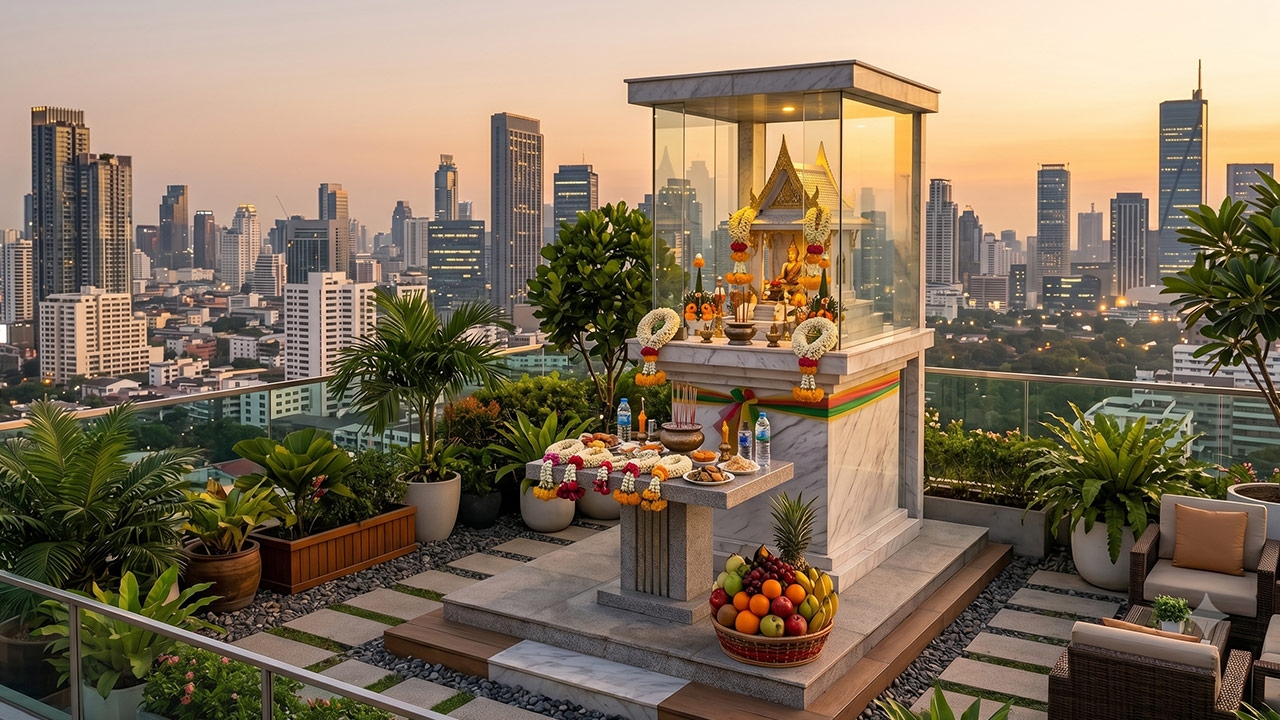
Modern residents living in townhouses or row houses often lack soil space to set up Spirit Houses. Many wonder if placing them on rooftops or inside buildings is permissible. Let's clarify these doubts with expert tips for auspicious arrangements.
In today's society, with changing living environments, many people reside in townhouses, row houses, or commercial buildings where there is limited land for placing a Spirit House according to traditional Thai beliefs. This raises questions among spiritual followers and those seeking spiritual refuge: Is it against religious and Feng Shui principles to set a Spirit House on the rooftop or inside a building?
A Spirit House is the residence of guardian spirits or sacred entities protecting the area, so it is traditionally linked to natural soil. However, experts in Brahmin rituals and Feng Shui masters state thatsetting a Spirit House on high buildings or rooftops "is possible" but requires adapting ceremonies to fit spatial constraints.
To substitute natural soil, experts often use a special ritual involving placing "soil from flat ground" (or auspicious soil from sacred sites) beneath the Spirit House base on the rooftop. This maintains the connection to the "earth element" per Feng Shui, providing reassurance and ritual correctness.
Although setting a Spirit House inside a building is allowed, a common mistake is placing it in the "center of a room" or "middle of the house" because
For those who find traditional single-pillar Spirit Houses on rooftops inconvenient, there are other suitable options for limited space:
Today, Spirit Houses are designed with simplified patterns in a minimalist style, intended for indoor settings like home offices or condominiums, blending well with modern home decor.
For residents of townhouses or commercial buildings, placing a "Tee Joo Yah" on the ground floor inside the house is a popular alternative, believed to invite the earth deity to reside without requiring outdoor space.
For condominium or apartment dwellers, replacing large Spirit Houses with a wall-mounted high shelf altar for Buddha or deities is an appropriate and space-efficient way to enhance auspiciousness.
Setting up a Spirit House on rooftops or in townhouses in modern social contexts is feasible and not unusual. It requires understanding and applying methods to properly supplement the earth element according to belief systems. Most importantly, worship is not just about size or location but about faith, maintaining cleanliness, and good conduct by residents, which generate positive energy and truly bring peace and prosperity.