

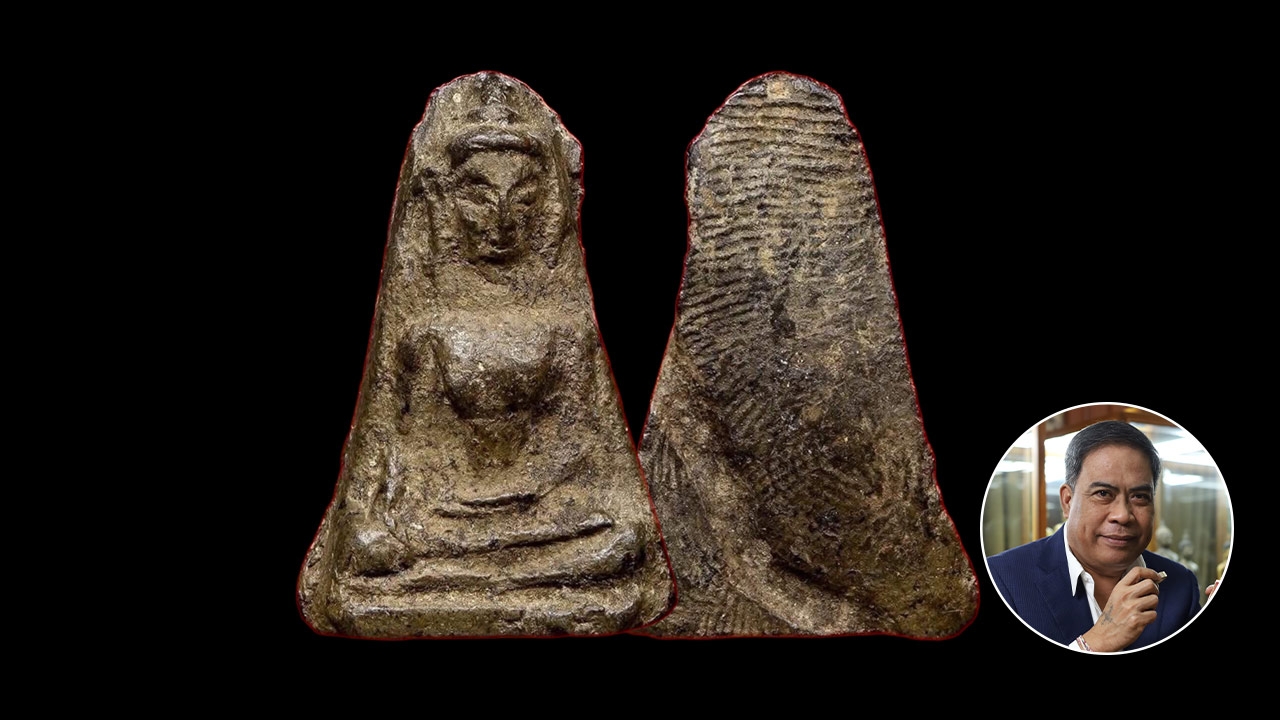
The beginning of the legend of Phra Phong Suphan's creation.
According to the golden palm leaf inscriptions found in the crypt of Wat Phra Si Rattana Mahathat, it was created by “Phraya Srithammasokaraj,” the supreme ruler of Suphanburi, together with four hermits, chaired by the hermit Pimpilai.
Phra Phong Suphan, the top Benjapakee amulet from Wat Phra Si Rattana Mahathat in Suphanburi Province, originated in the early Ayutthaya period (around 1343 CE). It was made by the Suphanburi royal court and the hermit Pimpilai, enshrined in a crypt to preserve Buddhism. It features baked clay mixed with herbs, three face molds—old, middle, young—and fingerprint marks on the back.


Phra Phong Suphan is a cherished local amulet and part of the famous Benjapakee set. In Suphanburi, when mentioning the greatest and still evident amulet crypts today, the main prang (tower) of Wat Phra Si Rattana Mahathat stands out.
Located in Rua Yai Subdistrict, Mueang District, Suphanburi Province, it ranks first among many amulet crypts discovered in Suphanburi. Phra Phong Suphan was officially unearthed in 1913 CE by Phraya Sunthornburi (Yi Kransut), the then-governor, who found numerous amulets, Buddha images, and antiques. He presented some of these amulets to King Vajiravudh during his visit to Don Chedi Memorial around the same time.
Phra Phong Suphan is a powder amulet mixed with 108 auspicious herbs and pollen. It comes in four colors: red, Pikul yellow, green, and black. Additionally, it is divided into three main molds.
1. Old-faced mold
2. Middle-faced mold
3. Young-faced mold
Regarding Wat Phra Si Rattana Mahathat, the main prang, and Phra Phong Suphan, some say that when the prang’s crypt was newly opened, many golden and silver palm leaf manuscripts were lost due to melting, though some were copied and translated later. In summary, Wat Phra Si Rattana Mahathat, its prang, and numerous amulets found in its crypt were established by King U-Thong, the first sovereign (reign starting 1347 CE), with the senior monk Piyathatsisareeput and the hermit Thiwalai presiding over the religious and hermit affairs. These relics are now over 600 years old.
It is considered a supreme amulet, endowed with all-encompassing spiritual power and mystical attributes.
