

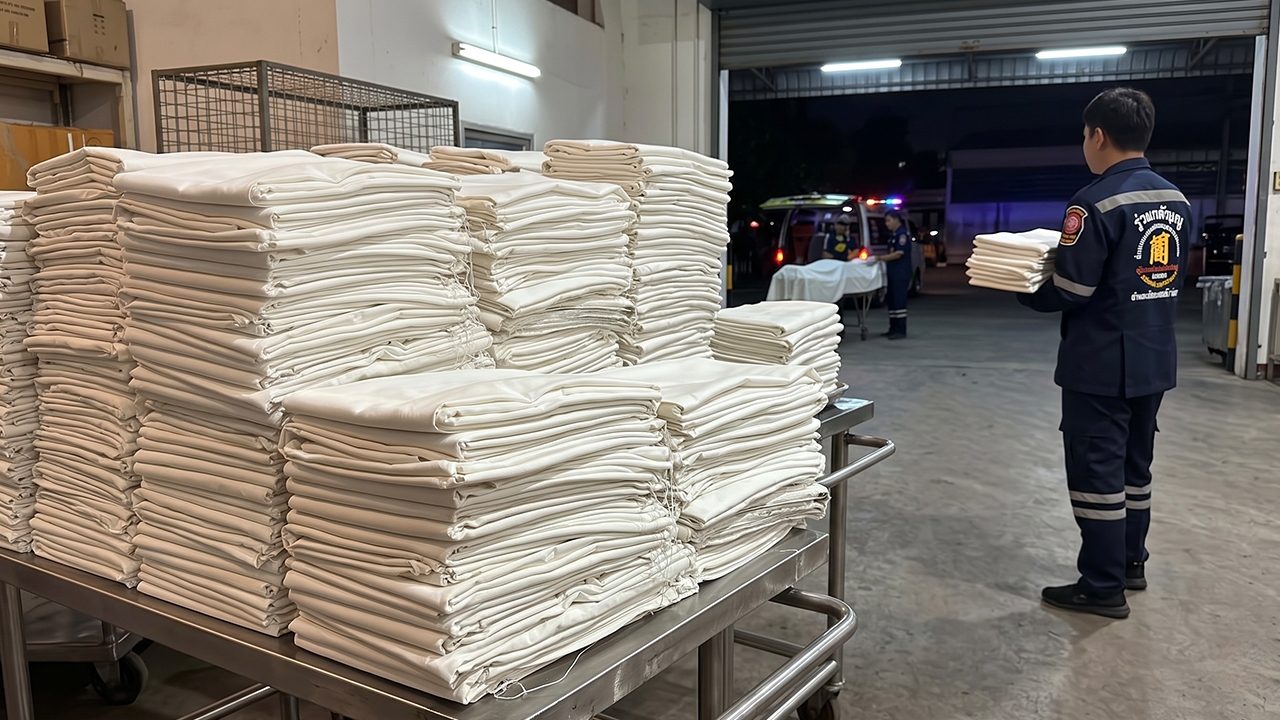
Solving the mystery of ancient beliefs Why must corpses be wrapped in white cloth? Revealing the ancient wisdom and astrological perspectives behind it, plus whether other colors are permissible—a concise, easy-to-understand explanation that’s not as frightening as commonly thought.
When discussing "white burial cloth" many may feel fear and associate it with the supernatural. However, the tradition of using white cloth or "unbleached cotton" to wrap the deceased stems from religious beliefs, astrology, and ancient wisdom imbued with philosophies of life and letting go.
In Buddhism and Thai belief systems, white symbolizes purity and the renunciation of desires. Wrapping the deceased in white cloth represents a return to the original empty state, free from embellishment. It serves as a reminder to the living that after death, wealth or even beautiful clothes cannot be taken along—everything must be left behind, leaving only the body wrapped in a single white cloth.
In ancient astrology, white is associated with the water element and the moon, representing purification, rebirth, and tranquility. Using white cloth symbolizes balancing elemental forces to send the soul peacefully to the next realm, free from earthly attachments or impurities.
From a practical viewpoint, in times before medical technology or formalin preservation, using "unbleached cotton" (cotton fabric not yet bleached) had several advantages, such as
being inexpensive and easy to find. Unbleached cotton was a basic fabric accessible to every household, avoiding the cost of silk or expensive woven fabrics.
Observing changes White makes stains or bodily fluids clearly visible, helping funeral handlers maintain cleanliness and hygiene more easily.
Natural decomposition Unbleached cotton is a natural material that decomposes easily, fitting traditional burial or cremation practices.
Many wonder if cloths of red, black, or other colors can be used instead of white. Theoretically, no strict rule forbids other colors, but culturally and traditionally, other colors are generally avoided for these reasons:
Colors convey emotions Other colors often relate to daily life meanings—for example, red symbolizes auspicious events, bright colors express joy. Using them for the deceased contrasts with the solemnity and mourning atmosphere.
Social uniformity Using white cloth as a standard reduces social inequality; regardless of wealth, everyone receives the same treatment at life’s final moment.
The use of white burial cloth is neither frightening nor mystical. It is an inheritance of ancient thought combining religious beliefs, astrology, and hygiene into a harmonious practice. It teaches humans to let go, symbolizes purity, and equality at life’s end.