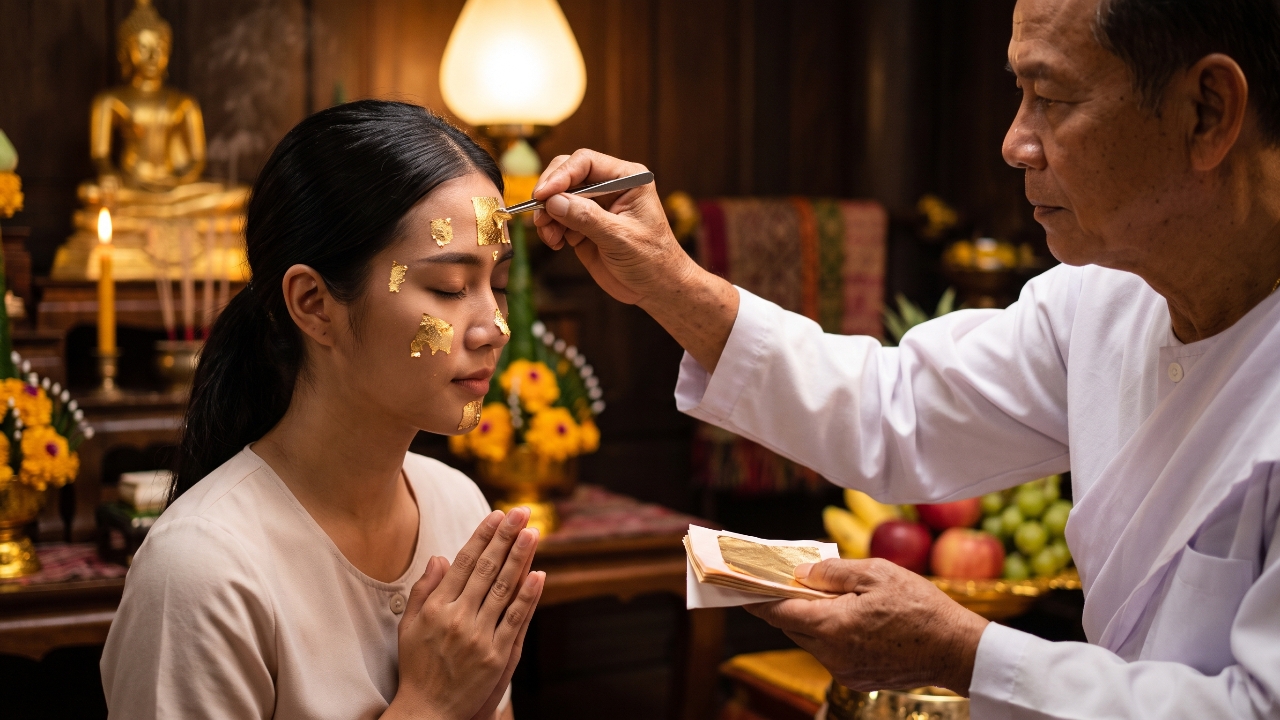
"Na Na Thang" (Golden Face Charm) A charm ritual enhancing attraction and popularity long embedded in Thai society, revealing hidden meanings, gold leaf placement, scientific explanations, and crucial prohibitions to preserve the spell's power.
An in-depth look at "Na Na Thang," a charm ritual for enhancing popularity—where to apply gold leaf for best results and essential prohibitions to know.
"Na Na Thang" is considered a branch of ancient Thai occult arts focused on charm and popularity, with a long history rooted in the belief of "Phra Lak Na Thang" (Golden-faced Phra Lak) from the Ramakien epic, a figure admired for his handsome appearance and beloved by all. Applying Na Na Thang embodies this belief to boost confidence, charm, and fortune in life.
What does Na Na Thang help with? Why is it popular among celebrities and merchants who follow ancient beliefs?
Applying Na Na Thang focuses mainly on "great charm" and "magnetism," enhancing one's personality to become more pleasing and attractive to others.
- Groups of celebrities, artists, and actors believe it enhances facial charm, fame, endears them to fans, earns the favor of industry seniors, and ensures a steady flow of work opportunities.
- Groups of merchants and businesspeople believe it improves persuasive speech and smooth negotiations, making customers more sympathetic and more likely to purchase.
Unveiling hidden meanings: where to apply gold leaf and what each spot enhances.
Different traditions use varying numbers of gold leaf sheets—from 1, 3, 9, up to 108—with each facial point carrying hidden meanings as follows.
Gold leaf placement positions, meanings, and their believed effects on fortune enhancement.
- Forehead The center of fortune, enhancing wisdom, authority, leadership, and gaining favor from superiors.
- Both cheeks Enhances kindness and affection, attracts good friendships, and creates visual charm.
- Cheekbones Boosts power, prestige, and credibility at work.
- Lips / chin enhancing persuasive speech Encourages pleasant speech, gaining trust, suitable for negotiation and sales.
- Eyelids Enhances eye charm, causing admiration and affection from others; palms enhance luck, handling money, and wealth.
Step-by-step process for applying Na Na Thang.
Traditionally, it starts with setting intentions; the master applies sacred powder or oil (such as sandalwood oil) on facial points, then places genuine gold leaf, recites incantations, and gently presses or rubs to release the gold particles, allowing them to absorb into the skin.
Why does the gold leaf absorb into the skin?
Scientifically, pure 100% gold leaf used in rituals is micron-thin. When it contacts oils or moisture on the skin, combined with gentle rubbing or pressing, friction breaks the gold into micro-particles that penetrate pores and the outer skin’s lipid layer, making it appear as though the gold dissolves into the skin instantly.
Check important prohibitions to prevent the charm’s power from fading.
Many misunderstandings exist! To preserve sanctity and auspiciousness, ancient masters set behavioral rules, which are often misinterpreted.
- No cursing parents, benefactors, or teachers—this is the gravest prohibition since this charm tradition depends on gratitude and virtue.
- No foul language or lying. Since gold leaf is applied on the lips to enhance persuasive speech, using it to curse or deceive others is believed to weaken the charm.
- Prohibitions related to food consumption. Traditionally, eating winter melon, starfruit, or funeral food was forbidden, but today many masters clarify that the most important practice is "observing the Five Precepts" and avoiding spitting saliva onto low places (like toilets) rather than specific food restrictions.
Please use discretion when reading.