

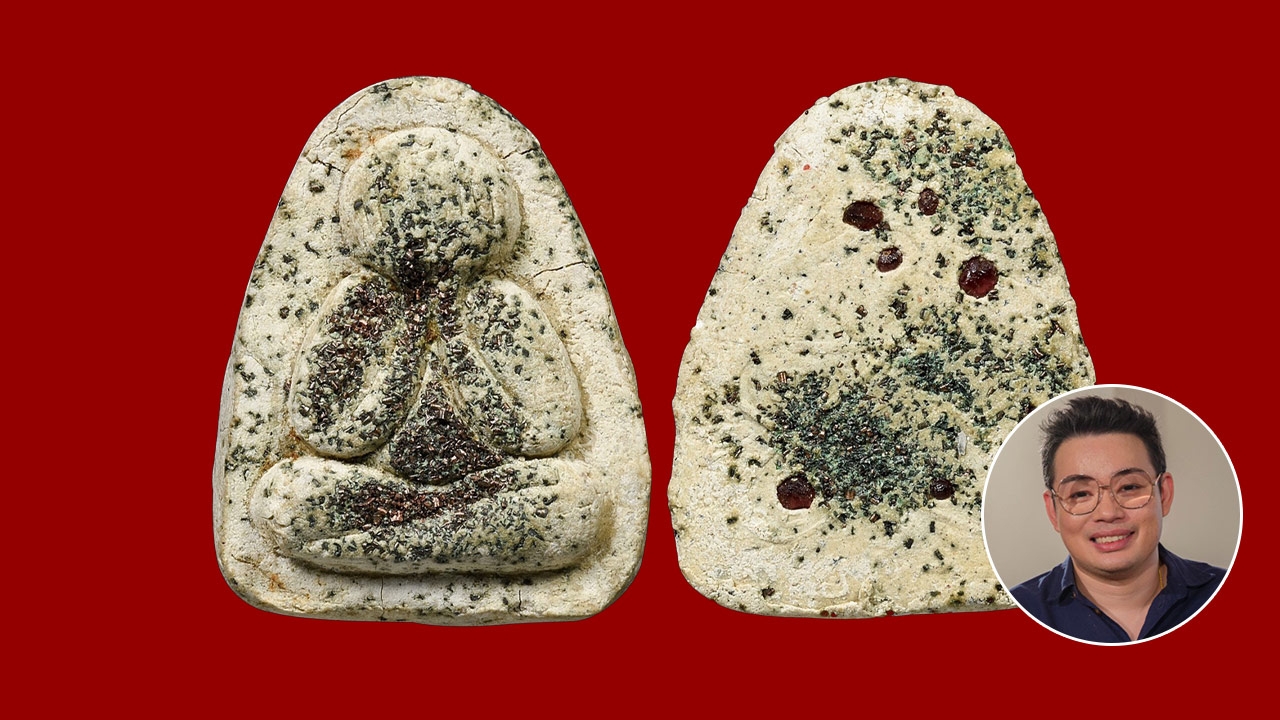
The legendary set of 48 Phra Pidta amulets made with spirit child powder and sprinkled with filings from the Shrinbanchorn Bell — where the finest powders and metals unite in a single amulet.
In the world of amulets, some are rare due to limited production, others because time has taken them piece by piece, and a few are rare from the very moment they were created.
The Phra Pidta amulet made with spirit child powder and sprinkled with filings from the Shrinbanchorn Bell by Luang Pu Tim Isariko of Wat Lahan Rai in Rayong province is one such example.
If we piece together stories passed down among disciples and the amulet community, we find that this Phra Pidta was not simply made by mixing powder, pressing it into molds, and consecrating it like ordinary powder amulets. Each small amulet's materials underwent various rituals, involved important sacred objects, and passed through many hands — as if each ingredient was destined to meet in 1974, the year Wat Lahan Rai produced several significant sacred objects, including the soon-to-be legendary Shrinbanchorn Bell.

The secret of the 96 amulets.
The story of this Phra Pidta set begins with the surprisingly small number 96, according to traditions in the amulet community. Only 96 special Phra Pidta amulets with spirit child powder were made, earning nicknames like the '96-piece edition' and 'Teacher Worship edition.' But the true secret behind this number lies deeper, as not all 96 amulets are identical.
The first 48 pieces were made solely from spirit child powder and various other materials.
The latter 48 pieces had an addition: a tiny element that may look like mere metallic specks from afar but whose origin completely changes the amulet's significance — filings from the Shrinbanchorn Bell.
Because of this, from the original 96 amulets, only 48 belong to this special category we are discussing. Before an amulet is made, the powders must be prepared first.
The charm of this Phra Pidta set lies in the fact that its history cannot begin simply from the pressing date, but must go back to the gathering of powders and materials by Luang Pu Tim. Among these materials, nearly every collector recognizes the name 'phong phrai kumarn' (spirit child powder).
Luang Pu Tim's spirit child powder is not a single substance but is combined with sacred powders, herbal ingredients, and various materials prepared and consecrated according to his formula, including itthije powder, pathamang powder, trinisinghe powder, phra wai powder, jindamanee powder, various herbs, and Luang Pu Tim's collected substances.
All these were combined to create what later collectors call 'aged powder texture' amulets.
This is also the challenge, as such materials cannot be endlessly produced. The more concentrated the materials, the fewer amulets can be made. It's like a precious potion with only one bottle of key ingredients; diluting it to make a thousand bottles would mean it's no longer the original. This Phra Pidta set thus defies mass production by focusing on quality over quantity, explaining why it was initially made in only a few dozen pieces.
An unexpected element was sprinkled onto the amulets.
In the same year, Wat Lahan Rai produced the Shrinbanchorn Bell, which would become one of Luang Pu Tim's most famous sacred objects.
Making the bell amulet did not end when molten metal was poured into molds. After casting, the amulets were trimmed, polished, and excess metal filings were scraped off. Each scraping left fine metal particles. To most, these are mere scraps, but to amulet makers of the past, metal from such important sacred objects was never discarded, as it shared the same origin and melting process.
These metal filings were collected, and thus the scraps from the Shrinbanchorn Bell met the spirit child powder — two elements usually worlds apart combined in just 48 Phra Pidta amulets.
The 48 amulets that contain two legends in one.
Imagine one amulet resting in your palm, containing the world of powder inside, while on its surface lies the world of metal.
Internally: the spirit child powder, the pinnacle of powder amulets; externally: metal filings from the Shrinbanchorn Bell, the pinnacle of metal-cast amulets.
While Luang Pu Tim's Khun Paen spirit child powder amulet may be his most famous powder amulet, and the Shrinbanchorn Bell his most renowned cast metal amulet, these 48 Phra Pidta amulets uniquely connect both worlds.
If one tries to recreate these amulets today, the question isn't just about having the mold but also:
1. Where to find the original powder mix.
2. Where to source the original materials.
3. Where to obtain the filings from the Shrinbanchorn Bell made in 1974.
The answer: it is impossible to go back in time to retrieve these. This rarity cannot be reproduced by money alone.
Each amulet is unique; another charm of sprinkling filings is that their placement cannot be identical across amulets.
One amulet might have a prominent metal speck on the face, another might have them scattered across the body; some on the front, others on the back.
Some amulets also show other materials like consecrated gems or larger metal pieces mixed with the filings.
Thus, each amulet is like having its own 'fingerprint.' None are exactly alike. If an amulet clearly shows filings, has a solid texture, original surface, naturally visible materials, and remains in good condition, it becomes an excellent reference piece for study.

Raised yantra on the back: another side of the legend.
Turning the amulet over, the story continues. The large-mold Phra Pidta recognized by the community features a raised yantra on the back, serving as a seal of authenticity.
Studying this set requires looking beyond just the mold to consider all factors together — mold, material, surface, age, shrinkage, materials, filings, and the pressing nature.
All aspects must be evaluated as one, since such complex old amulets cannot be judged by a single trait alone.
Rare from the moment of creation, becoming rarer each day.
The number 48 references the count about half a century ago, but no one can confirm that exactly 48 amulets remain accessible today. Over more than 50 years, some have broken, chipped, worn out, lost, gone abroad, or been kept hidden in collectors' vaults for decades without reappearance.
Therefore, for this amulet type, the first question is not price but availability. The Phra Pidta amulet cannot be remade. Its most intriguing value is not just mystical power but the irreplicable history of its making.
You could make a million new Phra Pidta amulets identical in shape, aged texture, and sprinkled metal filings, but one thing no one can recreate is time itself.
No one can return to Wat Lahan Rai in 1974.
No one can remake the original powder blend.
No one can scrape filings from the Shrinbanchorn Bell on the day the bell amulet was born.
Above all, no one can sit before Luang Pu Tim Isariko on a day when he was still alive.
The 48 amulets of memories.
These small Phra Pidta amulets hold stories far greater than their size: spirit child powder, sacred powders, herbs, the Shrinbanchorn Bell, metal filings, yantras, rituals, and an elderly revered monk from Ban Khai, Rayong province — Luang Pu Tim Isariko.
Every time an authentic amulet appears, it feels like a lost page of an old book has been opened for us to read again.
Today, genuine Phra Pidta amulets made with spirit child powder and sprinkled with Shrinbanchorn Bell filings are presented closely for everyone to study materials, filings, aging, molds, and details. The rarer the amulet, the more valuable seeing a genuine, easy-to-recognize piece is for study, as a good reference amulet can teach what many pages of books cannot.
Thanks are extended to the owner, Mr. Phadungchob, for kindly sharing images of this important amulet, allowing devotees and researchers of Luang Pu Tim's sacred objects to view, study, and help preserve the story of this set.
Some amulets are made to be possessed.
But others exist as evidence for future generations that such sacred objects were once truly made.
The Phra Pidta amulets sprinkled with filings from the Shrinbanchorn Bell, limited to 48 pieces, are among those.