

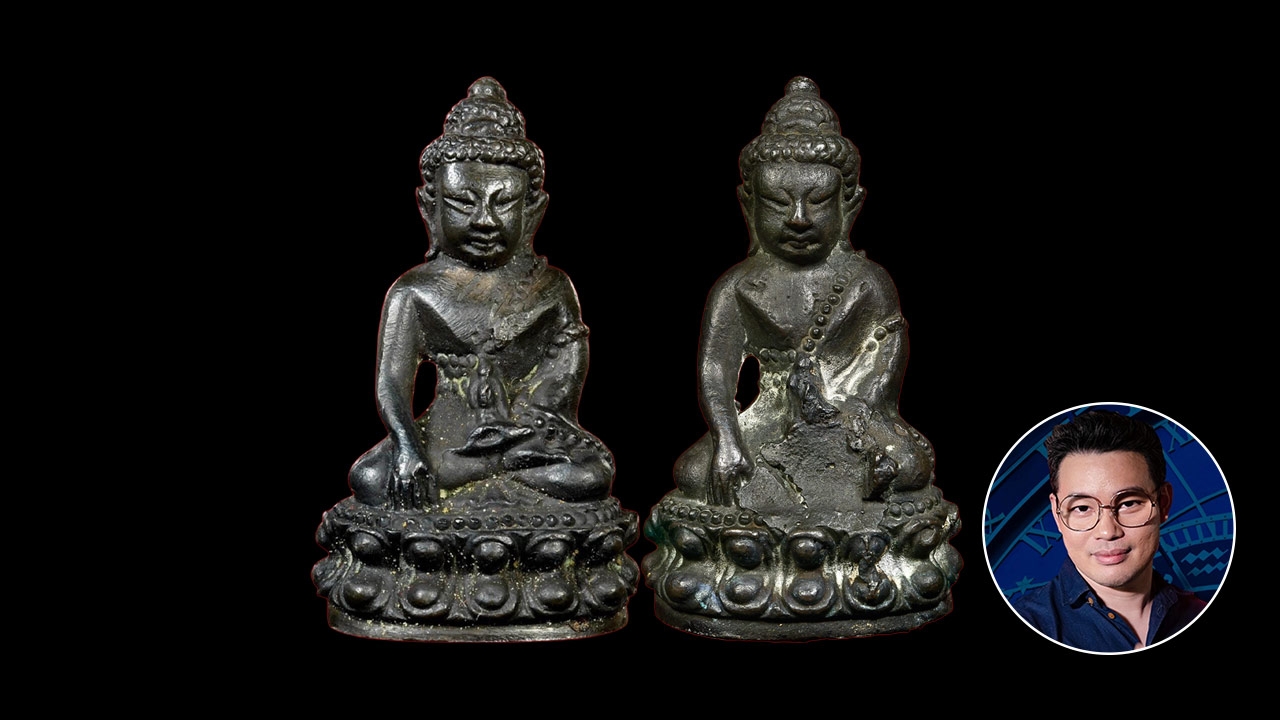
From an amulet no one chose to a sought-after set of 101 Phra Kring that collectors scour the land for. Sometimes, the most precious things don’t appear to the world in their full beauty at first—they are often overlooked.
They are set aside, waiting for time to reveal their true fate. The story of the Phra Kring Chinabanchorn filled with Ploy Prai Kumarn powder by Luang Pu Tim Isariko at Wat Lahan Rai is such a story.
Going back to the year 1974.
The Phra Kring Chinabanchorn was cast using ancient methods on Sunday, 5 May 1974, totaling 3,116 pieces. But when the amulets were newly made, the reality did not meet many people’s expectations. Some pieces were not as beautiful as the images on book covers or advertisements.
The ancient casting left traces on the amulets.
Some had pores.
Some had excess metal.
Some had missing material.
Some were incompletely filled.
Some had beautiful fronts but defects on the back. Others bore marks on both sides. Some buyers even returned amulets to the maker, Mr. Chinporn Sukasatit.


Mr. Chinporn was naturally concerned.
Because part of the purpose of making these was to raise funds to develop the temple. If the amulets weren’t popular, the plan might fail.
Amid this worry, a particular phrase was spoken—one that sounded ordinary at the time.
But more than half a century later, it sounds almost prophetic. According to Mr. Chinporn, Luang Pu Tim said,
“It’s okay, if they return them, just accept them. Someday, you’ll turn the land over and still won’t find them.” No one then knew what the future held.
No one knew that the very amulets being returned would one day be coveted by collectors nationwide.
And even less did anyone know that among these Phra Kring, a certain group would have a completely different destiny.
After the best pieces were selected and sold, over a hundred Phra Kring remained.
This is a crucial detail for studying the upcoming Phra Kring batch, because these remaining pieces were not the best kept aside.
On the contrary, they were the leftovers after the finest had been removed. According to Mr. Chinporn Sukasatit, the leftover amulets included both good and defective ones, mostly with diminished beauty, some with flaws, pores, or incomplete casting.
Beautiful pieces were mixed in but rare. This explains why today’s Ploy Prai Kumarn filled Phra Kring amulets each have distinct personalities.
One might have a hole here, another missing metal there. Some look good from the front but flawed at the back; some have defects on both sides. These traces originated during casting, as if the molten metal and flame left unique “fingerprints” on each piece.
An important note from old records states clearly: “You will not find one without any flaws; defects are certain. And making fakes is impossible because there are many points to check.”
This sentence is very significant.
It helps us understand that for this Phra Kring batch, imperfection was not abnormal but part of its birth story.
What once made these amulets considered “not beautiful enough”
Decades later became marks that collectors scrutinize closely.


But the story does not end here.
Because no one knew what awaited these leftover amulets when the unloved were chosen again.
More than a hundred Phra Kring were given to Mr. Worathep Udomratanasilp, who drilled and polished their bases.
Originally, there was an idea to put in the underground sacred relic powder of Luang Pu Iam from Wat Nang, but according to recorded accounts, when Luang Pu Tim learned of this, he said,
“Don’t mix others’ things with ours. If something happens from using them, others will get a bad name.”
“Better to fill them with our own Ploy Prai Kumarn powder.”
And that was the turning point for these Phra Kring.
The leftover amulets,
those with holes,
those incompletely filled,
those once considered less beautiful,
were drilled and filled with Luang Pu Tim’s Ploy Prai Kumarn powder.
From amulets no one chose, they became amulets that were "chosen" in another sense.
Historically, 104 Phra Kring along with 4 Phra Chaiwat amulets—totaling 108—were placed in Luang Pu Tim’s kuti (monk’s dwelling).
This set also underwent a particularly long consecration. The base contained not only Ploy Prai Kumarn powder.
Records mention metta charm balm, sacred powders, prayer bead powders, Tak Sae oil, and Ploy Prai Kumarn powder mixed together.
Some pieces had embedded Sariga takruts, found only on a few.
Then the base was lacquered black and gilded.


This gave rise to the Phra Kring later known as
“Phra Kring Chinabanchorn filled with golden Ploy Prai Kumarn.” Out of 104, only 101 were numbered. Three pieces were unnumbered.
The code stamped on the back mostly used the “Na” code on about 80 pieces.
This batch mostly used the “Na” code, but as these marks wore off, the “I” code was used on the remaining twenty or so pieces. Thus, the “I” code group is much rarer than the “Na” code group.
Over time, these codes were damaged, so what remains are only those stamped at the time.
No additional stamping was done.
No reproduction was made.
No one can go back to 1975 to remake this batch.
Time has transformed “defects” into legend. This is the most wondrous part of the story. Amulets once left after selecting the best are now those collectors seek. Amulets once seen as flawed, porous, or incomplete are now examined under magnifiers and light, point by point.
Pieces once uncertain in their future.
Today, recognized Phra Kring Chinabanchorn filled with Ploy Prai Kumarn are valued in the range of 3 to 6 million baht each, depending on condition, provenance, beauty, history, and acceptance.
Consider this: these were once the leftover amulets after selecting the best. Now they are million-baht amulets, and only 101 were numbered. These one hundred and one pieces are scattered among different owners—some unseen publicly for decades, some having changed hands multiple times, others quietly kept in private collections unseen by outsiders.
Looking back at Luang Pu Tim’s words,
“Someday, you’ll turn the land over and still won’t find them.”
That phrase gains deeper meaning as time changes it completely—from words said when amulets were returned, to a statement that makes later generations pause in awe.
Today, I present an authentic piece for detailed viewing. This is why I want to share a set of images—not just of any Phra Kring Chinabanchorn, but specifically those with bases filled with genuine Ploy Prai Kumarn powder.
I show the whole amulet, and importantly, detailed images of the base and the “I” code for study.
Regarding the “I” code, I intentionally took two types of photos: one in normal lighting to show the natural surface, stamping marks, and condition as seen by the eye,
and another with light shining directly on the code to reveal small details inside the stamp groove, which may not be clear under normal light. Please look carefully and don’t judge hastily.
Observe the surface.
Observe casting marks.
Observe the pores.
Observe the material.
Observe the imperfections.


Observe the base’s texture.
And observe the stamping of the “I” code.
Because sometimes a single book can tell us how amulets were made, and a story can tell us how many were made.
But when examining the real amulet,
the most valuable clues may be tiny marks on the metal surface, which we have seen and remembered from authentic pieces. Looking again at this amulet, the entire story returns to its strange beginning.
An amulet once unwanted for its flaws—the leftover after selection, with holes, pores, incomplete filling, and defects—
was drilled, filled with Ploy Prai Kumarn, survived more than half a century, and became an amulet today for which collectors pay millions.
From an amulet no one chose, to only 101 pieces; from defects that caused it to be overlooked, to marks now studied under light; from words once uncertain, to phrases now chilling to hear:
“It’s okay, if they return them, just accept them. Someday, you’ll turn the land over and still won’t find them.”
Some might call this time, some chance, others the merit of the master.
But for those devoted to Luang Pu Tim, some things do not come into our hands just because we have enough money.
Money can buy amulets, but not “destiny.” Money can set prices, but cannot determine which of the 101 scattered amulets in the world we will ever find.
Some sacred objects do not just have a price; they have history, markings, journeys, and owners changing over time.
Sometimes, we cannot help but wonder if, while searching for an amulet, we are the ones choosing it,


or whether the amulet is waiting for the right time to choose its owner. Perhaps not everyone with money will possess one,
but it must be the right time, the right destiny, and for devotees, a true karmic connection to find it.