

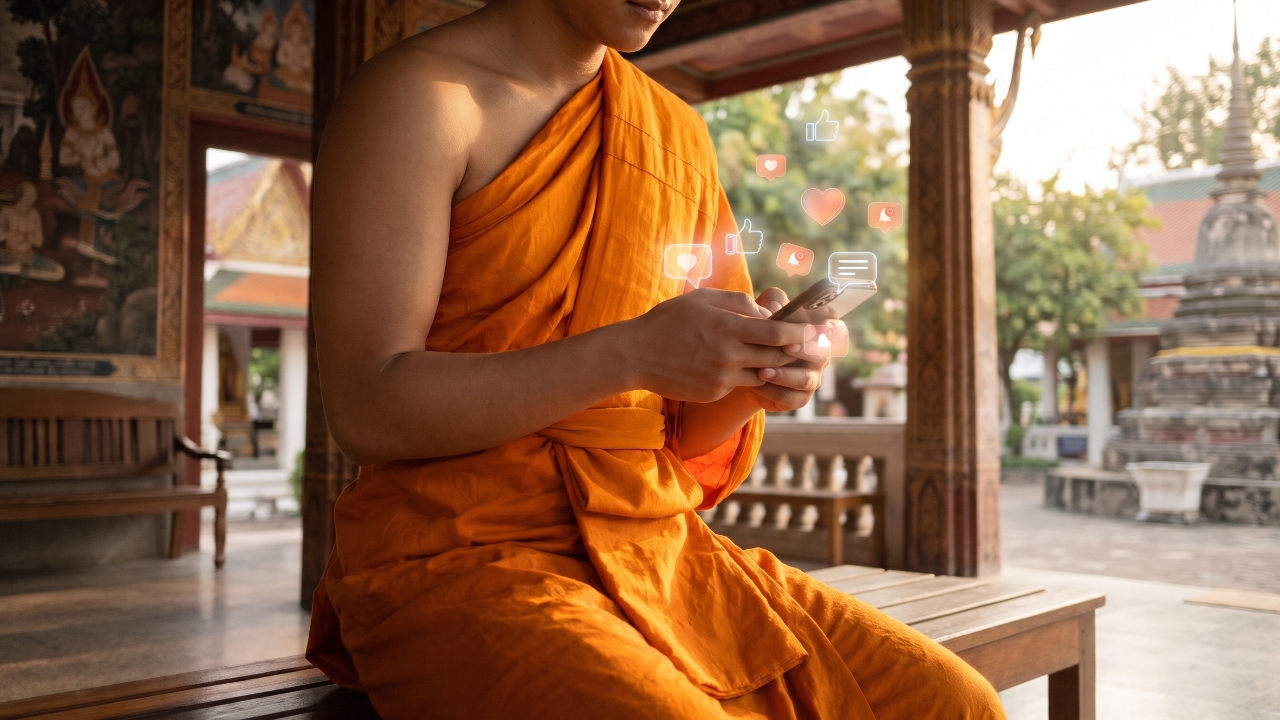
From a monastic rank built over decades of merit accumulation to a short clip with millions of views that overnight turns a new generation of monks into centers of faith.
Open social media feeds today, and many will recognize short videos of youthful monks with clear complexions walking calmly and solemnly, surrounded by disciples bowing along both sides of the path, accompanied by soft chanting or gentle music that creates a soothing atmosphere.
These images often come with captions addressing the monk as "Kruba." They attract huge numbers of views, shares, and devotees flocking to make merit at the temples, even though many of these monks have been ordained for only a few years. This raises societal questions about who exactly a Kruba is, and why young monks today rapidly become focal points of faith.
Looking into the cultural roots, especially in Northern Thailand or Lanna, the term "Kruba" literally translates to "teacher who is a master." It was not a self-appointed title or one anyone could claim at will.
According to traditional Lanna customs, a monk who earned the respectful title Kruba must meet two main criteria.
In the past, becoming a Kruba was not overnight; it was the result of a lifetime of goodness, patience, and selfless dedication benefiting the community, earning heartfelt respect from villagers.
Today, the definition of Kruba has visibly shifted. We see monks as young as 20–30 years old being called Kruba, garnering devotion comparable to that of elder revered monks from the past.
A key factor accelerating this phenomenon is the "power of social media," which has completely transformed religious communication through three main elements.
1. Content that resonates with lonely hearts. Short videos on TikTok or Facebook often selectively showcase serene scenes, compassionate gazes, and brief, easy-to-understand sermons—appealing to urban dwellers facing stress and inner uncertainty.
2. A clear, distinctive image. The use of robes or shoulder cloths in unique tones, monastic accessories, or a calm demeanor creates a memorable and eye-catching image on social feeds.
3. A systematic behind-the-scenes team. Behind seemingly natural clips, there is often a team managing filming, lighting, camera angles, admin responding to messages, and running ads to promote amulet reservations or fundraising for large construction projects.
When an accessible image combines with algorithms that promote clips, many young monks become "Dharma influencers," quickly gathering faith and followers.
| Consideration dimensions | Traditional Kruba (Lanna) | Current social media Kruba |
| Title acquisition | Community and villagers collectively honor based on tangible achievements. | Arises from followers' and disciples' online naming and recognition. |
| Length of ordination | Ordained for many decades as senior monks. | Many are young, ordained only a few years. |
| Primary role | Vipassana meditation and community infrastructure development. | Spreading brief teachings via videos and digital media. |
| Means of building faith | Visible disciplined conduct and word-of-mouth reputation. | Platform algorithms, camera angles, image tone, and background music. |
While young monks attracting people to temples and interest in Dharma is positive, the inevitable follow-up to massive faith is vast financial gain.
Past cases have revealed cracks when faith shifts toward commerce—creating amulets promoted with fortune claims, price inflation of talismans becoming business ventures, and opaque donation management where monks’ personal and temple accounts are not clearly separated, leading to conflicts of interest involving followers and temple officials.

Regulatory bodies like the Sangha Supreme Council and the National Office of Buddhism have issued ongoing rules to prevent monks from using online media to advertise in ways that boast supernatural powers or engage in activities risking commercial exploitation.
Lessons from the young Kruba phenomenon show that faith can be rapidly built with technology in the modern world, but the lasting strength of Buddhism depends not on views, likes, or grand constructions, but on the core teachings and the purity of the precepts upheld by those who wear the monastic robes—a truth that only time will prove.