

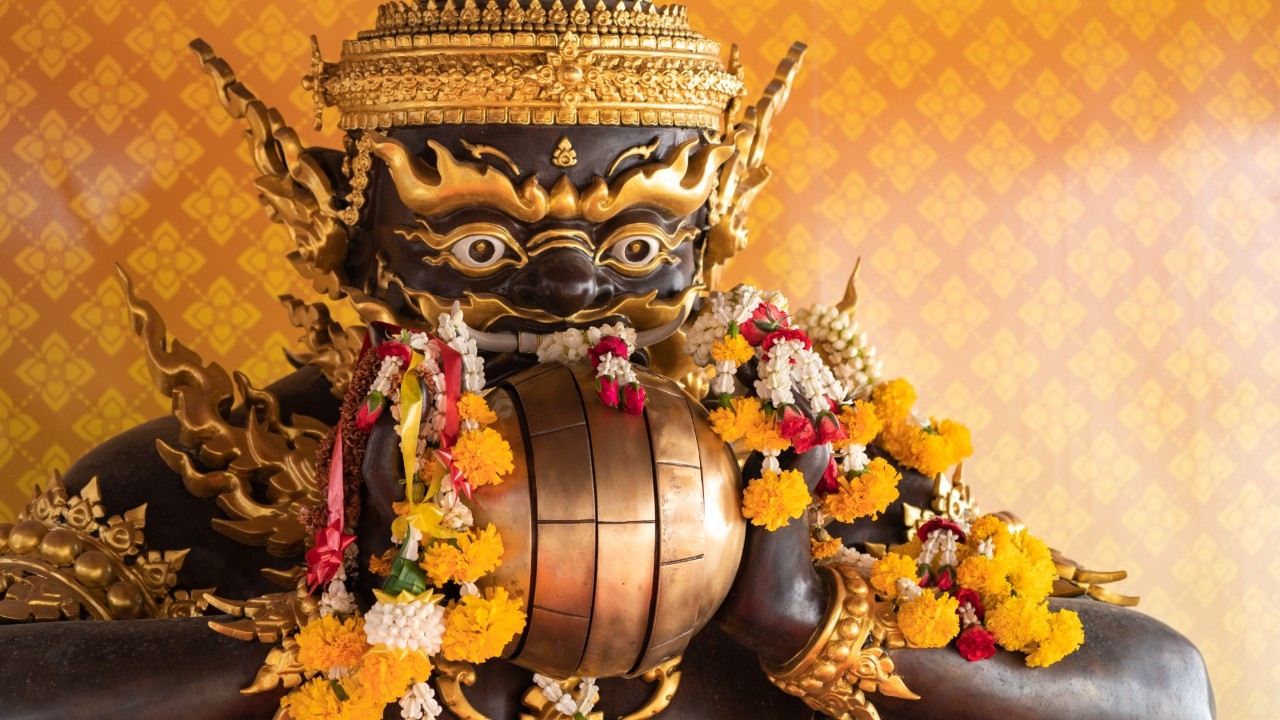
When discussing deities connected to destiny and life changes, many people likely think of " Rahu ", who often appears as a demon swallowing the moon. Although in astrology Rahu represents obsession, uncertainty, and major transformations, many still worship it to seek fortune, dispel misfortune, and enhance auspiciousness in their lives.
So who exactly is Rahu? What is the origin legend, and why has Rahu become a deity people believe in for turning their fortunes around? Thairath Online explores the legend and the beliefs surrounding Rahu.
Rahu is a demon deity originating from Hindu-Brahmanical beliefs and is one of the nine celestial bodies important in astrology. The belief in Rahu entered Thai society through the influence of Brahmanism and Buddhism, later merging with local traditions.
According to legend, Rahu is the son of Viprachitti and Singika, depicted as a large demon. In Thai society, Rahu is often portrayed as a black demon with only the upper half of his body, grasping the moon or sun to swallow them, a reference to the churning of the ocean of milk legend.

The widely known Rahu legend relates to the churning of the ocean of milk, when gods and demons collaborated to obtain the nectar of immortality, believed to grant eternal life to whoever drank it.
After the nectar was obtained, Lord Vishnu transformed into a woman named " Mohini " to distribute the nectar among the gods. Rahu disguised himself to mingle with the gods and secretly drank the nectar but was discovered by the sun and moon, who reported him to Lord Vishnu.
Lord Vishnu then used his discus to cut Rahu's body in two, but since Rahu had already drunk the nectar, he did not die. According to Hindu legend, the head became Rahu and the remaining body became Ketu.
Since then, Rahu has held a grudge and chases to swallow the sun and moon for revenge, but because his body is incomplete, he cannot swallow them permanently. This explains the origins of solar and lunar eclipses, known in Thai as " Rahu swallows the sun " and " Rahu swallows the moon ".

In astrology, Rahu is designated as the eighth celestial body, associated with obsession, ambition, unpredictability, and life changes. This belief represents natural phenomena explained through stories, legends, and ancient beliefs.
Although many view Rahu as a symbol of darkness and bad luck, astrologically, being influenced by Rahu does not necessarily mean encountering misfortune; it depends on each individual's astrological chart.
On the other hand, Rahu is interpreted as representing wit, courage, ambition, the pursuit of new opportunities, and significant changes that may lead to success.
Therefore, during the astrological event known as " Rahu transit ", many people choose to make merit or worship Rahu to bolster their strength in facing changes.

According to personal belief, worshiping Rahu is not only for averting bad luck but is also believed to enhance various aspects of one's fortune, including:
Worshiping Rahu is popular among those facing problems or seeking life changes, viewing Rahu as a spiritual anchor.
Offering eight black items in Rahu worship is a popular Thai custom because black symbolizes Rahu, and the number eight is Rahu’s astrological number. Common offerings include:

From the demon swallowing the moon legend explaining natural phenomena in the past to a sacred figure people worship for blessings, " Rahu " reflects the evolution of belief in Thai society—from a symbol of misfortune and darkness to a representation of opportunity and hope for turning fate around.