

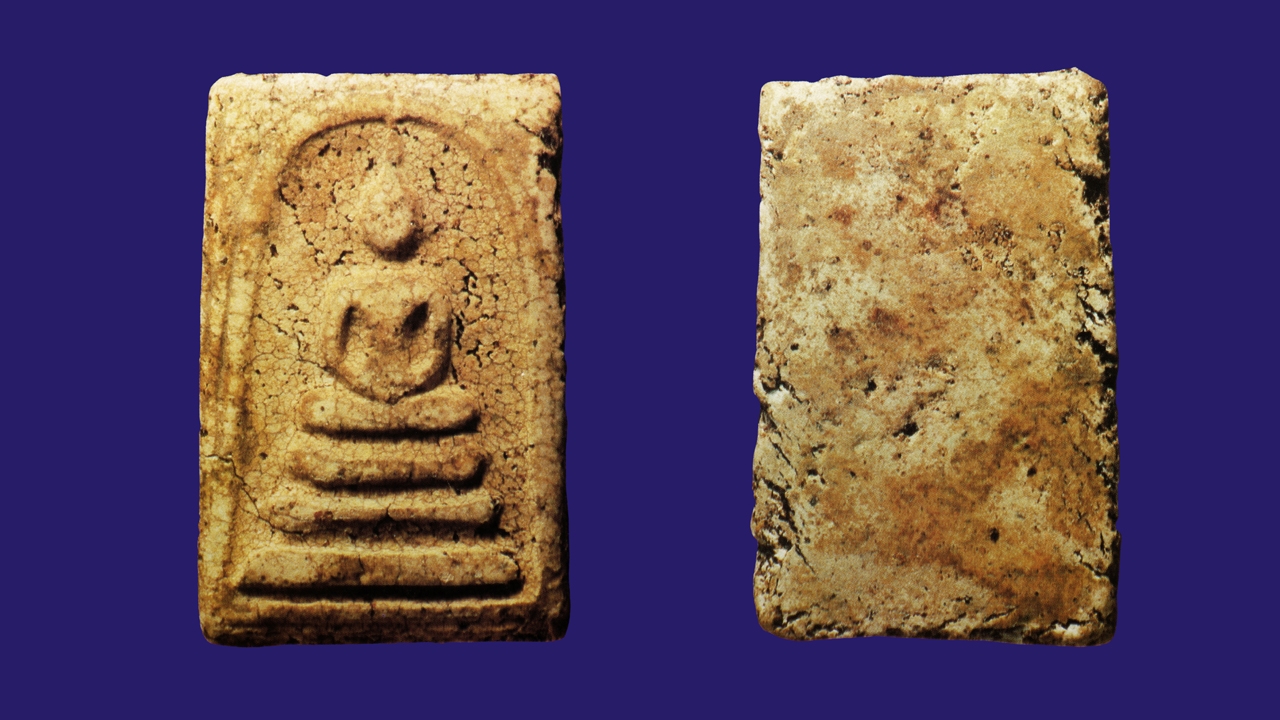
Phra Somdej amulet creation process, royal assistance, Department of Ten Artisan Trades, Somdet Krom Phra Bamrab Porapak, royal craftsmanship, mold making, royal court support, Somdet Phra Buddhachan (Toh Prommarangsi)
Somdet To’s Phra Somdej amulets are considered artistic works in the plaster craftsmanship category, a branch of the Ten Artisan Trades—traditional Thai wisdom handed down since ancient times. This craft was organized as a royal department called the Department of the Ten Artisan Trades, under royal court supervision since the Ayutthaya period.
Plaster, pounded plaster, and beaten mortar all refer to the same type of mortar processed by pounding or grinding. Pounding or grinding uses impact force to thoroughly mix the materials or components together. The main ingredients include white cement (made by burning and grinding shells or limestone into a white or grayish powder), sand, fibers, and glue. Ingredients may vary by region. For Phra Somdej amulets, reliable sources suggest the white cement used was likely made from shell lime. Some books argue shell lime might be unsuitable since it is a biological material, but no concrete evidence supports this.
Traditional pounding mortar has been used in plaster sculpture since ancient times, passed down to later artisans regionally as "ancient pounding mortar." Plaster artisans in Phetchaburi province remain a key source preserving this ancient mortar recipe and method excellently. Some texts note that during the Rattanakosin era, especially under Kings Rama IV to V, there was an exchange of plaster art knowledge between Phetchaburi artisans and royal court craftsmen.
"The Science of Phra Somdej" It has been observed that in 1859 (B.E. 2402), King Rama IV commissioned the construction of a summer palace at Phra Nakhon Khiri (Khao Wang) in Phetchaburi province—famous for its unique plaster craftsmanship lineage. This event possibly triggered a significant knowledge exchange between royal craftsmen from the capital and Phetchaburi artisans who preserved their own lineage since Ayutthaya, with a distinctive skill comparable to the Ten Artisan Trades. It is plausible that the mortar pounding technique used in the popular Phra Somdej amulets from Wat Rakang, supported by royal court craftsmen, closely resembles the plaster work of the Phetchaburi artisan lineage.

Phetchaburi plaster craftsmanship includes key steps such as soaking white cement made from burned shell lime in water for one month—called "fermenting the lime"—to reduce its saltiness (alkalinity) and improve stickiness, allowing better adhesion when used. The pounding process must be done appropriately until the texture is finely ground enough so that over time, the amulet’s surface becomes smooth, dense, and glossy.
The document "Report on Knowledge of Plaster Sculpture in Thai Architecture" by the Architecture Division, Fine Arts Department, explains that plaster sculpture (pounded mortar) means patterns or images created by molding mortar for decoration. It is an ancient Thai art form. Pounded mortar mainly uses white cement mixed and pounded with sand, glue, and fibers in proportions varying by region (for example, the traditional pounding mortar of the Phetchaburi artisan lineage, passed down to the present, rivals central or Ten Artisan Trades craftsmen). Once finely pounded and combined, the mortar becomes smooth, sticky, and creamy white, soft to the touch and stable in shape. After shaping, exposure to air hardens it quickly, and over time, it gains strength. Essential steps for making traditional mortar include fermenting white cement (mixing and sieving to remove coarse particles, soaking, and sun-drying), preparing glue (boiling leather glue with water and sugar until thick like honey—likely the sticky residue found on Phra Somdej amulets), preparing sand and fermenting paper fibers (sieving fine sand, tearing paper into small pieces soaked until soft and drained), and the pounding process (mixing paper fibers and fine sand in a mortar, pounding finely, adding white cement, mixing thoroughly, adding glue in measured proportions, and pounding repeatedly until the mortar forms sticky, cohesive clumps that no longer stick to the mortar bowl).
Professor Prakit Limsakul, also known as Phlai Chumphon of Thairath newspaper, once said that the Kru material of the Phra Somdej amulet is as valuable as a precious diamond.
In the Phra Somdej amulet creation process, the pounding of the mortar is extremely important. The ancient pounding method yields the distinctive texture of the popular Wat Rakang Phra Somdej amulets in the Kru material group, as Triyampawai explained. The amulet’s material is finely textured (typical of powder-based amulets). Any coarser texture in some pieces is due to insufficient mixing of the material components. To obtain the uniquely characteristic Kru material Phra Somdej amulet requires detailed and meticulous steps, especially pounding it finely according to the knowledge of master artisans—royal craftsmen who assisted Somdet To in creating the amulets at that time.
For more information, visit the page Phra Somdej Science by Police Lieutenant Colonel Komsan Sanongpong Special thanks to Assistant Professor Rangsarn Tosuwan for kindly providing a photo of another Wat Rakang Phra Somdej Kru amulet for educational purposes. Thanks also to the current owner of this amulet, a Wat Rakang Phra Somdej in the Chedi mold, which is beautifully worn with a rich surface and bright sheen, dense and strong texture. The front shows crackle patterns from lacquer application (dense amulets often crack when lacquered). The color is creamy white with yellow tint and lacquer residue in grooves and crackle lines, typical of authentic amulets per Triyampawai's texts. Brownish oil-like spots appear sporadically on front and back. The amulet exhibits three authentic Phra Somdej features: granulated relic particles, worm tracks, and porous needle holes. The mold is correct per texts, with a large basket-arched frame typical of Wat Rakang Phra Somdej. The back is smooth with wrinkles, cracks, and "ant trails" (edge flaking), commonly seen in Wat Rakang amulets. This is an excellent original model for study. More articles can be found in the "Science of Phra Somdej" column.
Author Police Lieutenant Colonel Komsan Sanongpong, former forensic police officer
Facebook page –Phra Somdej Science