

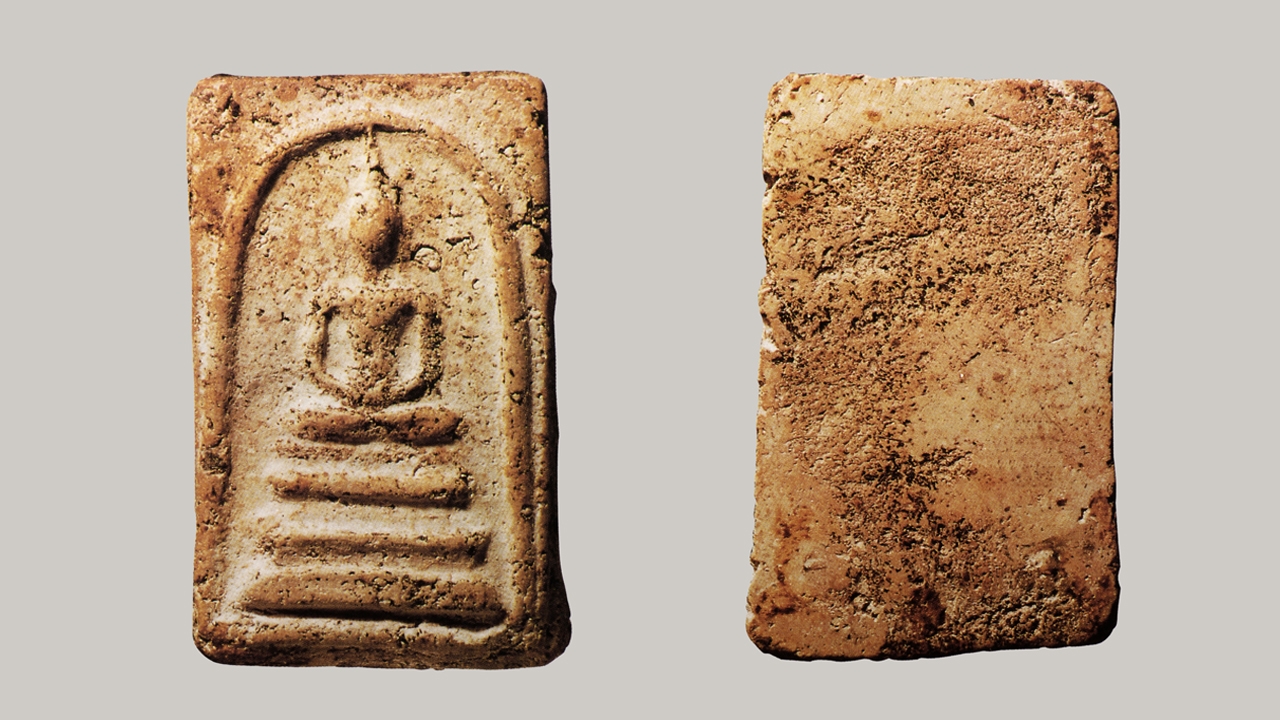
The biography of Somdet Phra Phutthachan (To) by Phra Khru Kalyananukoon (Phra Maha Heng Itthajaro), published in 1952, discusses the Phra Somdej molds: “Originally, Somdet Phra Phutthachan intended to have local casting artisans from Ban Chang Lo in Thonburi Province make the molds. Later, respected followers and disciples skilled in mold-making offered their work as tribute... At first, razor stones were used to carve the molds, then marble and hardwood were also used.”Tags: [Phra Somdej, mold-making, biography, craftsmanship]
(Originally, Ban Chang Lo was called Ban Chao Nuea because it was inhabited by northern people who served in the Royal Palace's rear department. The “Art of Phra Somdej” suggests that the knowledge of amulet casting by Ban Chang Lo artisans likely descended from ancestors skilled in casting ancient Lanna Buddha images. Typically, casting artisans also mastered mold carving.)Tags: [Ban Chang Lo, northern craftsmen, Lanna art, casting tradition]
There is no clear evidence about the exact materials used to create the molds for Phra Somdej Wat Rakang, but it is likely they were made from soapstone (which resembles marble) or other materials that allow sharp amulet impressions, such as razor stone. Soapstone is naturally easier to carve than the more brittle razor stone. Some molds may have been made from hardwood, such as heartwood, as mentioned in Phra Maha Heng’s book above. Additionally, certain woods like Mok wood have been used to carve molds, especially in modern times.Tags: [mold materials, soapstone, razor stone, hardwood, carving]
Research by Associate Professor Dr. Thanom Bannaprasert from the Faculty of Medicine at Chulalongkorn University, presented in a 2018 special lecture titled “Creating Royal Attired Buddha Images with Soapstone Molds of Royal Artisans from the Reigns of Rama IV-V” at Chiang Mai University's Faculty of Fine Arts, found that soapstone molds were widely used by royal artisans during early Rattanakosin through the reigns of Kings Rama IV and V. Numerous soapstone molds remain in the possession of some heirs of the royal artisans of the Ten Artisan Groups, featuring exquisitely detailed carvings difficult to replicate today. These molds were partly used to produce the ornamental attire for Buddha images during those reigns, which were enshrined in important Bangkok temples such as Wat Bowonniwet Vihara. This knowledge was also passed down through generations of Ban Chang Lo artisans, whose community was near Wat Rakang. It is possible that the expertise in producing such Buddhist art was inherited from ancestors skilled in Lanna period Buddhist arts.Tags: [soapstone molds, royal artisans, Rattanakosin art, Buddhist sculpture, heritage]

Regarding carving the Phra Somdej molds, historical data from the Somdej history texts by Triyampawai suggest the earliest molds were carved by local craftsmen (such as those from Ban Chang Lo, some of whom may have worked for the Ten Artisan Groups), mostly producing molds for Wat Ket Chaiyo amulets, likely made of wood. Later, royal artisans (Ten Artisan Groups) assisted in refining the original Wat Ket Chaiyo mold designs to enhance their beauty. They also carved early Wat Rakang Phra Somdej molds (Triyampawai’s book on applied amulets mentions types like Sangkhati and Thread Line molds, which were probably recarved later by royal goldsmiths). Ultimately, the standard mold groups for Wat Rakang and Wat Bang Khun Prom (and likely including the seven-layer popular mold types of Wat Ket Chaiyo) were carved by royal goldsmiths (Triyampawai identifies them as the Luang Wijarnjearnai group). Examining signature lines on most amulets indicates molds of these two temples were made by the same group. Wat Rakang’s standard molds were probably soapstone (some also used for Wat Bang Khun Prom amulets), while the later Wat Bang Khun Prom standard molds were mostly wood. The “Art of Phra Somdej” has previously detailed differences between amulets made from these two mold types.Tags: [mold carving, local craftsmen, royal artisans, Wat Rakang, Wat Bang Khun Prom, mold materials] Another easily observable feature, described as hair-like lines obscuring the background, is that nearly all master Phra Somdej Wat Rakang amulets have a distinctly flat background. This results from pressing the amulet clay onto soapstone molds, which are typically carved with patterns on the soapstone’s original flat surface (sometimes slightly polished but minimally altered).Tags: [amulet background, soapstone molds, carving technique, Phra Somdej Wat Rakang]
The molds for Phra Somdej Wat Rakang can be said to reflect abstract art influences, characterized by continuous line carvings, a novel style at the time. Earlier molds tended to mimic real objects with detailed features of the Buddha image’s face and body, such as those seen in Phra Rod, Phra Soom Kor, and Phra Pong Suphan amulets (reference: the 2013 book "Phra Somdej Wat Rakang" by Suradet Limpanit and colleagues).Tags: [abstract art, mold style, traditional amulet molds, Phra Somdej]
In the mold carving process, artisans used iron rods of various shapes depending on the desired surface texture. They carefully scraped and refined carved grooves on the mold material’s surface, such as wet soapstone. During the process, wax lumps were pressed onto the mold and removed periodically to check the completeness of the carving. The artisans then refined the groove surfaces to add detail until achieving the desired look. The innermost groove surfaces are critical because they form the top surface of the Phra Somdej Wat Rakang amulet when pressed. These surfaces are finely smoothed and polished for special clarity.Tags: [carving tools, mold detailing, wax check, soapstone carving, craftsmanship]
Mold carvers needed knowledge of casting techniques, a branch of the Ten Artisan Groups, because pressing the material into the mold requires grooves and walls shaped for proper flow. The clay-like material must be fully pressed into every corner, similar to how molten metal flows in casting. The groove patterns carved with iron tools leave distinctive marks visible on amulets made from these molds, differing from amulets made by copying or molding without original carving.Tags: [casting knowledge, mold function, clay pressing, tool marks, artisan skills]
Creating molds from other materials may involve different methods but follows similar principles. For example, razor stone or wooden molds require using sharp, hard tools to carve grooves and patterns. However, wooden mold surfaces often show wood grain marks. Prakit Limsakul and Phlai Chumphon of Thairath Newspaper explain that such grain marks are clearly seen on Phra Pong Suphan amulets as waterfall-like lines on the amulet background from top to bottom.Tags: [mold materials, razor stone, wood grain, carving marks, Phra Pong Suphan]
The creation of Phra Somdej amulets by Somdet Phra Phutthachan (To) was not only a stucco art form but also incorporated the knowledge of mold carvers and possibly other related artisans such as casters, engravers, painters, and lacquer artists. This collaboration resulted in Phra Somdej amulets of outstanding beauty, worthy of their reputation as the "Emperor of Amulets."Tags: [Phra Somdej, artistry, collaboration, craftsmanship, reputation]
An important point to consider is that the artisans who carved the molds for these exquisite Phra Somdej amulets must have been highly skilled, at a level comparable to the Ten Artisan Groups or royal artisans. Such expertise produced finely detailed art pieces, giving Phra Somdej amulets both artistic value and unique characteristics in their mold designs, known as the “Phra Somdej signature,” which signifies the authenticity of Somdet Phra Phutthachan (To).Tags: [artisan skill, Ten Artisan Groups, artistic detail, Phra Somdej signature, authenticity]
Follow for more articles at the pageTags: [publication, follow-up] Phra Somdej ScienceTags: [Phra Somdej Science, page] By Police Lieutenant Colonel Komsan Sanongphong, with thanks to Assistant Professor Rangsarn Tosuwan for kindly providing images of another master Phra Somdej Wat Rakang amulet for educational purposes. Thanks also to the current owner of this amulet: a large-base chest-type master Phra Somdej Wat Rakang amulet in very beautiful condition, showing moderate signs of use. It has a white-yellowish tone, soft texture, no visible crackling, and many visible relic particles, especially a large one near the left ear. It has characteristic porous needle marks and worm trails on the background, unique to Wat Rakang amulet clay. The mold shape matches reference books, with brownish oil-like stains on both front and back. The edges are precisely trimmed to the mold frame. The back has a mixed plank-and-khaki pattern with minor chipping, indicating natural age. This serves as a good original model for studying Phra Somdej Wat Rakang amulets. More articles can be read in the “Art of Phra Somdej” column.Tags: [Phra Somdej amulet, condition, study model, author acknowledgment]
AuthorTags: [author] Police Lieutenant Colonel Komsan Sanongphong, former forensic police officerTags: [author, police, forensic]
Facebook page –Tags: [social media, Facebook]Phra Somdej ScienceTags: [Phra Somdej Science, page]